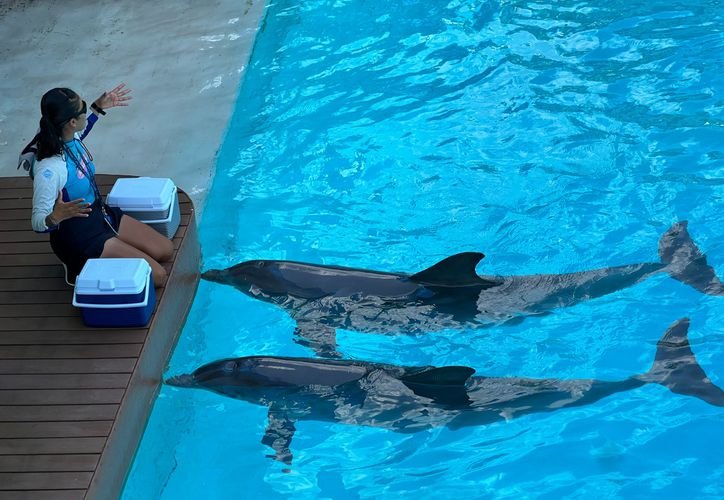
CANCÚN, Quintana Roo — PETA Latino is calling on Quintana Roo and federal authorities to create Mexico’s first coastal dolphin sanctuary, arguing that the recently approved “Mincho Law” is an important step but does not go far enough for dolphins already living in captivity.
The animal rights organization says the sanctuary should be established in the sea off Quintana Roo, where dolphins currently held in marine parks could live in large protected ocean areas while still receiving veterinary care and long-term supervision. The proposal would not release captive dolphins into the open ocean without oversight. Instead, it envisions a managed coastal refuge where animals could swim in natural seawater, interact socially, avoid performances and no longer be used in tourist swim programs.
The request follows the approval of federal reforms to Mexico’s General Wildlife Law, widely referred to as the Mincho Law, after a dolphin named Mincho was seen in a viral video striking a concrete platform during a performance at the Barceló Maya Grand Resort dolphinarium in the Riviera Maya. PROFEPA later suspended dolphin show activities at the facility, saying those activities were not authorized in its management plan and had put Mincho’s integrity at risk. The agency also said the case was connected to other proceedings involving the deaths of two dolphins, Alex and Plata, at the same dolphinarium.
PROFEPA later imposed a definitive closure on Dolphinaris Barceló, citing the 2020 incident involving Mincho and saying it had filed a criminal complaint with the federal Attorney General’s Office over possible conduct punishable under Mexico’s Federal Penal Code for harming or killing a marine mammal.
The new federal law now prohibits the reproduction of marine mammals in captivity except in limited conservation-related cases, bars the possession and use of marine mammals for activities not allowed under the law, and requires cetaceans such as dolphins to be kept in marine pens rather than concrete pools whenever possible. Where geography makes marine pens impossible, the law says cetaceans must be kept in open facilities that receive outside seawater through tides or pumping systems.
The law also creates a transition process. Current owners and holders of marine mammals may continue activities previously approved in their management plans until the animals are removed from the inventory, but reproduction is no longer allowed under the new rules. Facilities were given 90 days from the law’s entry into force to submit an inventory of the animals in their care, including species, sex, age, identification marks, legal origin and photographs of identifying features for cetaceans.
For cetaceans already under professional care, the law gives owners and holders a maximum of 18 months after submitting that inventory to relocate the animals to marine pens or another legally permitted situation, following transfer protocols issued by SEMARNAT. During the transition, permitted human contact is limited and specific practices are prohibited, including riding the animals, swimming while holding their fins, being pushed by their feet or any other activity that compromises the animals’ integrity.
That transition period is where PETA says the sanctuary question becomes urgent. The organization argues that without a dedicated coastal refuge, many dolphins could spend the rest of their lives in facilities that no longer align with the spirit of the reform. In its campaign, PETA says dolphins are intelligent, social animals that naturally live in groups and can swim long distances each day, conditions that cannot be replicated in small tanks.
Quintana Roo is central to the debate because it has long been one of Mexico’s main centers for dolphin tourism, with facilities concentrated around Cancún, Playa del Carmen, Cozumel and the Riviera Maya. El Economista reported that roughly half of Mexico’s dolphinariums are located in the state, making Quintana Roo the most logical place for a national sanctuary model if authorities decide to pursue one.
The issue also has direct tourism implications. Dolphin swims and shows have been marketed for years as family-friendly attractions in Caribbean destinations, but public tolerance for captive marine mammal entertainment has shifted sharply. The Mincho case gave the issue a name, an image and a political opening, turning what had long been an animal-welfare debate into federal legislation.
For supporters of the sanctuary, the next step is to move from prohibition to practical care. A coastal sanctuary would require environmental studies, a suitable protected marine site, veterinary infrastructure, security, long-term funding, transport protocols and federal coordination. Captive dolphins that have spent years interacting with humans may not be candidates for full release, so any sanctuary would need to balance animal welfare with realistic management.
For the marine park industry, the new law creates a significant operational shift. Existing animals may remain under approved care during the transition, but the end of breeding and the requirement to move cetaceans away from concrete tanks point toward a future with fewer captive dolphin attractions.
PETA Latino’s petition is now open through its campaign page, asking authorities to create the first dolphin sanctuary in Mexico. The federal law has already changed what marine parks can do. The unresolved question is where the dolphins who remain in captivity will go next.
More Environment
- Cancún to Host Climate Change Colloquium With Experts From Mexico, Guatemala and New York
- Tulum Records Over 6,000 Sea Turtle Nests as Beach Furniture Threatens Hatchlings
- Lab Coral Restoration Urgent as Caribbean Reefs Decline, Expert Warns
- Quintana Roo Bolsters Sargassum Strategy With Satellite Monitoring and Research
- Stationary Front to Bring Rain Across Yucatán on Tuesday
More Quintana Roo
- Quintana Roo Youth Sailors Join Mexico’s Team for Optimist Championship in Uruguay
- Mara Lezama Hands Out 100 Sewing Machines in Chetumal to Boost Women’s Self-Employment
- Tourism Slump Forces 35% of Skål México Businesses to Borrow to Cover Payroll
- Crystal Meth Addiction Surges in Quintana Roo, Fuels Nearly 90% of Homicides
- Quintana Roo Leads Yucatan Peninsula in Rape and Sexual Abuse Cases