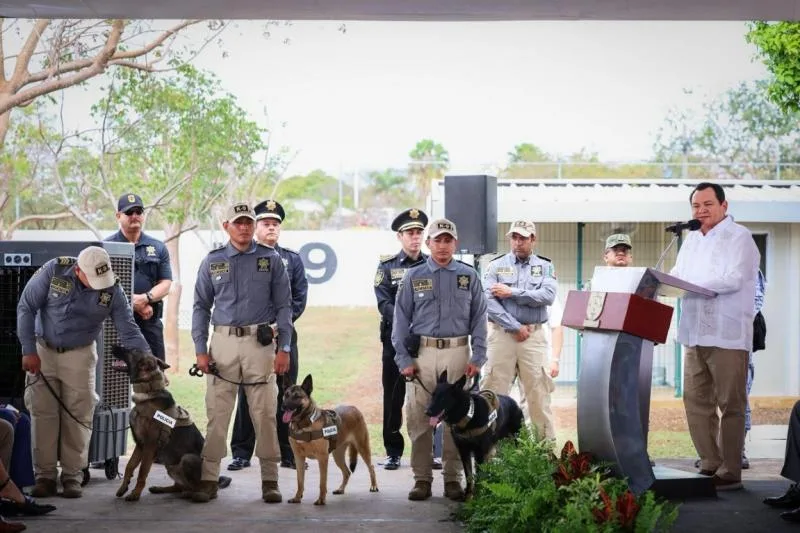
Mérida, Yucatán — Yucatán has integrated three new explosive detection dogs into its police canine unit as part of a security partnership with the United States, aimed at strengthening preventive operations and public safety.
Governor Joaquín Díaz Mena led the incorporation of the dogs—Mary and Jackson, mixed breeds, and Zaphir, a German shepherd—into the Public Security Department’s canine unit. The move follows cooperation with the U.S. Embassy in Mexico and is intended to enhance timely and precise responses in protecting residents.
“Security is a shared commitment that requires responsible collaboration between institutions and nations,” Díaz Mena said. “This donation reflects trust in Yucatán and its agencies; it also shows the seriousness with which we work to preserve our state’s stability. It symbolizes the bilateral collaboration between the United States and Mexico, particularly with Yucatán, in combating drugs.”
The governor thanked the U.S. Embassy for its support, noting it has been crucial in strengthening the canine unit’s technical and operational capabilities. He detailed that over $2 million was invested to boost operational and medical infrastructure, including more than 2,000 items such as dogs, patrol vehicles equipped with carriers, trailers, laboratory equipment for sutures, X-ray and ultrasound machines, software for health monitoring, tactical gear, specialized training materials, and prefabricated kennels.
“This cooperation raises the professional standards of the agency and allows our officers to work with better tools, greater technical capacity, and improved conditions for caring for the animals,” Díaz Mena added.
He emphasized that the canine unit plays a strategic role in preventive operations, specialized inspections, and support at high-concentration events by enabling accurate risk detection and prompt action. Díaz Mena also thanked Mexican President Claudia Sheinbaum Pardo for bolstering security capabilities in federal entities and coordinating with the federation to consolidate strategies and expand tools for preserving national stability.
Public Security Secretary Luis Felipe Saidén Ojeda stated that the new dogs enhance the operational capabilities of the Yucatán force. He explained that the dogs form teams with SSP officers who were trained in San Antonio, Texas, from November 17 to December 12 last year.
Saidén Ojeda indicated that the dog delivery is part of the Bicentennial Understanding on security, public health, and safe communities. The U.S. government, through its International Narcotics and Law Enforcement Affairs office, invested $7,803 per dog and $2,497 per handler course.
“I want to extend a cordial thank you to the staff of the U.S. Embassy in Mexico and the Consulate General in Mérida for the great support we have received in equipping our Canine Unit,” Saidén Ojeda said. “This bilateral relationship has always been respectful and coordinated, focusing on the people who live in and visit Yucatán, on what matters most to us and what we work for every day.”
Alex Thurn, deputy director of the Anti-Narcotics Program and representative of the U.S. Embassy in Mexico, noted that the three dogs symbolize the strategic alliance with Yucatán and reiterated the commitment to continue working cooperatively with respect, shared responsibility, and a results-oriented approach to build stronger institutions and safer communities.
Thurn also recognized the professionalism of the SSP in maintaining tranquility and the coordinated work with the Mexican Navy, Mexican Army, and National Guard. During the event, Governor Díaz Mena witnessed a demonstration of the dogs’ training and performance, which are now in service for Yucatán residents.
The event was attended by Erika Beatriz Torres López, president magistrate of the Superior Court of Justice and the Judiciary Council; General of Division José Francisco Terán Valle, commander of the 10th Military Region; General of Brigade Juan Carlos Guzmán Giadans, head of the Seventh Territorial Coordination of the National Guard; Germán Quintal Medina, president of the State Congress’s Board of Directors; and General of Brigade Juan Manuel Mendoza Portillo, commander of the 32nd Military Zone, among other officials.
Discover more from Riviera Maya News & Events
Subscribe to get the latest posts sent to your email.