Merida, Yucatan — Residents of Mexico’s Yucatan Peninsula should know how to handle snake encounters, experts say, as three venomous species live in the outskirts of the state capital Merida despite its urban environment.
During the last weekend of March, a 13-year-old boy suffered a fer-de-lance bite in Chacsinkín, a municipality in southern Yucatan. Additionally, a woman and a girl sustained rattlesnake bites in Cabichén and Emiliano Zapata, communities in the eastern Tizimín region.
Why Snake Bites Occur
Herpetologist Pedro Nahuat Cervera, director of Ekuneil Península de Yucatán, an organization that promotes knowledge about the region’s amphibians and reptiles, explained that snake bites result from multiple factors.
“The main reason is that people are increasingly encroaching into the jungle,” Nahuat said. “We have more land, houses, and other constructions within forested areas.”
Another factor is snakes’ effective camouflage. “Sometimes we can be very close to them and not see them,” he added.
Nahuat emphasized that snakes do not seek to bite humans because people are not their prey. “It does them no good to bite us. They simply try to defend themselves. Often they don’t know we mean no harm, and when we get too close, they defend themselves.”
He offered an analogy: “Imagine someone suspicious approaches us while we’re standing. Since we don’t know their intentions, we think they might harm us and we defend ourselves. The same happens with snakes. That’s when bites occur.”
Snakes in Merida Neighborhoods
Despite Merida’s concrete landscape, snakes appear in residential areas because they adapt to habitat loss, according to Nahuat.
“Snakes are everywhere,” he said. “A zone with natural vegetation, like a park or a yard with many plants, is habitat for them. As we destroy their habitats, they have to adapt, they have to find places to be, like yards or parks.”
He noted that many snakes in the city are harmless, such as boas and rat snakes. “But on the city’s periphery, where neighborhoods are in almost direct contact with the jungle, we can find more snake species, including venomous ones.”
The same occurs in rural areas surrounded by natural vegetation, where snakes and other animals like insects, bats, and mice live near people.
“In rural areas there are animals that aren’t in the city, but in the city we still have snakes,” Nahuat emphasized.
How Snakes Move Between Properties
Snakes can climb rough surfaces like stone walls with enough grip, though they cannot climb smooth walls, according to the herpetologist. They sometimes climb nearby trees to access another property or pass through small holes in walls.
Nahuat explained that snakes might climb from ground level to a tree, then to a roof, and back to the ground, either by chance or while seeking specific resources.
“For example, now with the heat, a house that has a pool and lots of vegetation is an important water source for all animals,” he said. “A snake might approach to drink water, as might an opossum, a bird, etc.”
Similarly, houses with large, well-watered gardens might attract frogs, which snakes eat. Homes with debris that attracts rats also draw snakes.
“This can lead to snakes being in our homes and us seeing them regularly,” Nahuat said.
Common Snakes in Merida
Within Merida, Nahuat has observed many snakes, all harmless species: the boa, olive rat snake, Yucatecan striped snake, and parrot snake.
“On the city’s outskirts, we could find venomous snakes, although venomous snakes in homes are very rare,” he said. “I estimate that of every 100 snakes I’ve seen, five have been venomous on the city’s periphery, but they do exist.”
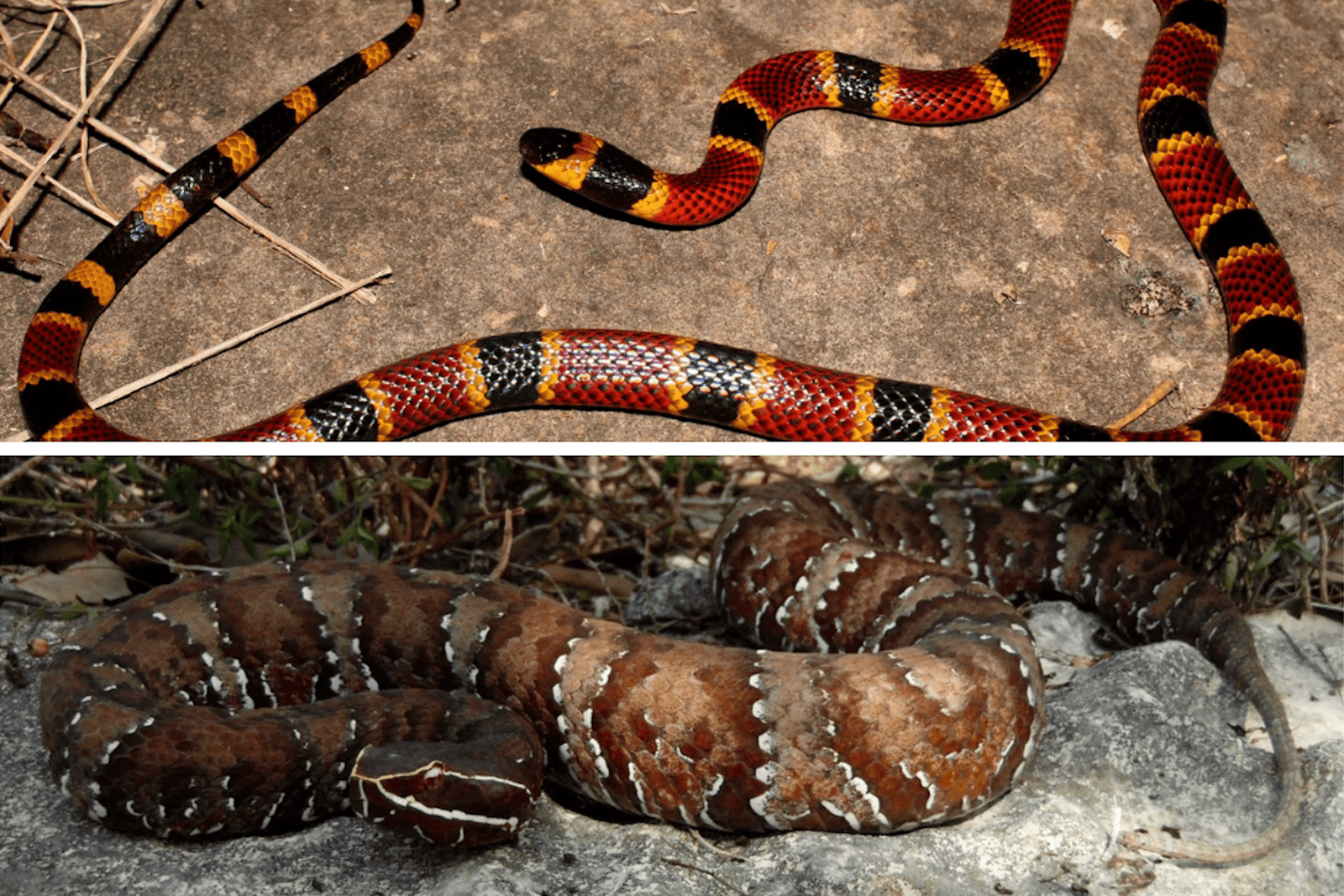
Yucatan has five venomous snake species: the coral snake, rattlesnake, Yucatecan cantil, fer-de-lance (four-nosed viper), and Yucatecan fer-de-lance. However, only three inhabit areas around Merida: the cantil, rattlesnake, and coral snake. The two fer-de-lance species do not reach Merida, with the closest recorded sightings in Sacalum (about an hour away) and Chichén Itzá.
Nahuat has observed cantils in many locations across the Yucatan Peninsula: in Merida, near Campeche, near Progreso beach, and in Valladolid, among others.
The most frequently reported snake in Merida is the boa. “It’s a snake people contact us about a lot because they’re large, easy to see, and manage to survive in the city,” Nahuat said. “They’ve been found even in downtown Merida.”
Among venomous species, the coral snake appears frequently in northern, southern, and eastern zones—”really all around Merida’s periphery.”
Why Not to Kill Snakes
Nahuat strongly advises against killing snakes. “Killing a snake damages our future because snakes are an incredibly fundamental part of the ecosystem, and unfortunately many people don’t know this,” he said.
“We act out of fear, often when they’re not even dangerous. We have instant fear, but we don’t see that snakes help us control animal populations and are prey for other animals. This is very important for our ecosystem.”
He emphasized that nature is increasingly affected, and harming snakes causes serious damage.
What to Do If You See a Snake
Nahuat recommends the following steps when encountering a snake:
- Stay calm first and foremost.
- Keep the snake in sight, noting where it hides to help authorities.
- Call emergency services. Firefighters and police are trained to capture these animals, remove them, and relocate them from homes. Civil Protection can also help.
“We shouldn’t kill it because, besides harming the ecosystem, we could get bitten,” he warned. “Many bites that occur each year happen because people try to handle or kill the snake, and snakes are fast—the bite happens because they defend themselves from what they consider aggression.”
“So it’s never advisable to approach to kill a snake, especially if we don’t know what species it is, because it could backfire on us.”
Safe Distance and Behavior
If you see a snake, stay at least one meter away, though three to four meters provides complete safety. A snake’s strike range is typically half its length.
“You can move, but move away calmly because if we run, the snake will also move quickly,” Nahuat advised. “And don’t lose sight of it so help can arrive, whether firefighters, police, or Civil Protection.”
Snakes sometimes raise their heads to survey their surroundings, look for predators, or seek refuge, depending on the species. Some move with their heads raised, others crawl more, and some live underground and never raise their heads.
Myths and Realities
Contrary to some beliefs, coral snakes are not aggressive. “On the contrary, the coral snake is one of the shyest snakes that exists,” Nahuat said. “There are very few coral snake bites. In the last 15 years, if there have been five bites, that’s a lot. I think there were even fewer.”
With their vibrant coloration, coral snakes primarily want to be seen to avoid conflict. When threatened, they first try to escape predators and rarely attack. Bites typically occur when someone tries to handle them or steps on one that has entered a shoe.
“Bites from cantils and rattlesnakes are much more common than coral snake bites,” Nahuat noted.
He also dispelled the myth that snakes chase people. “Snakes cannot jump to chase people. They don’t chase us because they have no reason to.”
When snakes coil up, particularly boa constrictors, they’re camouflaging themselves to avoid detection by prey. “I’ve seen over 100 boa constrictors in my life, some very close to me, and none has tried to bite or chase me. The ones I’ve encountered have been very calm.”
Treatment After a Bite
While deaths from snake bites in Yucatan are extremely rare—it can take hours or even days for serious damage to occur—Nahuat recommends seeking hospital care within the first two hours after a bite.
“If we arrive five hours later, maybe it won’t kill us—we can survive—but we might already have permanent damage to a hand, foot, or kidneys,” he explained. “That could compromise or harm our quality of life.”
Although main hospitals may be far from some communities, the health sector has antivenom well distributed across different health centers. With adequate transportation, most people in Yucatan can reach a medical unit within two hours.
Health centers typically have an initial dose to stabilize a person before urgently transferring them to a hospital with more antivenom. Treatment involves administering antivenom doses until the venom subsides, with the amount varying based on individual sensitivity. Some cases have required 90 to 100 doses, with patients surviving.
Snake bites can be lethal when combined with comorbidities. For example, if a snake that affects blood bites someone with hypertension, hemophilia, or coagulation problems, complications could arise.
“The effects of snake venom depend greatly on how sensitive the person is and what comorbidities they have,” Nahuat said. “But a healthy person can generally withstand several hours.”
Age also matters, with children and the elderly more sensitive to snake venom.
Nahuat concluded by emphasizing respect for snakes. “If we respect their space and don’t try to attack them, they won’t attack us. And we should keep yards and land clean so there’s less chance of snakes being there.”
“I would tell people not to focus only on the negative, to also research the importance of snakes. I’m sure that will open their eyes to see that killing them isn’t the first option and shouldn’t be done.”
Discover more from Riviera Maya News & Events
Subscribe to get the latest posts sent to your email.