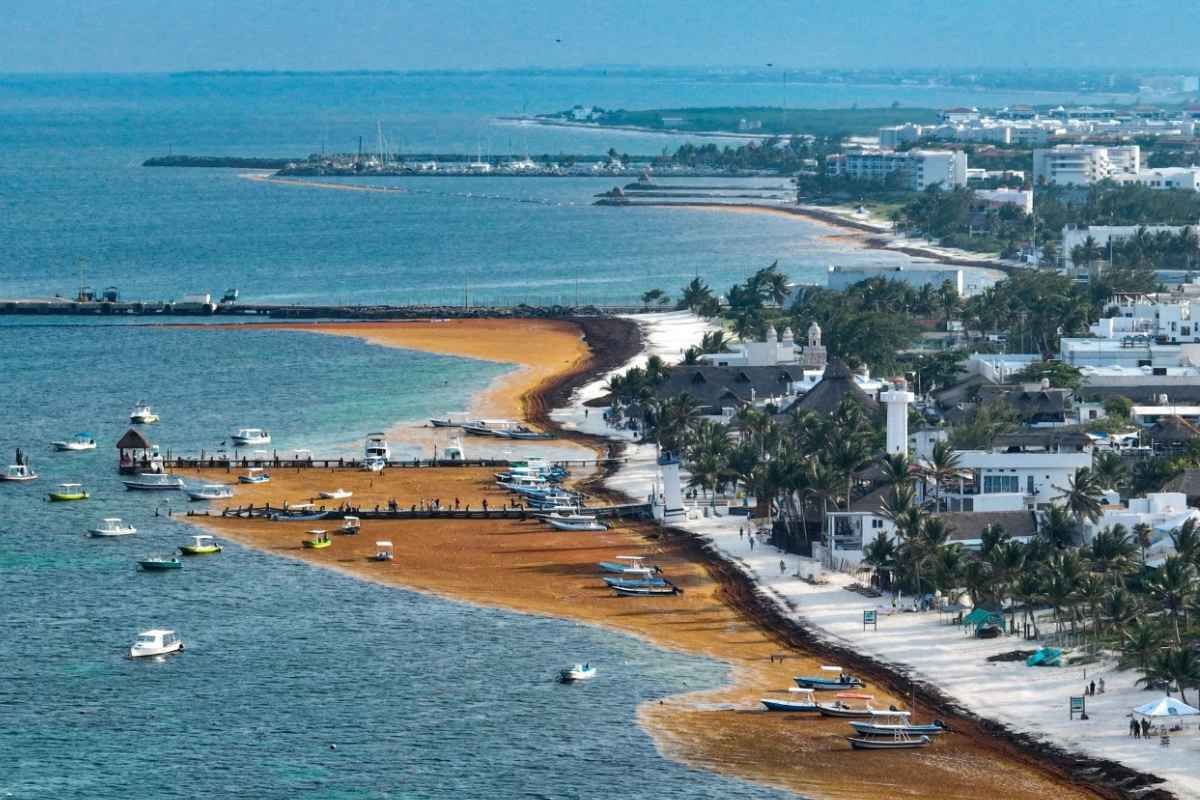
Puerto Morelos, Quintana Roo — Mayor Blanca Merari Tziu Muñoz led the fifth session of Puerto Morelos’ sargassum task force, where officials from all three levels of government reviewed priorities and operational needs for the 2027 season.
During the meeting, the mayor reaffirmed her administration’s willingness to coordinate closely with the Quintana Roo state government and the Mexican federal government, through the Mexican Navy and the National Tourism Development Fund (Fonatur), to draft plans and protocols tailored to the municipality’s specific conditions.
“It is essential that we work in a coordinated way, with planning and clear objectives, to get ahead of the next season. Puerto Morelos has particular conditions and we must build a strategy that allows us to address them efficiently, protecting our beaches and tourism activity while not losing sight of the well-being of our residents,” she said.
Among the main topics discussed was the prioritization of beaches for cleanup work in 2027. The municipality identified Ventana al Mar, Adolfo López Mateos (Cayuse), Playa Sol, the Heriberto Frías access, the Leona Vicario access and the Margarita Maza access as priority sites.
Four additional beaches were presented to the task force for consideration in the operational plan: Primero de Junio, Milla Verde, UNAM and Calle 53.
Another central point was the review of transfer and collection sites, as well as the identification of temporary sargassum concentration points linked to the expansion of marine barriers. Officials also discussed proposed operational sections and the Navy’s maintenance and cleaning plan for those structures next year.
As part of agreements to align criteria among participating institutions, officials proposed establishing a glossary of technical terms so that general response protocols use a common language. Proposed definitions include the Sargassum Operation Zone (ZOS), the Temporary Sargassum Concentration Area (ACTS), the Sargassum Transfer Center (CTS) and the Sargassum Collection and Handling Center (CAMS), along with the concepts of recreational window and operational beachfront.
The session was attended by William Castillo, director of evaluation at Sectur-Fonatur; Navy Capt. Cuauhtémoc Velázquez Santiago, representing Adm. Topiltzin Flores Jaramillo, coordinator of the Navy’s sargassum response strategy; Rafael Aznar Martínez, director of administration for the federal maritime-terrestrial zone, riverbanks and lagoons in Quintana Roo; and Gerardo Rosas García, Puerto Morelos’ secretary of environment, animal welfare and sustainable mobility, along with Emmanuel Tuz Betancourt, director of the federal maritime-terrestrial zone (Zofemat) in Puerto Morelos.
Also present were Ana Martínez, a representative of the state Environment and Ecology Department (SEMA); Mario Salinas Castro, secretary of public works; and Karina Vázquez Díaz, the municipality’s secretary of sustainable tourism.
Mayor Merari stressed that no effort is being spared in building a comprehensive, coordinated strategy for 2027 that optimizes human and material resources, improves response capacity and preserves the beaches as one of the municipality’s main natural assets and economic drivers.
More Environment
- Cold Front 8 Halts Cozumel Water Tours, Costing Operators $8,000 a Day
- Playa del Carmen Officials Coordinate Crackdown on Illegal Trash Fires
- Zamna Festival’s New Tulum Venue UX Arena to Hold 40,000 People
- 26 Vallarta Mud Turtles Seized at Amsterdam Airport; Only 300 Left in the Wild
- Playa del Carmen Mayor Oversees $23 Million Renovation of Punta Esmeralda Beach Access
More Puerto Morelos
- Kantunilkín Plant Swap Collects Food for Needy Families in Lázaro Cárdenas
- Two Puerto Morelos Schools Certified for Health Promotion and Dengue Prevention
- Puerto Morelos to Host Disability Services Day on December 1
- Mandarin Oriental Breaks Ground on Kanai Resort in Mexico’s Riviera Maya
- Quintana Roo Hosts Fourth Climate Action Forum in the Mexican Caribbean