CIUDAD DE MÉXICO — In the last four to five years, violence has increased “like never before” in areas impacted by the construction of the Tren Maya, where “remains of dismembered or bagged people have appeared, and for the first time, organizations searching for the disappeared have been formed,” who are persecuted and threatened.
This is one of the conclusions of the report “Civil Observation Mission on Impacts and Affections of the Tren Maya Project (construction and use of railway tracks and collateral developments) in the states of Quintana Roo and Campeche (sections 5, 6, and 7).”
The report involved coordination from the National Indigenous Congress, U kúucchil k Ch’i’ibalo’on Community Center, Xpujil Regional Indigenous and Popular Council, Urban Cenotes, Mexican Civil Council for Sustainable Forestry, International Tribunal for the Rights of Nature, Fray Bartolomé de las Casas Human Rights Center, Greenpeace, Jultun Research and Collective Action, Kanan Human Rights, Latin American Geopolitics Observatory, Observatory of Multinationals and Terravida.
The document results from an expert deployment to the affected area conducted in April 2025, based on the systematization of testimonies from local inhabitants, social organizations, researchers, water users, agricultural producers, landowners traversed by the train, as well as workers from tourist developments managed by the military, combined with direct observations from activists.
Violence
The report indicates that in the construction zone of the megaproject, there has been “a widespread and noticeable increase in violence to which the local population is exposed,” attributable to “criminal groups linked to illegal economies (drug trafficking, arms trafficking, and human trafficking) that have expanded into regions that were previously marginal.”
According to the report, “the presence of a floating population unrelated to local contexts hired for the construction of the railway has opened an incipient market for drug consumption and prostitution in rural settings and has provoked disputes between criminal groups that use small communities in southern Quintana Roo and Campeche as their theater,” while in the tourist zones of northern Quintana Roo, violence has worsened.
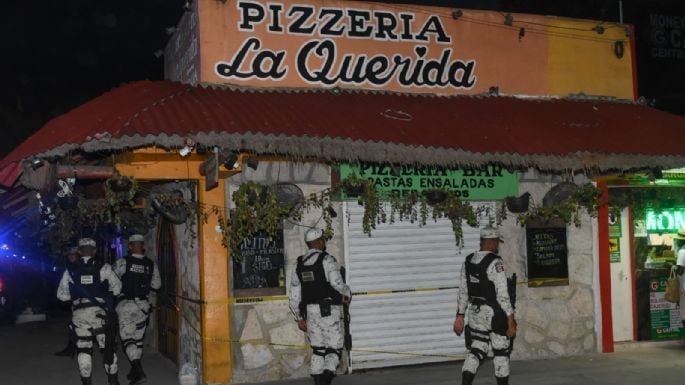
“The massive presence of the armed forces has not stopped the exacerbation of violence,” the experts highlight in the document, noting that “a widespread perception of insecurity” prevails in the area.
In addition to the ongoing socio-environmental impacts that have not ended, the experts identified concerns about real estate speculation and land and territory dispossession, driven not only by businesspeople but also by institutions, “that impose arbitrary and unfavorable conditions in expropriations for the right of way.”
They also documented “inaccessibility to justice and violations of the current legal framework, given that legal actions against the megaproject have been neutralized by the State through strategies ranging from military intervention, coercion of the population, targeting and stigmatization of territory and human rights defenders, promotion of shock groups within communities, and, what has been crucial: a political determination to secure the railway project through presidential decrees that declared it a matter of National Security (2022), and the cooptation of the Judiciary that maintained a performance subservient to the presidential ordinance.”
Proof of the above is that of the more than 50 amparo lawsuits related to the Tren Maya filed since 2020, “they did not manage to stop the works or the damages, much less restore the order of things.”
Despite everything, the members of the Mission found in the affected area “the active presence of a great variety of civil society organizations, informal collectives, and citizen groups, both in rural and urban contexts, who, against all threats, maintain spaces for dialogue and vindication of their rights, and publicly express their disagreement with an imposed territorial occupation model.”
The authors of the document warned as one of the effects of the Tren Maya construction that resistance to the megaproject persists and manifests in different ways, through mobilizations and legal actions “to defend the territory and related human rights and against the project.”
Militarization of the Region
After systematizing the collected information, one of the concerns of the Observation Mission is the militarization in the region, where for every Tren Maya passenger there are two military personnel.
“The promiscuity of activities, impunity, and the wide circulation of armed forces members throughout the region, in an occupation that does not end with the train’s construction, has changed the dynamic and community profile. They can be found in restaurants, supermarkets, stores, movie theaters, bars, and parks, moving among the inhabitants, despite being conspicuously armed. The freedom with which children, women, and the general population moved has transformed into fear and violence,” the report states.
It cites data provided by the megaproject’s own director, Óscar David Lozano Águila, who in June 2025 reported that “the military presence in the territory where the Tren Maya project is deployed is 6,583 personnel, which contrasts with the 3,320 passengers transported per day.”
It details that of the 6,583 personnel, 5,661 belong to the National Guard (GN), 832 to the Army, and 90 to the Air Force.
Based on the Comprehensive Security Plan of the Tren Maya 2023, disclosed by the Secretariat of National Defense (Sedena), the document highlights that in the seven sections comprising the flagship project of Andrés Manuel López Obrador “there are 38 installations and 4,931 GN personnel, 28 drones, five Augusta helicopters, 90 Air Force personnel with three bases in Mérida, Tulum, and Palenque.”
In fact, in the zone of megaprojects promoted by the federal government in the south-southeast, 58,504 military personnel were deployed, of which 27,633 were assigned to Sedena, 17,610 to the GN, and 13,261 to the Secretariat of the Navy, the document points out.
Recalling that for the materialization of his flagship project, through the decree of November 22, 2021, President López Obrador “transferred its construction, administration, and even its benefits to Sedena, in a dynamic of empowerment of the military, as well as the increase in militarization and militarism imposed on the south-southeast as a fundamental part of the territory reconfiguration process.”
Based on the conducted research, the mission members alert that with the presidential decree to Sedena, “doors were opened for them to take over the territory and act with impunity, generate profits from business and para-state companies, and concretize the phenomenon of militarization in the region, disciplining any type of critical manifestation, denunciation, or opposition to State intervention.”
The testimonies collected among the inhabitants speak of “humiliations, abuse of power, and overstepping of functions by military elements over people, lands, community institutions, and public spaces of the communities.”
Affections
With deforestation of 11,482 hectares of jungle; installation of 15,000 steel pilings in the cave system; irreversible damage to fauna and flora; and affecting 130 cenotes and thereby the natural aquifer system of the Yucatán Peninsula.
The main damages were detected in “agricultural plots, forests, common-use lands, and private lands; lack of respect for local productive activities; exploitation of water sources; installation of camps; exploitation of personnel hired for the work; fencing of public space; and armed patrols in recreation, commerce, and cultural venues (such as archaeological zones) conducted without respecting or consulting the local population; non-payment to ejidos for right of way and petrous material extracted from their lands, as well as to workers and suppliers contracted during the works.”
After adding that the inhabitants have been dispossessed by the project of “parks, lagoons, cenotes, beaches, rural roads, among others,” inhabitants agreed that they are defenseless “against the arbitrariness of the military” due to not being able to report damages caused to military commands because of the “palpable fear felt in an altered environment with the imposition of Sedena as the new authority that came to displace civil authorities.”
For the defenders who prepared the report, the handover of the Tren Maya project to Sedena is an “occupation of the territory” by the armed forces, who have taken over “roads, stations, warehouses, barracks, material banks, airports, and others.”
The observation mission verified that the train stations installed where there was previously jungle are empty most of the day, and that other works have invaded areas previously protected for their environmental value, destroying habitats of animals and plants near archaeological zones.
Thus, the military hotel in Uxmal impacted 40 hectares of jungle; the military hotel in Calakmul was built within the Biosphere Reserve considered by UNESCO as Mixed Heritage for its historical-cultural and environmental importance.
A sample of “the impunity with which the armed forces act” is that they appropriate territories beyond those required for the train, since “where there is a lagoon (like Bacalar’s) or an ancestral path (Sakbej), a cenote, or a beautiful landscape, they dispose of the place, remove the vegetation, and build,” as precisely occurs with “the rest house” for high military commands in Bacalar, which began construction without environmental permits “and against the will of the local population.”
Among the most serious features are the opacity in the management of military companies that are part of the Grupo Mundo Maya corporate, being considered by decision of President López Obrador as of “national security.”
Discover more from Riviera Maya News & Events
Subscribe to get the latest posts sent to your email.