
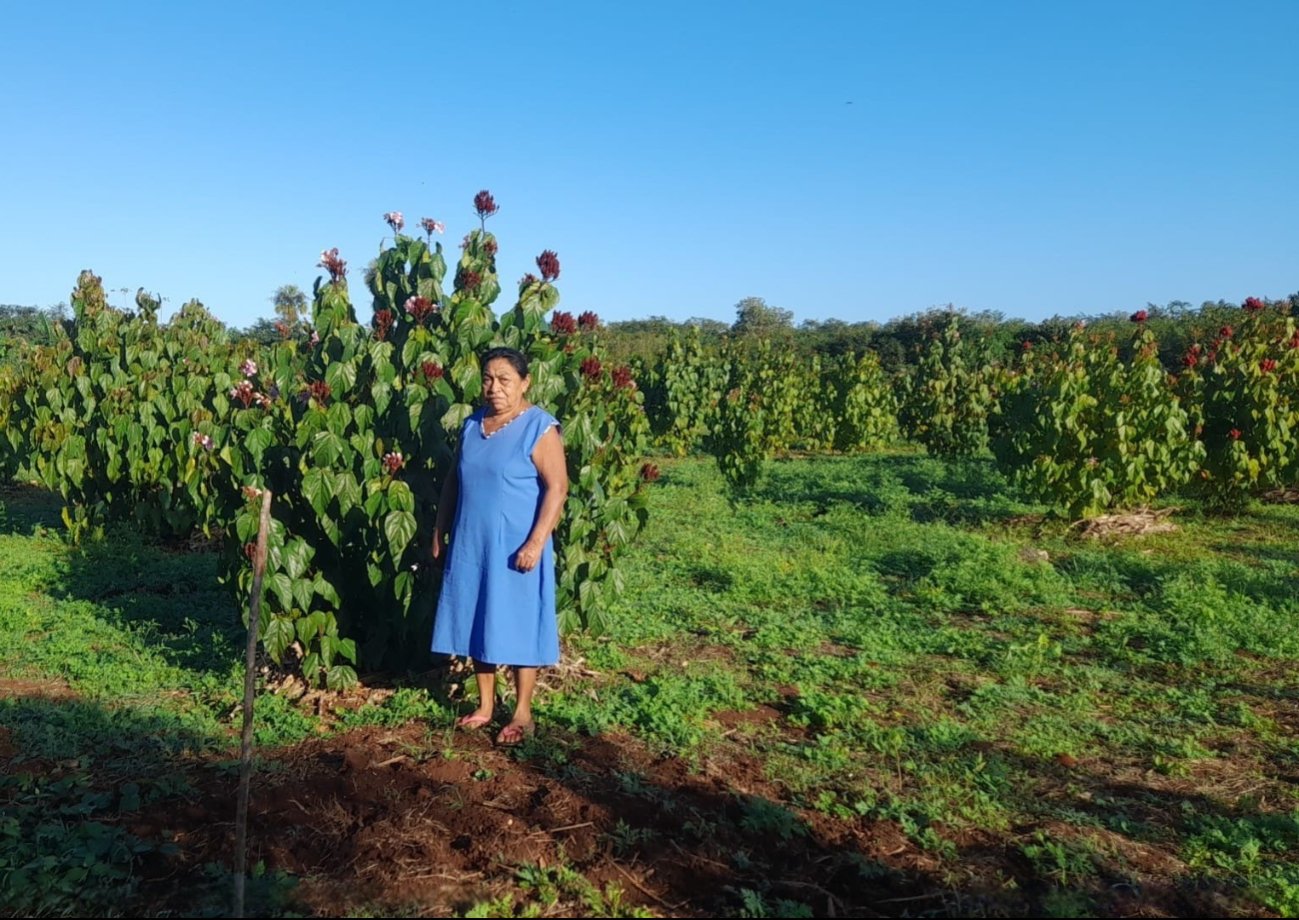
Lázaro Cárdenas, Quintana Roo — Local producers and the “Sembrando Vida” (Sowing Life) program are establishing agroforestry systems in beneficiary communities to diversify rural family incomes by reactivating the cultivation and commercialization of annatto (Bixa orellana).
This initiative seeks not only to cover the current deficit of this ingredient in regional gastronomy but also to position communities as references for local export given peninsular demand and potentially for chemical and cosmetic companies, according to Olegario Canul, president of the Campesino Learning Centers (CAC) of “Sembrando Vida.”
The strategy responds to the need to stabilize prices for this product, which currently fluctuates between 50 and 55 pesos per kilogram in direct sales, according to data provided by program leadership and representatives of the agroforestry systems.
For decades, annatto production in areas like Kantunilkín suffered stagnation due to a lack of commercialization channels and a shift toward less labor-intensive monocultures.
However, the landscape has taken a 180-degree turn. Under the agroforestry systems scheme, millions of plants have been distributed that are now bearing fruit in the plots of program beneficiaries.
Olegario Canul explained that the process of resuming this cultivation is a direct response to market demand. “Each Sembrando Vida group in our region already has active production in their plots, in places where planting had been abandoned, like Kantunilkín. We are returning to our roots because the market demands it,” he said.
Annatto is the soul of Yucatecan and southeastern Mexican cuisine. Without it, emblematic dishes like cochinita pibil, tamales, and escabeches would lose their characteristic coloration and unique flavor profile. Currently, local demand frequently exceeds supply, forcing merchants to import annatto paste from other regions, sometimes of lower quality or with excessive artificial colorants.
The current production focuses on delivering a pure product that can be transformed into:
- Dry seed for bulk sale
- Artisanal pastas, following traditional milling recipes
Despite the enthusiasm and growing production, farmers face the challenge of logistics. Canul emphasized that the next crucial step is the installation of a state-level collection center.
This center would allow for standardizing product quality, centralizing cargo volume to negotiate better prices with large buyers. For now, it is being sold locally with great success, selling for between 50 and 55 pesos per kilogram. “But with a collection center, the program could scale to a processing phase where we not only sell the seed, but the added value of the derivative,” Canul stated.
For the average producer, annatto does not come to replace corn or beans, but rather integrates into a triad of financial security. As a perennial crop that requires specific but constant care, it allows the farmer to have a “petty cash” or extra income while the cycles of basic grains are completed.
More Business
- Sheinbaum Announces More Gas and Power Grid Upgrades for Quintana Roo
- Sheinbaum Acknowledges Little Progress in Talks With Vulcan Over Calica
- Fitch Downgrades, Then Upgrades Playa del Carmen Credit Rating Over Missed Payment
- Riviera Maya Hotel Occupancy Plunges to 36% in October 2026
- Quintana Roo Hoteliers Say DNR Hike Favors Punta Cana Over Cancún
More Zona Maya
- Quintana Roo Opens 2026 Poetry Contest for Indigenous and Afro-Mexican Girls
- Drought Damages Farmland in Felipe Carrillo Puerto as Quintana Roo Assesses Losses
- Aluxes Endure in the Beliefs of Maya Communities in Quintana Roo
- Search Operation for Missing People Deployed in Felipe Carrillo Puerto
- Mothers of Missing Children Ask Quintana Roo to Display Their Faces on Public Transport
