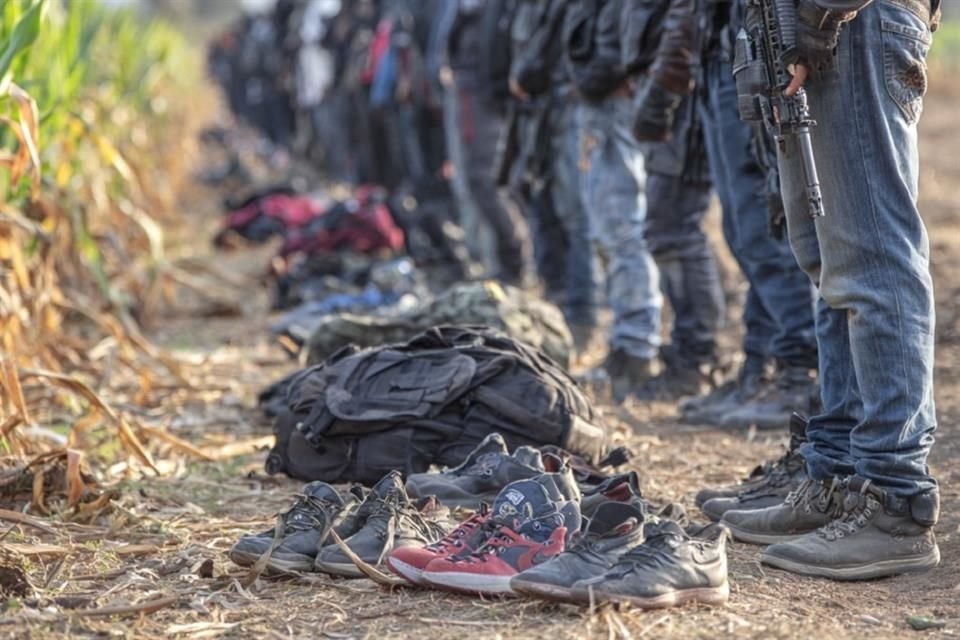
Mexico City — With deceptive job offers through platforms like Facebook, X, and TikTok, organized crime groups operating in the country are taking advantage of social vulnerability and family abandonment to recruit adolescents and young people into criminal activities.
Cases like that of Víctor, a 17-year-old identified as the killer of Uruapan, Michoacán Mayor Carlos Manzo, have brought renewed attention to this problem. The teenager was originally from the town of Paracho and was reported missing days before the attack, having tested positive for drug use.
Legal Gaps and Recruitment Methods
The lack of a legal framework that punishes child recruitment for criminal activities is one reason why Mexican cartels are now seeking young people for hitman work, lookouts, extortion, and other illegal activities, according to Jaime Laines Potisek, director of the Juan Antonio Montesinos Center.
Studies conducted by the Network for Children’s Rights (REDIM) and the Seminar on Violence and Peace at El Colegio de México warn that fertile ground for narco-recruitment includes a mix of criminal presence, lack of income, low educational levels, and limited access to health services.
Beyond the supposed “job offers” from criminal groups on social media, the reality is that 70 percent of young people in Michoacán who approached criminal activities did so through an acquaintance, said Juan Carlos Quirarte, responsible for context analysis of trafficking and recruitment in that state.
Gender Differences and Manipulation Tactics
In the case of underage women, they become victims of trafficking and sexual exploitation through romantic partners; males would be recruited for criminal activities through family members and employers. Those who recruit minors would be people admired in their circles because criminals manipulate their images with children and adolescents through actions like delivering toys and gifts on occasions such as Three Kings’ Day or Children’s Day, as has been frequently documented.
One such occasion was December 30, 2024, when the Coalcomán, Michoacán municipal government held a party where banners were hung thanking Nemesio Oseguera Cervantes, “El Mencho,” leader of the Jalisco New Generation Cartel (CJNG), following the supposed delivery of toys to children in that town.
Although the initial response of adolescents to participate is economic aspiration, they would continue with criminal activities to establish themselves in their communities where violence plays a significant role.
Narcoculture and Social Media Codes
Respect for these figures is also reinforced by various displays of narcoculture such as corridos and other multimedia content found on social media like podcasts and videos created by influencers who use codes with which cartels identify.
Grupo REFORMA documented the use of these signs and codes that cartels use on social media to discreetly infiltrate young people. Emojis would be used to differentiate criminal groups, such as “Los Chapitos,” the faction of the Sinaloa Cartel of the sons of Joaquín “El Chapo” Guzmán, who would be represented with a pizza; or the CJNG, represented with a rooster, in reference to the group’s leader, Nemesio Oseguera, also known as “El Señor de los Gallos.”
Simply searching for hashtags #maña and #trabajoparalamaña on networks like TikTok is enough to find supposed job offers, often commented on by users requesting information.
Government Actions and Expert Perspectives
From that front, the federal government has taken action: on April 23, it reported the elimination of at least 200 social media accounts that allegedly recruited children and adolescents for organized crime. Sanctions have also been imposed against musical groups that sing narcocorridos in their performances, as happened with the group Los Alegres del Barranco, who in May were linked to proceedings for alleged apology of crime after projecting images of drug trafficking leaders at concerts in Jalisco.
However, experts specified that fertile ground for narco-recruitment is a mix of criminal presence, lack of income, low educational levels, and limited access to health services combined with abandonment of young people in their families, not the use of social media.
The Infancia Cuenta en Veracruz document by REDIM, which investigates organized crime methods to swell its ranks in that state, specifies that the phenomenon has its main origin in the lack of protection for young people, who turn to organized crime also to escape a family environment marked by neglect, abuse, and even sexual aggression.
“These experiences (the abuses) have a significant impact on the rights of girls, boys, and adolescents, creating an environment of helplessness that can be exploited by organized crime,” the document states.
Root Causes and Systemic Failures
In addition to household negligence, the report adds that young people are often defenseless because their parents or guardians had to leave their homes to go to the United States in search of a more stable source of income.
School dropout is also a key factor, as besides young people abandoning their studies after committing a crime or having been detained in a reformatory center, a significant percentage had ruled out school from the beginning as a path of social mobility. 27.5 percent of those surveyed cited lack of interest or enjoyment in studies; 27.3 percent decided to leave school to enter the labor market.
Other factors mentioned included family problems (17.1 percent), drug use (15.1 percent), and some completely dismissed education as something “useful” for their future (15.1 percent).
Media Criticism and Research Challenges
The way in which media and some federal government strategies address the recruitment of children and adolescents by organized crime reveals a “civilizational crisis,” says Daniel Hernández Rossete, a researcher at Cinvestav.
“I’m talking about a very serious civilizational crisis, not a moral issue, but an ethical one. The relationship between ethics, political power, and journalistic power is thinning alarmingly,” he warned in an interview.
Aspects such as the exposure of data, images, and sensitive information by the press are practices that both the researcher and various collectives have criticized regarding this topic. Cases like the same murder of Uruapan Mayor Carlos Manzo, in which the young man’s face circulated in both traditional media and social media, are examples of a type of “commercialization of morbid curiosity” regarding this problem.
“I’m talking about a morbid curiosity about violent death. We are facing an anonymous spectacle about violent death and it’s becoming a commodity. It’s a product that is sold and bought,” he criticizes.
“I think we need much reflection on the phenomenon of drug trafficking and violence, but not only from the morbid, almost pornographic data. But from how we are posing the relationship with this phenomenon as an object of study.”
On the other hand, the doctor specialized in urban sociology lamented that more technical and specialized information about youth contexts is often biased by the very nature of organized crime.
“We have more than 15 years without being able to enter communities more openly. Not only anthropologists, but sociologists, and even Inegi has precedents of surveyors who enter and disappear,” he stated.
Even this type of work, he noted, is conducted with another framework of respect for the rights of children and adolescents, such as safeguarding their identities.
Demands for Legal Reform and Social Solutions
The lack of a legal framework that punishes child recruitment for criminal activities is another reason why Mexican cartels seek young people for hitman work, lookouts, extortion, and other illegal activities, affirms Jaime Laines Potisek, director of the Juan Antonio Montesinos Center.
In an interview, he highlights that civil organizations have called for the creation of a judicial framework that protects children and adolescents who become involved in crime networks. “The crime is not what the minor commits while in a recruitment situation. That is, a minor who goes and commits crimes, steals, mistreats, or even kills another person having been captured by crime is actually in a victim situation. Since there is no crime of ‘recruitment,’ they cannot be classified in that sense.”
“One way to protect them would be to say: ‘all crimes committed by that person are carried out as a victim,'” he indicates.
In addition to the lack of a legal framework with this perspective, the researcher warns that responsibility does not only fall on the guarantees that the State must provide to this sector, such as security and access to educational and medical services, but also on the creation of social fabric that involves the population.
“It’s not that they are not my sons or daughters. They are our sons or daughters because they are socially generated, created, and cared for or neglected. As civil society, it is important to promote an ethics of care, attention, and hospitality.”
Having a critical perspective toward the promotion of aspirational cultural products of crime, such as narcocorridos and admiration for characters who promote these expressions, he affirms, is a topic that corresponds to society.
“It is society’s responsibility not to play along with this type of invitation about what is good, what is desirable, what is aspirational. Etcetera. It’s incredible if one listens to certain music, certain culture, in places of very high incidence of criminality,” he refers.
Laines Potisek highlights the creation of social programs aimed at this population; however, he warns that the coincidence of violence and poverty increasingly pushes children and adolescents to seek “jobs” in criminal activities, despite there being cases where school does represent a path of social mobility for young people.
“The offer that organized crime can give to a young person, a much higher salary for a much more -I’ll put in quotes- simple, less complex activity. The programs are supports, but they are not the fundamental solution to the problem,” comments the researcher.
Although the topic is complex, he affirms, a plan to address child recruitment would include job training programs, the creation of real work alternatives, strengthening education, and effective combat against impunity.
The Need for Social Embrace
The expert cites an African proverb: “The child who is not embraced by his tribe, when he grows up, will burn the village to feel its warmth,” and warns that organized crime tends to take on a paternalistic role in communities with high criminality.
“Organized crime very skillfully has seen and specialized in presenting itself as a benefactor, a substitute for father, mother, caregiver, person who cares. They become a trusted person, who gives attention, who cares about the other. It’s terrible, because effectively it’s one of the reasons why many people underage fall into these networks,” he warns.
Discover more from Riviera Maya News & Events
Subscribe to get the latest posts sent to your email.