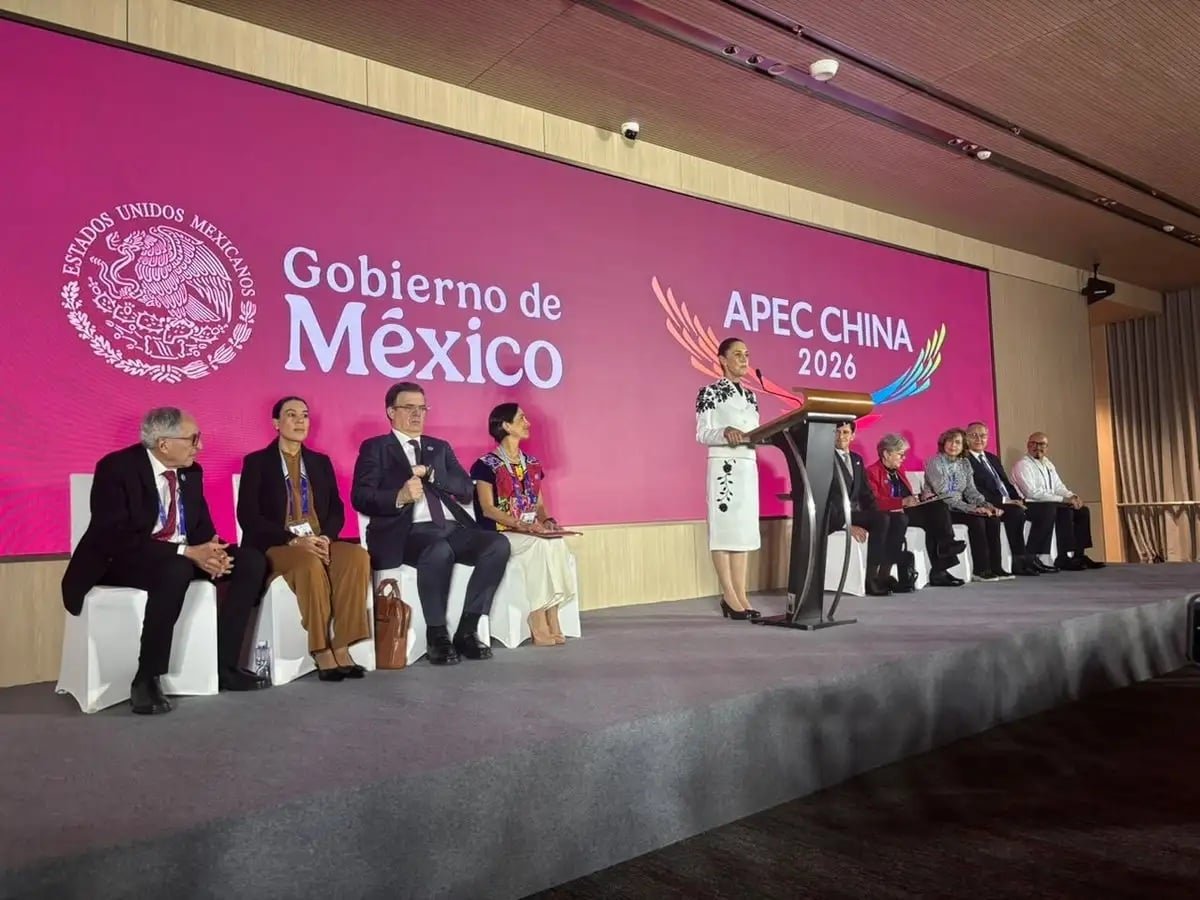
Shenzhen, China — President Claudia Sheinbaum described her working tour of China as highly productive and successful, saying it laid the groundwork for stronger ties with Beijing and showed that Mexico is well regarded around the world.
Speaking at a press conference before flying home, Sheinbaum said her participation in the Asia-Pacific Economic Cooperation (APEC) forum was important. “We brought the representation of the people,” she said, calling the summit an opportunity to meet with other heads of state.
Cooperation agreements signed
On relations with China, the president announced the signing of about ten memorandums of understanding and preliminary cooperation agreements covering the economy, the environment, energy, health, science and technology, and diplomacy.
She stressed that Mexico is not seeking a free trade agreement with China, and said the closer relationship with Beijing will not affect ties with the United States. Integration with Mexico’s northern neighbor “is very large,” she said, adding that important progress has been made on a trade agreement that could be finalized in December.
Sheinbaum said her government wants tariffs reduced on vehicles, steel, aluminum and related products, while President Donald Trump’s priority is cutting the U.S. trade deficit. Although Mexico exports more to the United States than it imports, she said, it is also the largest buyer of American goods. She added that Trump recognizes Mexico’s growing global relevance amid the expansion of artificial intelligence and data centers.
The USMCA trade pact remains in force and will undergo a new review in six years, she said, reiterating that she will meet with Trump again at the G20 summit in December.
Praise for trilateral meeting
Sheinbaum welcomed the meeting between the presidents of China, the United States and Russia — Xi Jinping, Donald Trump and Vladimir Putin — at the end of the APEC plenary session, saying it contributes to a vision of peace and prosperity worldwide.
She said she invited every leader she met bilaterally to visit Mexico. IMF Managing Director Kristalina Georgieva presented the fund’s global economic review at her own request and “spoke very well” of Mexico’s performance, Sheinbaum said, adding that they also discussed the role of artificial intelligence in the world economy and the need for diversification.
The president also mentioned greeting Peruvian President Keiko Fujimori, who reaffirmed her decision to restore trade relations with Mexico, suspended since the previous Mexican administration backed the innocence of former Peruvian President Pedro Castillo, who remains in prison.
On the new chapter in relations with China, Sheinbaum said Mexico wants greater cooperation, from scientific research to tourism, to move toward shared prosperity. “We want the geographic distance between Mexico and China to be shortened through cooperation. That is what we are seeking,” she said.
As a symbol of friendship, she asked Xi for a panda for the Chapultepec Zoo. She said Xi is well aware of Mexico’s history on the issue, dating to 1975 when China gave Mexico a pair of pandas, and recalled with precision that the panda living in Mexico City is 36 years old. Xi responded that he would look into lending another panda, since China now sends the animals abroad only under such arrangements, she said.
Later in the day, Sheinbaum held bilateral meetings with the prime ministers of Singapore, Lawrence Wong, and Australia, Anthony Albanese.
Return to Mexico
Interior Secretary Rosa Icela Rodríguez said Sheinbaum was on a commercial flight back to Mexico City and was expected to arrive early Friday. The president will then lead the military parade marking the 116th anniversary of the start of the Mexican Revolution.
Rodríguez said APEC “represents an opportunity to strengthen Mexico’s presence in the region,” noting that the 21 member economies account for about 60 percent of global GDP. “The agreements and dialogues have important implications for trade and global development,” she said.
More Government
- Former Playa del Carmen Mayor Roxana Lili Campos Miranda Reportedly Detained in Mexico City
- Heavy Rain Floods Cancún Streets, Disrupts Traffic and School Commutes
- Mexico’s Prepaid Cell Phone Registration Deadline Nears
- Quintana Roo Sets Precedent With First ‘Social Family’ Recognition for Trans Woman’s Burial
- Cancún Expands Women’s Entrepreneurship Center to Boost Female Financial Independence