
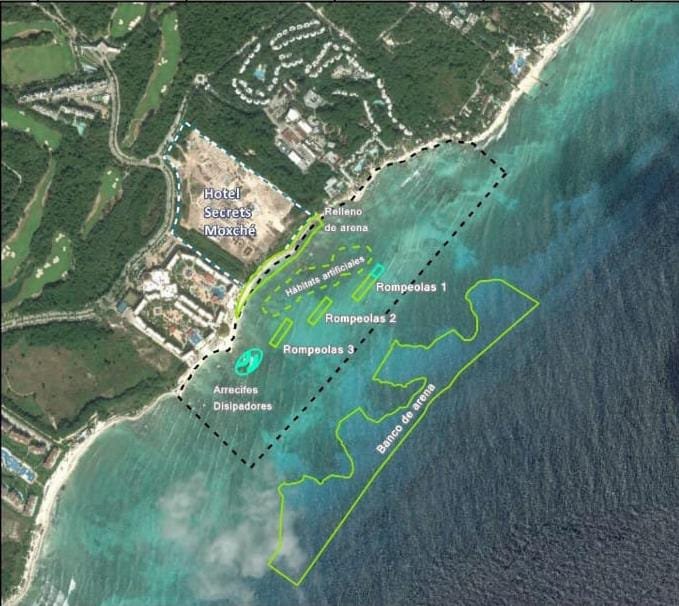
Playa del Carmen, Quintana Roo — Mexico’s Environment and Natural Resources Secretariat (Semarnat) has denied an environmental permit for a coastal protection and restoration project at the Secrets Moxché hotel after finding that part of the work had already been carried out without federal approval.
The project, promoted by the Fideicomiso Moxché I 2346/2016, sits inside the Grand Coral complex between Punta Esmeralda and Punta Bete, north of Playa del Carmen. It was submitted to Semarnat in October 2020 under file number 23QR2020T0046.
According to project documents, the plan aimed to address erosion along that stretch of coastline by rebuilding beach and reinforcing protection of the seafront. Among the measures proposed was the construction of three breakwaters, each 75 meters long.
Those structures, however, had already been installed before the federal agency issued any environmental impact authorization. The proposal also included curtains designed to stop materials from dispersing within the work area.
Sand Extraction Questioned
The file states that the project also called for extracting and transporting roughly 28,660 cubic meters of sand from a marine bank known as Mox, which would then be used to restore a stretch of beach of about 300 meters. Semarnat itself had recorded those details in the environmental impact statement filed by the promoter since 2020.
Sand extraction was another point challenged during the review. The National Commission of Natural Protected Areas (Conanp) said the project did not demonstrate the viability of the activity and failed to analyze in sufficient detail how the proposed work would be carried out. It also warned of possible violations of the administrative rules of the management program for the Mexican Caribbean Biosphere Reserve.
Profepa Called In
The General Directorate of Environmental Impact and Risk (DGIRA) ultimately decided to deny the environmental impact authorization and ruled that the promoter cannot carry out any work or activities tied to the project until it holds the corresponding permit.
The decision did not stop at the permit refusal. Semarnat also notified the Quintana Roo office of the Federal Attorney’s Office for Environmental Protection (Profepa) to review conditions at the site.
That review is meant to determine whether environmental laws have been violated, carry out the relevant inspections and, if warranted, open an administrative proceeding to set corrective or urgent measures.
The coastal protection works built before the environmental authorization now remain under Profepa review, which must decide whether administrative measures are warranted — including a possible closure — and what steps are needed to regularize or correct the conditions found.
The case joins other Riviera Maya tourism projects in which federal environmental authorities have found work or activities carried out before the environmental assessment process was completed.
More Environment
- Mara Lezama Unveils Quintana Roo Sustainable Tourism Master Plan Through 2050
- Cozumel Beach Club Injury: New Reports Identify Worker, but Crocodile Link Remains Unconfirmed
- Unicaribe Students Mark One Year Monitoring Sian Ka’an Biosphere Reserve
- Laura Beristain Returns to Politics With Environmental Banner in Playa del Carmen
- Wind Farm Project in Southern Quintana Roo Moves Forward
More Playa del Carmen
- Playa del Carmen Councilor Votes Against Mototaxi Agreement With Imoveqroo
- Body of Man Found Near Arco Vial in Playa del Carmen
- La BAMBA Festival in Playa del Carmen Closes Ninth Edition With Six-Hour Concert
- Playa del Carmen Courts French Tourists With Experiences Beyond All-Inclusive Resorts
- Six Detained in Playa del Carmen on Drug Offenses