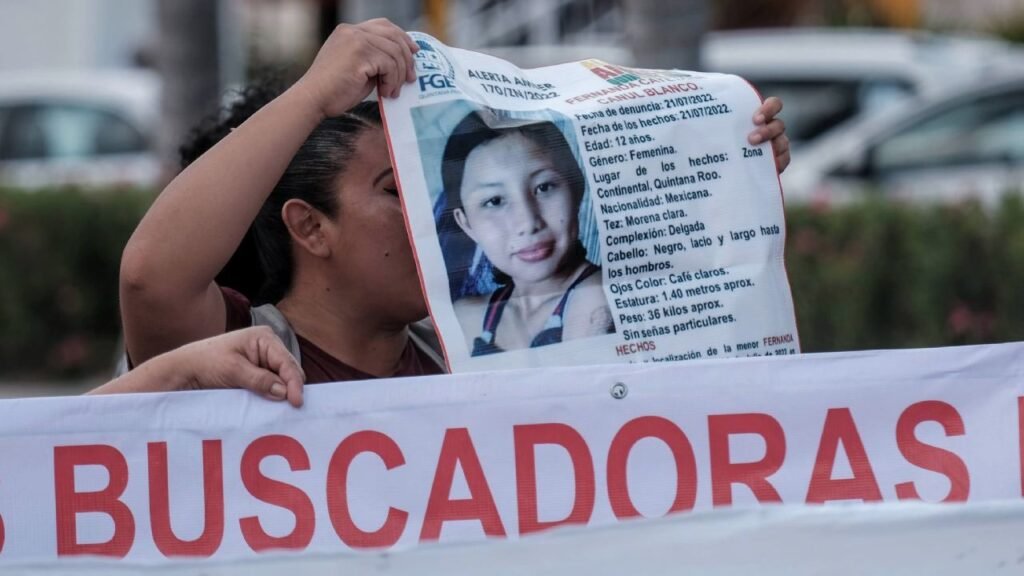
Cancún, Quintana Roo — Searching mothers in Quintana Roo have intensified protests against government inaction, demanding justice, access to case files, and the resumption of field searches for the disappeared. Despite a leadership change in the state’s Search Commission, with the appointment of Haydé Saldaña Martínez — proposed by 11 civil society organizations — the groups say promises of dialogue have not translated into concrete action.
Unmet Demands Amid Disappearances Crisis
The mothers denounce a state of institutional abandonment. Since December 2025, biweekly search operations have been suspended, blocked by the State Prosecutor’s Office, which centralized procedures without issuing the necessary orders for the Mexican Navy to accompany field work.
Among their main unmet demands are:
- Access to investigation files, denied by the State Prosecutor’s Office.
- Free legal and psychological assistance, promised by Governor Mara Lezama but not yet implemented.
- Immediate reactivation of searches in jungle areas and caves, where families operate on their own without logistical support or security.
- An end to revictimization acts, such as alleged attempts to charge fees to open investigation cases reported in early stages.
From Negligence to Outrage
The case of Francisca Mariner Flores Patrón remains the most emblematic. Her body spent 4 years and 11 months in the Cancún morgue listed as “unidentified,” despite her mother, María Patrón Pat, searching tirelessly. It was only identified after demanding DNA comparison with her granddaughter, revealing structural negligence by former officials like Rosa María Hernández and Luis Fernando Ávila, who face charges for omission.
Another unresolved case is that of William Hernández Zapata, missing since December 2017. His body was also found years later in the morgue after pressure from the collective. Although now identified, his case symbolizes institutional slowness and opacity. Relatives like “Doña Carmita” have maintained indefinite sit-ins, even relocated from Cancún Airport to the State Prosecutor’s Office, demanding justice.
A State in Crisis: Over 4,000 Disappeared
According to the collective, Cancún has accumulated more than 4,000 disappeared persons, with a critical spike in 2026: 1,500 disappearances in less than six months, of which 600 are women, suggesting a possible link to human trafficking networks.
Organizations like Ni Una Menos Cancún and Marea Verde Quintana Roo have accused the government of manipulating figures and repressing protests, as occurred in Chetumal, where 10 women were injured during a police eviction.
In late February, protests demanded justice for public officials’ negligence in the case of Francisca Mariner. On February 16, collective members demonstrated outside federal courts in Cancún, demanding that injunctions not be granted to officials accused of omission, like Rosa María Hernández, former head of the Specialized Disappearances Prosecutor’s Office, whose request for an injunction was denied.
Marybel Mondragón and Luis Fernando Ávila, also accused of negligence, are awaiting decisions on their legal appeals.
The mothers allege the officials failed to promote search procedures at the time of the disappearance and did not identify Francisca’s body, which lay for months in the morgue as “unidentified.”
On February 25, María Patrón Pat, founder of the collective, noted that the backlog of unidentified bodies in Quintana Roo’s morgues has been reduced by 97%, from 860 bodies to just 30, indicating the problem was one of political will rather than technical capacity.
Murder of a Searching Mother in Sinaloa
Meanwhile, Rubí Patricia Gómez Tagle, a 38-year-old searching mother and member of the collective Corazones Unidos por una Misma Causa in Mazatlán, Sinaloa, was murdered on Friday, February 27, 2026, in her home in the Jabalíes subdivision on Santa Rosa Avenue. Her body was found with multiple injuries allegedly caused by a sharp weapon.
The crime occurred during President Claudia Sheinbaum’s official visit to southern Sinaloa, generating widespread condemnation and demands for justice.
Organizations like Amnesty International and the Human Rights Program at Universidad Iberoamericana have described the murder as an intimidation message and a reflection of the structural risk faced by searchers in Mexico.
The Sinaloa State Prosecutor’s Office confirmed investigations are underway, focusing on Gómez Tagle’s work as an activist. The case has led to the suspension of scheduled search activities by collectives and demands for immediate protection measures for her relatives and colleagues. Her son, Édgar Daniel López Gómez-Tagle, disappeared in May 2025, motivating her activism.
Discover more from Riviera Maya News & Events
Subscribe to get the latest posts sent to your email.