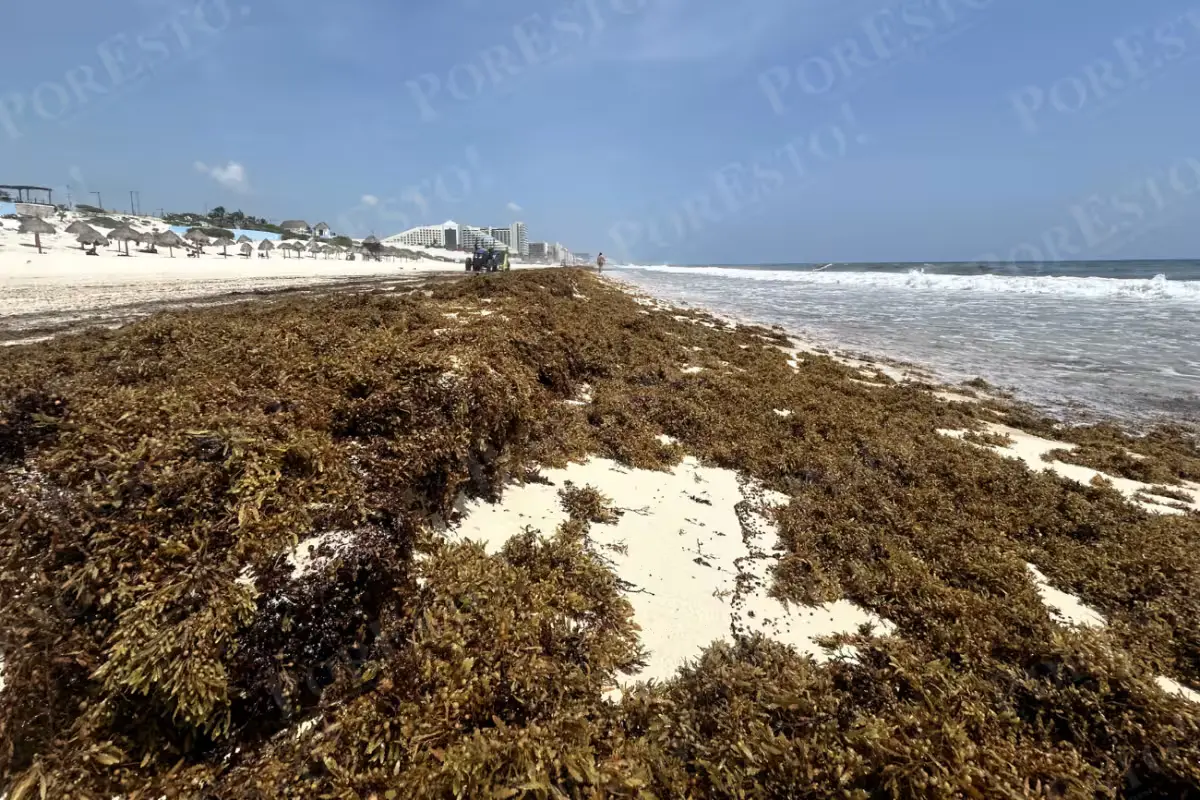
Cancún, Quintana Roo — Quintana Roo has set a record for sargassum removal, collecting 138,000 tons of the seaweed so far in 2026, and state officials expect the total to surpass 150,000 tons by the end of the year.
This is the first year in which the sargassum season has had neither a defined start nor a defined end. Landfalls began in January rather than the traditional March, and although the influx was expected to wind down in September, the macroalgae continues to reach the coast in smaller quantities.
Óscar Rébora Aguilera, head of the state Environment and Ecology Department (Sema), confirmed the collection figures and said monitoring will continue.
Mexico’s Environment and Natural Resources Department (Semarnat) described the 2026 landfall period in the Mexican Caribbean as the worst on record, exceeding all previous measurements. Sargassum levels were four times higher than last year and 27 times above the historic average, according to the agency. The crisis has overwhelmed the response capacity of authorities and threatens Quintana Roo’s tourism economy.
Response Outpaced by Volume
The scale of the problem has exposed how limited the resources dedicated to fighting it are. The Mexican Navy reported an operating budget of 19.5 million pesos for 2026, an increase of just 0.27 percent over the previous year, while the volume of seaweed collected has grown by more than 77 percent on a monthly average.
Rébora said the operation is carried out in coordination with Semarnat and the Navy. So far, crews have installed 13,380 meters of sargassum barriers, and removal work is under way in eight municipalities.
“In September the landfall dropped significantly, with 1,700 tons collected compared with 6,684 tons in August. Even so, we are keeping up permanent monitoring to identify where the macroalgae is concentrating and move brigades to the beaches that need them most, depending on wind, current and wave conditions,” he said.
The 138,000 tons collected in 2026 represent 67.2 percent more than the 92,782 tons removed during all of 2025. The Navy acknowledges that 2025 and 2026 are now the two years with the highest historic removal of macroalgae in the state.
Environment Secretary Alicia Bárcena warned that the phenomenon is no longer temporary and has become a permanent condition.
The Navy’s Oceanographic Institute of the Gulf and Caribbean Sea updated its alert level from high to low, issuing a green flag after reporting that 10,103 tons of sargassum are drifting in the Mexican Caribbean. At the start of the month, that figure stood at 46,632 tons.
“The season has eased, but our operation remains active. Coordination between institutions allows us to anticipate landfalls, contain the sargassum and remove it from our coasts to protect our ecosystems,” the state official said.
Push to Bring in 840 Vessels
Ignacio Muñoz, director of the organization The Seas We Love (TSWL), said it is urgent for the Mexican Institute for Research in Sustainable Fishing and Aquaculture (IMIPAS) to complete the operating regulations for the sargassum management plan included in the National Fisheries Charter. That, he said, would bring coastal communities and fishing cooperatives into the effort and allow European Union financing to be used to add 840 vessels capable of working along 1,500 kilometers of coastline.
Muñoz spoke during the forum “Building Multisectoral Technical Alliances for the Sustainable Management of Sargassum,” held in Cancún and convened by the European Union, the German Society for International Cooperation, the Mexican government and the private sector.
He welcomed the scientific recognition of pelagic sargassum as a fisheries resource by IMIPAS, which opens the door to collecting it in deep water and led to its inclusion in Mexico’s National Fisheries Charter on Aug. 6.
“We already have the National Fisheries Charter, but no progress has been made on the sargassum management plan. That first formal fishery needs to be completed and local communities brought in — the fishing groups that until now have not been able to take part in a formal, structured way to guarantee their survival and ease the overexploitation of other fisheries,” he said during the forum.
Manuel Jesús Puerto Mocoroa, regional head of fishing and aquaculture research in Puerto Morelos for IMIPAS, noted that Mexico’s National Fisheries Charter is the only legal framework in the country binding under law, because it gives legal certainty to those who harvest sargassum for productive use.
The strategy seeks not only to clean beaches but also to turn the macroalgae into a usable resource. In August 2026, the federal government reclassified sargassum from waste to resource, legally permitting its use in private ventures.
That change has opened the door to an entrepreneurial ecosystem that sees the species as an abundant, free raw material. Companies including CarbonWave, which produces agricultural extracts and cosmetic emulsifiers; Sargazo Sandals, which makes biodegradable footwear; Nopalimex, which holds a patent for generating biogas; and EcoColor, which uses the algae to make colored pencils, are already operating in Mexico.
More Environment
- Cancún Hosts 45 Nations at EU-Caribbean Summit on Sargassum
- Heavy Rain and High Heat Forecast Across Quintana Roo on Friday
- Playa del Carmen Unveils Recycled-Plastic Lifeguard Tower at Playa 72
- Chankanaab Park Eyed as Site for Cozumel’s First Dolphin Sanctuary
- Tulum Launches Credentialing Program for Parque del Jaguar Tourism Workers
More Quintana Roo
- Quintana Roo Warns Against Unchecked Hotel Growth as It Courts Brazil and Colombia
- Four Years After Decriminalization, Quintana Roo Feminists Say Abortion Access Still Falls Short
- Quintana Roo Congress Approves Single-Nationality Rule for Top Elected Offices
- Mexico’s Senate Approves ‘Anti-Meme’ Law With Five-Year Prison Terms
- Quintana Roo Ranks Third Nationally in Corruption of Minors With 182 Cases