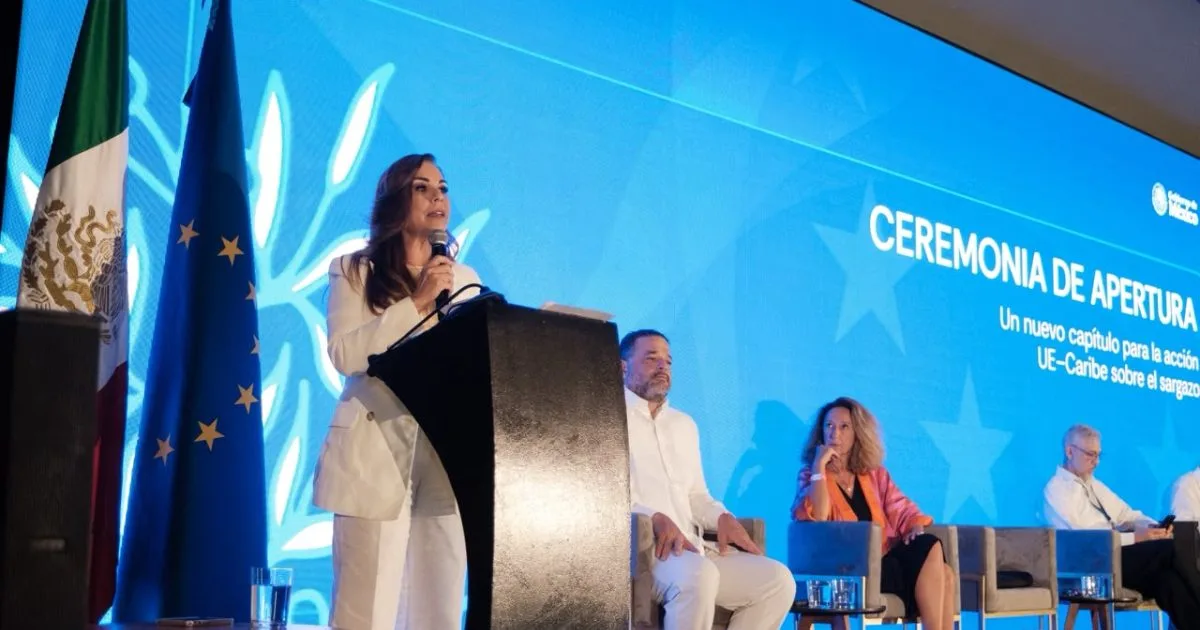
Cancún, Quintana Roo — Cancún is hosting the 4th EU-Caribbean Global Gateway Conference on Sargassum, drawing 350 representatives from 45 countries and territories to weigh new approaches to the seaweed’s growing spread, with a focus on technology, financing and the circular economy.
The two-day event, held Oct. 1-2, 2026, is co-organized by the European Union and the Mexican government through the Secretariat of Environment and Natural Resources (SEMARNAT), with support from the Quintana Roo state government.
Lezama Calls for Coordinated Response
Speaking at the opening ceremony, Governor Mara Lezama Espinosa said the growth of sargassum requires a coordinated response from governments, businesses, universities, international organizations and financial institutions.
The governor noted that the phenomenon is no longer a problem confined to certain coastlines, since ocean currents can carry the seaweed across the Caribbean and to other regions of the world.
The conference brings together government officials, private-sector representatives, academics, financial institutions and international organizations, with specialists spending two days reviewing projects and cooperation mechanisms.
Cancún’s selection as host was announced in July, when the Mexican government said the meeting would aim to exchange experiences and strengthen regional cooperation.
From Environmental Problem to Economic Challenge
One of the conference’s central themes is how to move from pilot projects to a regional market capable of managing and using sargassum on an industrial scale.
The proposal calls for developing value chains that use the seaweed as raw material for a range of products, rather than focusing efforts solely on collecting and disposing of it.
In her remarks, Lezama argued for mechanisms that turn the environmental phenomenon into a source of knowledge, innovation and new economic activity.
That approach aligns with the Global Gateway agenda, a European Union initiative aimed at mobilizing investment and strengthening projects in infrastructure, climate transition, energy and sustainable research and development.
Sargassum Could Reach 80 Million Tons by 2027
Figures presented at the opening underscored the scale of the problem.
According to data shared by the governor, roughly 38 million tons of sargassum were floating in the Atlantic in 2025.
That figure is estimated to have risen to about 60 million tons in 2026, while projections for 2027 point to around 80 million tons.
The growth has heightened the need for mechanisms to anticipate arrivals, improve collection capacity and find ways to make use of the seaweed.
Mexico Expands Its Anti-Sargassum Strategy
The international meeting follows Mexico’s announcement of a reinforced strategy to address sargassum along the Mexican Caribbean.
In July, President Claudia Sheinbaum Pardo announced an investment of more than 2 billion pesos to strengthen collection in open water, shallow water and on beaches, as well as transport, final disposal and use of the seaweed.
The first phase, covering 2026, includes 768.7 million pesos with the goal of raising collection capacity to 1,870 tons per day, according to the government’s plans.
The strategy also calls for adding two tugboats, six coastal sargassum collection vessels, 1.5 kilometers of dynamic barriers and 50 kilometers of coastal containment barriers in priority areas including Playa del Carmen, Cancún, Tulum, Puerto Morelos and Mahahual.
EU Pushes Sustainable Value Chains
European participation aims in part to support projects that develop sustainable solutions around sargassum.
The European Union has identified management of the seaweed as one of its cooperation priorities under the Global Gateway agenda for Latin America and the Caribbean.
European Commission documents outline support for Mexico’s sargassum collection efforts and for value chains tied to its use, along with the organization of the international conference held in Quintana Roo.
At the opening, Myriam Ferrán, deputy director-general of the European Commission’s Directorate-General for International Partnerships, stressed the bloc’s interest in contributing both to environmental response and to sustainable value chains and jobs linked to the activity.
More Environment
More Cancun
- Two Missing Children Found Walking Alone in Cancún After 18-Hour Search
- Man, 27, Has Lived in Cancún Airport Terminal for Three Weeks
- Quintana Roo Authorities Search for Mother and 2-Year-Old Son Missing After Trip to Isla Mujeres
- Cancún Shelter Offers Medical Care and Detox for Homeless Residents
- IMSS Workers in Cancún March to Demand Higher Pay, Supplies and Staffing