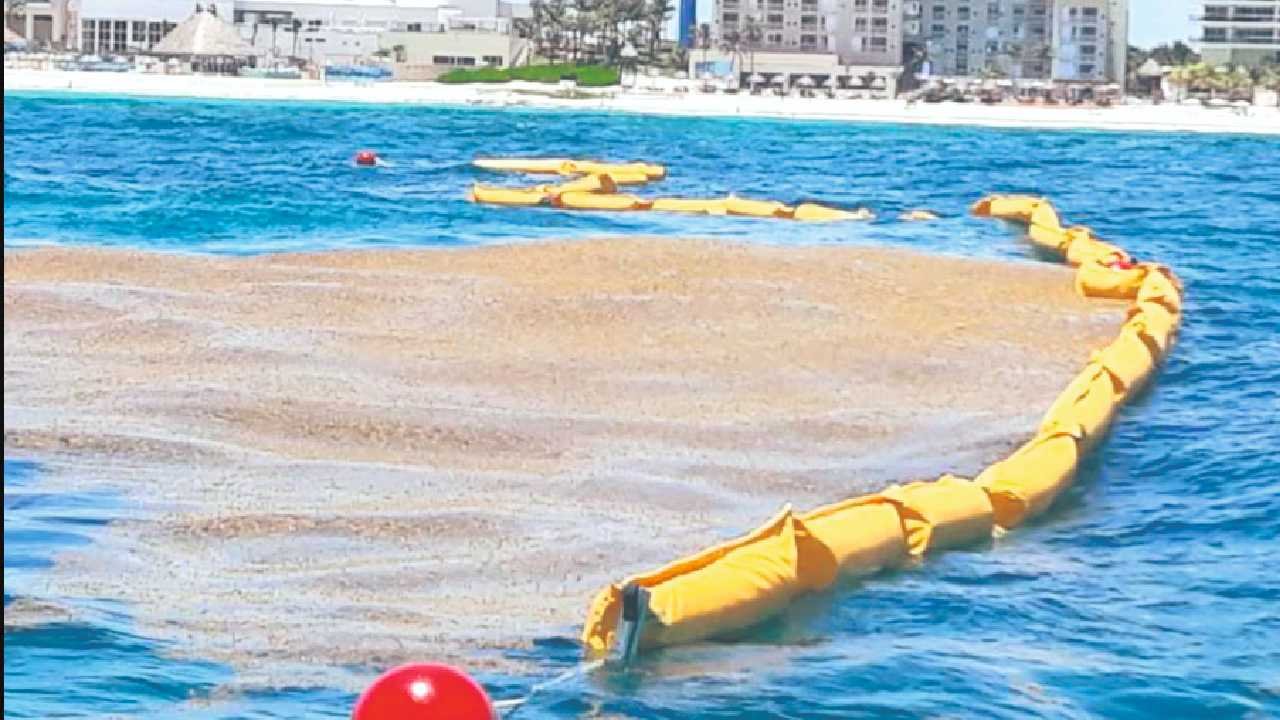
Cancún, Quintana Roo — Installing anti-sargassum barriers along the entire coastline of Quintana Roo is not feasible due to ocean conditions and the need to protect sensitive ecosystems such as reefs and seagrass beds, warned Antonio Ortiz Hernández, a biologist on the Sustainability Committee of the Cancún, Puerto Morelos, and Isla Mujeres Hotel Association.
Ortiz explained that beyond technical limitations, the barriers require constant removal of trapped sargassum, as its accumulation can degrade water quality. The main challenge for hotel operators is currently concentrated along the coastal strip between Cancún and Puerto Morelos, where increasing volumes of the algae have complicated cleanup efforts.
He warned that if massive landings continue, sargassum buildup on the shoreline could cause water discoloration and contribute to erosion, especially when heavy machinery is used for removal. Hotels have developed protocols prioritizing the use of sweepers to reduce beach impact.
After a decade of dealing with the phenomenon, the hotel sector has learned that barriers should only be installed where oceanographic conditions allow and where they pose no risk to ecosystems or navigation, Ortiz stressed. They are not a one-size-fits-all solution for the entire coast.
Fernando Haro, director of Ecology for the Benito Juárez municipality, said the city is coordinating with the state Environment Department (SEMA) as part of the state strategy to address the sargassum influx. If a proposal to install barriers in the Nichupté Lagoon moves forward, the municipality will participate in its implementation. The most recent barrier installed in Cancún is at Playa del Niño, while a project for Playa Coral remains on hold.
More Environment
- Maya Frog and Toad Shell Pendants May Reveal Ancient Trade Routes
- Heavy Rains to Soak Quintana Roo as Unstable Weather Moves In
- Brain-Eating Amoeba Found in Six Artificial Lakes in Mérida; Water Contact Restricted
- Semarnat Approves Artificial Reefs and Sand Relocation for Akumal Hotel
- Chetumal Plans 836 Million Pesos in Stormwater Works to Curb Flooding
More Quintana Roo
- Mexican Caribbean Courts Convention Business at Las Vegas Trade Show
- Ten Rural Communities in Quintana Roo Form Community Conservation Territories
- Study Finds Cancún’s Laguna Manatí Mangrove Could Qualify for Carbon Credits
- Lawmakers Seek to Make Mexican Sign Language Mandatory in Quintana Roo Schools
- Quintana Roo Signs Deal for First Formal Sargassum Fishery, Involving Up to 840 Boats