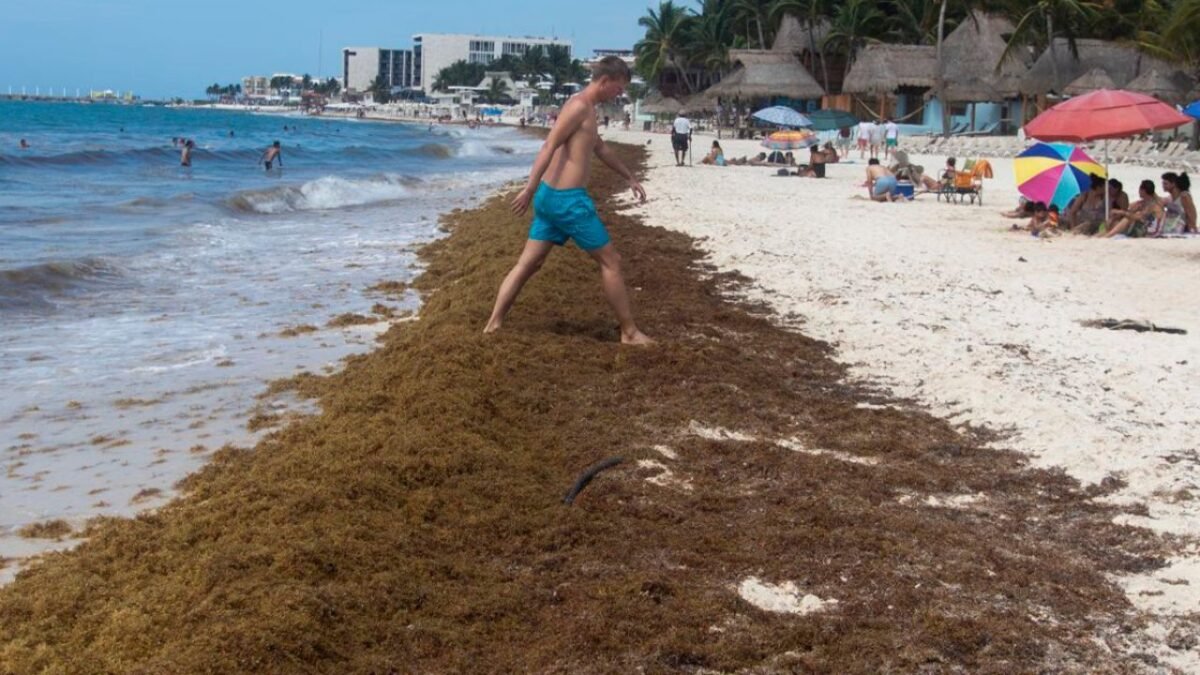
Playa del Carmen, Quintana Roo — Despite a record investment of 80 million pesos ($4.4 million) this year and the removal of some 20,000 tons of sargasso seaweed from its beaches, Playa del Carmen’s tourism-dependent economy is struggling. Local tour operators and fishing cooperatives report they are operating at only 20 to 30 percent of normal capacity.
José Gómez Burgos, president of the Mar Caribe Tourism Cooperative and the Xaman Ha Fishing Cooperative, said the massive, persistent influx of the macroalgae has crushed seasonal expectations. The dark patches along the coastline deter tourists from booking snorkeling tours or boat rides, while the seaweed tangles fishing nets and damages boat engines, he explained, devastating the incomes of dozens of families.
Million-dollar cleanup effort
On the government side, cleanup efforts have been relentless. Guillermo Brahms González, municipal treasurer of the Solidaridad city council, said authorities have injected 80 million pesos into combating sargasso in recent months.
The collection strategy involves the daily deployment of nearly 100 beach cleaners on foot and heavy machinery, operating under a coordinated plan:
- Continuous manual cleaning of main public beaches.
- Coordination of sargasso-collecting barges with the Mexican Navy (Semar).
- Satellite monitoring and placement of offshore containment barriers.
Containment at sea urged
Despite the land-based efforts, Brahms González acknowledged that cleaning the sand is insufficient given the scale of the ecological phenomenon. He argued that the strategy must evolve to prevent the visual impact that damages the international reputation of Solidaridad’s beaches.
“The phenomenon continues to be a challenge, and it will be necessary to strengthen preventive actions for the next season,” the treasurer said. “The most effective strategy is to contain the sargasso before it reaches the coast, so it is essential to reinforce joint work to address the problem at sea.”
While authorities plan to redesign floating barriers in coordination with the Navy, tourism service providers insist time is running out and urge long-term solutions to stop the tons of seaweed before they hit the shore.
More Business
More Playa del Carmen
- Playa del Carmen Health Center in Villas del Sol to Close Two Days for Maintenance
- Mara Lezama Delivers 288 Infonavit Homes in Puerto Aventuras as Quintana Roo Targets 76,000
- Playa del Carmen Bars New Developments Without Electrical Investment, Mayor Says
- Student Hospitalized After Alleged Drug Intoxication at Playa del Carmen Middle School
- Selvame MX Calls HAZUL Project With Artificial Beach a ‘Fantasy’ in Playa del Carmen