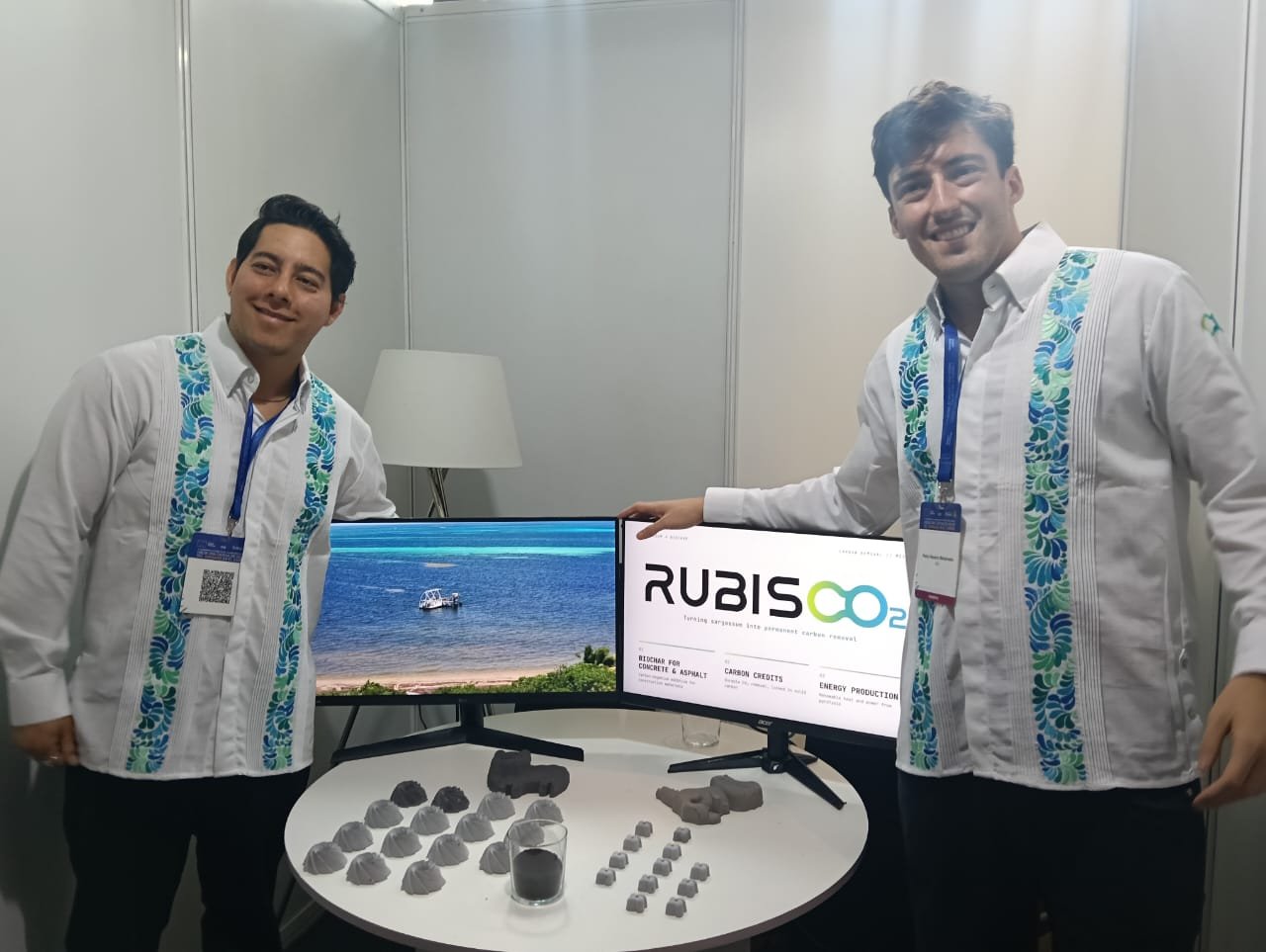
Playa del Carmen, Quintana Roo — A pilot plant in Playa del Carmen is processing two tons of sargasso a day and turning the seaweed into a substitute for traditional cement, an initiative its backers say is already up and running in Quintana Roo and is set to expand rapidly next year.
Pablo Navarro Maldonado, CEO of the company RubisCO2, confirmed that transforming sargasso into a material that replaces conventional cement — keeping carbon out of the atmosphere and offering an ecological alternative for construction — is now a reality in the state and will grow exponentially starting next year.
“If 1% of Mexico’s cement used this material, 100% of Mexico’s sargasso would be encapsulated and would no longer decompose,” he warned in an interview on the sidelines of the Fourth EU-Caribbean Global Gateway Conference, held in Cancún on Oct. 1 and 2. “Right now sargasso decomposes in landfills, polluting the atmosphere with harmful gases, contaminating our cenotes with leachate and our soils with heavy metals and salts.”
How the Process Works
Navarro Maldonado said the procedure separates hydrogen from carbon using heat. The hydrogen feeds the system itself to generate energy, while the carbon crystallizes into a black powder that replaces cement. The model therefore not only cleans beaches but also produces clean energy and prevents environmental pollution, he said.
The company currently operates a pilot plant in Playa del Carmen that processes two tons of seaweed daily. Navarro Maldonado confirmed the project is preparing its first industrial factory at Xcaret with a 40 million peso investment, which will process 50 tons of sargasso a day to produce four tons of cement substitute.
Although demand from concrete producers is more than 10 times the available supply of sargasso, he said the company is already working with businesses to open doors for the material and has held talks with firms including Cemex.
He said the resulting material is more resistant than conventional cement, allowing homes and public works to be built in a sustainable, climate-regenerative way.
“Cement needs energy to be produced; this produces energy. Cement requires mining; this is a product the sea brings to us. Beyond that, this is what is generating energy and carbon credits, which means it is cheaper to produce than cement itself — and that is why it is the solution,” he said.
Navarro Maldonado added that the initiative aims to extend its social impact to southern Quintana Roo through international funding, with the goal of installing scalable factories in vulnerable communities to create jobs and improve well-being, consolidating a model that tackles the environmental crisis and drives regional development.
More Business
- Tourists Report Visitax Fee of Up to 550 Pesos at Cancún Airport
- Judge Orders Pretrial Detention for Man Accused of Extorting Cancún Mototaxi Drivers
- Playa del Carmen to Spend 66 Million Pesos on Fifth Avenue and Road Repaving
- Business Leaders Propose Autonomous Committee to Run Quinta Avenida Trust
- Cancún Airport Flight Operations Rise 4.4% at Start of October
More Playa del Carmen
- Technical Study Advances for Quintana Roo’s Grand Subterranean Rivers Reserve
- New Cracks Around Playa del Carmen Sinkhole Raise Fears of Expansion
- Playa Food Week Joins a Busy October for Playa del Carmen Restaurants
- Playa del Carmen Weighs Scooter Limits and Zoned Mototaxi Operations
- Mayakoba Residents Cite Robberies as Playa del Carmen Announces New Park