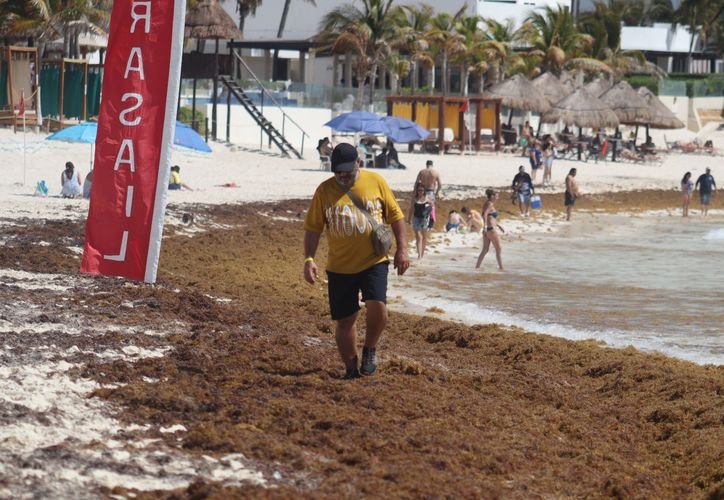
Puerto Morelos, Quintana Roo — Quintana Roo will soon become home to Mexico’s second circular economy hub, a project designed to boost research, offer tax incentives, and promote sustainable industrial development in the Mexican Caribbean, with a focus on sargassum utilization.
The Polo de Desarrollo de Economía Circular para el Bienestar (Poecibis), set to open in Puerto Morelos in the coming weeks, will operate as a special economic zone providing fiscal stimuli, administrative facilities, and strong support for industrial research and development related to sargassum.
How the Poecibis Will Operate
Germán Ruiz Méndez, director of Sustainable Urban Environmental Performance at the Secretariat of Environment and Natural Resources (Semarnat), announced that all documentation is complete and the physical space has been demarcated for launch this March.
Incentives include an immediate 100% deduction on investment in new fixed assets between 2025 and 2030, and a 100% tax credit on public property usage fees for developers. To qualify, companies must be up-to-date on tax obligations, have a local address, validate their project with Semarnat, and submit quarterly decontamination reports.
Why Quintana Roo Was Chosen
Developers can obtain concessions or contracts for up to 25 years to install projects. They will also receive an additional deduction equivalent to 25% of increased spending on worker training or innovation expenses, applicable in their annual income tax returns from the year they sign the legal instrument granting access to Poecibis until 2030.
Fifteen such hubs have been established across states including Campeche, State of Mexico, Puebla, Quintana Roo, and Veracruz, aimed at energy and waste utilization. This new model promotes public-private collaboration for sustainable infrastructure, similar to existing Polos del Bienestar elsewhere in Mexico.
Ruiz Méndez noted that Quintana Roo will be the second to launch, following one in Hidalgo.
Óscar Rébora Águilera, Quintana Roo’s secretary of ecology and environment, reported that a 14-month biogas plant pilot in Cancún concluded in 2025, demonstrating that residual sludge from hotel wastewater treatment plants can be combined with sargassum for industrial-scale biogas production. This model will be replicated at the Puerto Morelos Poecibis.
Next Steps for Sargassum Industrialization
Following the pilot phase, the Secretariat of Economic Development and the Strategic Projects Agency will determine whether industrialization will involve public investment or a mix of private and government resources.
Rébora explained that sargassum’s unpredictable arrival on coasts has hindered major investment, but proving that treatment plant sludge can be used in the same facility removes that uncertainty. Private investment offers for industrial algae utilization are now concrete and could materialize once the Poecibis opens.
The biogas plant involved a state government investment of 40 million pesos, providing assurance that significant investment in algae industrialization is viable even without total certainty about annual raw material volumes.
Return on investment is also possible through beach algae collection, which prevents pollutant emissions—an impact that can be measured, certified, and traded in international carbon credit markets, the official added.
Once testing concludes, the most appropriate utilization model for Quintana Roo must be defined, considering that sargassum collection is likely the costliest part of the process—a key economic variable still to be resolved for industrialization projects.
Discover more from Riviera Maya News & Events
Subscribe to get the latest posts sent to your email.