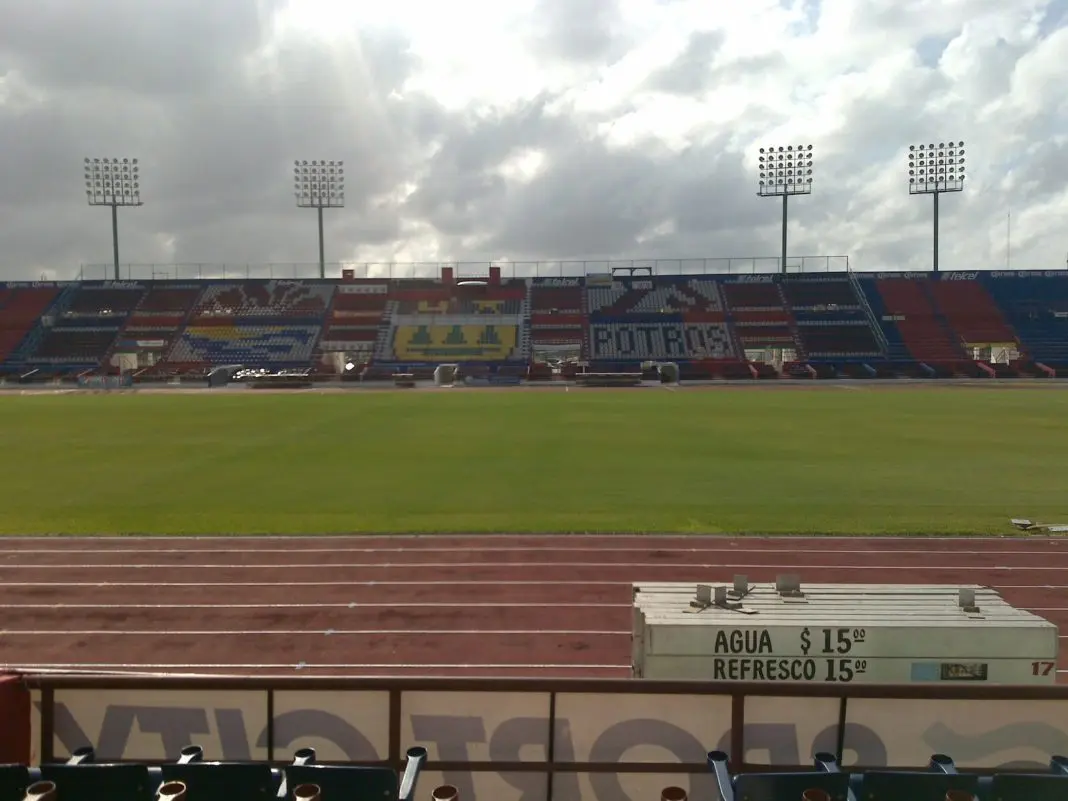
For years, they have been silent witnesses to entire generations of runners. Under the sun that hardens them and the humidity that seeps into their cracks, the athletic tracks of Quintana Roo have seen girls who once dreamed of becoming sprinters, young people who trained there without knowing if their times would be enough to qualify for the next stage, and coaches who learned to improvise because the tartan no longer responded.
They are surfaces that have endured longer than officially recognized, carrying memory, wear, and a kind of dignity that only facilities that remain standing by inertia rather than budget possess.
Contrast with the Socca World Cup 2025
While these tracks erode in silence, the cameras tell another story. The director of the Municipal Sports Institute, Alejandro Luna López, proudly presents an international event that will serve as a general rehearsal—according to him—to demonstrate the logistical, touristic, and sporting capabilities of the municipality: The Socca World Cup 2025.
In his statement made to the newspaper Luces del Siglo on October 20, Alejandro Luna López described the Socca World Cup 2025 as a showcase of Cancún’s organizational power, a polished display for the world to see the best of the municipality. It is a discourse that fits perfectly into the aesthetic of social media: that which shines, that which is shown only from the most flattering angle.
But as the tournament progresses—from November 28 to December 7—that luminous narrative coexists with another that rarely enters the frame: that of the tracks where young Cancún athletes train, spaces that do not appear in official photographs because they do not match the shine of the international event. The distance between what is showcased externally and what actually supports local sports is greater than any filter allows.
Use of Efideporte in Facilities Prior to the Socca World Cup 2025
In 2023, while it was celebrated that Quintana Roo had obtained 96 million pesos through the Fiscal Stimulus for High-Performance Sports (Efideporte), it was promised—according to official announcements led by Governor Mara Lezama Espinosa and her sports cabinet—a profound transformation of the state’s sports facilities.
Under the governor’s management, along with the then head of the Commission for Youth and Sports of the Government of the State of Quintana Roo (Cojudeq), Eric Arcila Arjona, and the then Secretary of Finance and Planning, Eugenio Segura Vázquez, the announcement sounded like the beginning of a new stage: extraordinary resources so that local sports could stop surviving and finally compete.
But that promise coexisted with an uncomfortable contrast. While the arrival of a soccer world cup is showcased and million-dollar figures destined for high performance are celebrated, the tracks where Quintana Roo athletes train continue to show cracks that no discourse can hide. The shine of major events always finds a way to illuminate itself; what that light fails to do is reach the facilities that sustain the day-to-day of sports. And there, in that gap between what is announced, is where the commitment of a state to those who train without spotlights is truly measured.
Now let’s see, how does a state that hosts a soccer world cup and receives millions in fiscal stimuli maintain the facilities where its own athletes train?
Current State of Athletic Tracks Used by Cancún Athletes
Cancún High-Performance Center (Cedar)
The Cedar was always presented as the symbol of high performance: the place where the athletes who would one day represent the state are supposed to germinate. In 2023, with official fanfare, an investment of 11.5 million pesos was announced to rehabilitate the Sports Villas.
That same year, 7,381 m² of synthetic grass were installed, new 500-watt LED lighting, and general maintenance of the tartan track. The figure was celebrated as a step towards “sports transformation,” driven by Efideporte resources.
Two years later, the track shows visible wear, one that does not match the discourse of constant renewal nor the idea of a center that should be a national reference. The money passed, but the tartan still speaks more clearly than any official bulletin.
Toro Valenzuela Athletic Track
A few blocks away, the Toro Valenzuela Sports Unit tries to sustain itself among patches of modernization. In March 2025, the municipal president, Ana Patricia Peralta de la Peña, supervised new works: stands, restrooms, locker rooms, baseball field. Everything sounded good, but although the athletic track patiently waited its turn, it never arrived.
In 2024, the “construction” of an aerobic walking track with 3 million 309 thousand 899.99 pesos from Participatory Budgeting was celebrated: nine months of work, lighting included. It is the type of investment that sounds robust on paper but, when walked on, is perceived more as a gesture than a solution. The tartan continues to wait its turn in a unit that was always more multi-sport than athletic.
These partial interventions coexist with a reality evident to anyone who trains there: the space is far from being a high-performance venue. It responds to the urgent, not the ideal.
Andrés Quintana Roo Olympic Stadium
And then there is the Andrés Quintana Roo Olympic Stadium, the venue that once opened its doors as a “stadium with a track.” Its history is almost a perfect metaphor: inaugurated in 1984, demolished and rebuilt in 2007, re-inaugurated that same August 11. At that time, its doors remained open to the public. Today it is a professional soccer venue, and the track—if it can still be called that—is a cement scar around the field.
In 2024, a private company, Palcos Kasterz, promoted a small runners’ club that met every other Sunday at 6:30 in the morning. Outside that schedule, access to the facilities was not allowed.
Those who attended describe that the space can no longer be considered a functional track, as it is made of cement. Currently, those “meetings” are no longer held or are very infrequent. That is, the track exists only on paper. Officially it appears; in practice, it disappeared. A ghost ring that is not useful for training but decorates well in an aerial photograph of the stadium.
That raises a curious question: does a formal and “official” infrastructure really serve local athletics, or does it only remain as a facade for soccer?
Panorama of Quintana Roo Track Infrastructure
Before looking at what happens outside Cancún, it is worth understanding how the rehabilitation of Quintana Roo’s tracks really works, which are not rehabilitated at the same pace because they do not depend on the same budget.
Legally, sports units are the responsibility of municipalities—as established by Article 115 of the Mexican Constitution, which states that city councils are responsible for the “equipment” of their public spaces—while the State can only intervene through agreements or extraordinary programs like Efideporte.
That institutional architecture fragments resources, because each municipality invests according to its own budget, priorities, and operational capacity. That is why some tracks receive domes, others tartan, others only paint… and many remain halfway not due to disinterest, but due to a model that distributes responsibilities without guaranteeing continuity.
With that institutional map in mind, what happens outside Cancún ceases to be an exception and becomes part of the same pattern. According to the State Development Plan (PED) 2023-2027, by 2021 Quintana Roo had 14 athletic tracks registered at the state level, although without detailing their technical condition. Below is a tour of some of them.
Chetumal
Bicentenario Unit
In Chetumal, the track at the Bicentenario Unit has accumulated two years of rehabilitation, financed through the federal Efideporte program. The project records 70% progress—verified by Governor Mara Lezama Espinosa and the president of the Quintana Roo Sports Commission (Codeq), Jacobo Arzate Hop—but although the works began in 2023 and continue in 2025, there is still no usable space for athletes’ training.
The following images were taken on November 20, 2025.
Cozumel
Independencia Sports Unit
The Independencia Sports Unit had dragged over a decade of lag until in 2024 the municipality allocated 11.5 million pesos to repair roofs, stands, courts, and electrical systems. In the process, the track was closed for safety.
The space that hosted the municipal athletics qualifier for the 2024 National Games of the National Commission of Physical Culture and Sports (Conade) was left, literally, without a track for those seeking to qualify again.
Playa del Carmen
Mario Villanueva Sports Track
In Playa del Carmen, the Mario Villanueva Track is one of the few examples of Quintana Roo tracks where the tartan has a date and a surname: renovated in December 2019, with coating certified by the then International Association of Athletics Federations (IAAF), it is perhaps the only facility that—at least on paper—meets the essential criteria that the “Track and Field Facilities Manual” of World Athletics (2019 edition) establishes for a regulation track: an even surface, with stable cushioning and secure grip.
It is ironic that one of the most functional venues in the state was last intervened six years ago.
The unit has auxiliary facilities such as tennis courts, basketball courts, and general training spaces. The track has been the venue for local and regional sporting events, such as the Inframundo Race 2025.
Felipe Carrillo Puerto
Chan Santa Cruz Sports Unit
Further south, in the municipality of Felipe Carrillo Puerto, the Chan Santa Cruz Sports Unit has gone through several stages of investment that have not always translated into sustained progress. In 2018, the kickoff was given for the installation of a tartan track, with a reported budget of 5 million 509 thousand 112 pesos.
By 2023, the then Cojudeq announced a comprehensive rehabilitation—restrooms, locker rooms, lighting, and common areas—along with the promise of converting the space into a sports seedbed through the so-called ‘Transformation Academy’. The track has functioned as an official venue, for example, in the state athletics qualifier for the 2024 Conade National Games.
Bacalar
Serapio Flota Mass Sports Unit
In Bacalar, the Serapio Flota Mass Sports Unit was conceived as the great formal infrastructure of the municipality. Inaugurated during the administration of Governor Roberto Borge Angulo (2011-2016), it integrated a soccer field, multi-use areas, and a tartan track that was part of an investment of 14 million 750 thousand pesos.
Over time, interventions have been punctual: in 2023, a double dome, LED lighting, and renovated recreation areas were added, according to local reports from that year. But in 2025, rather than consolidating as a high-performance nucleus, the unit continues to function as a social reference space: there, deliveries of functional support—93 wheelchairs and other implements—were carried out, a community use that confirms its public importance, although not necessarily its specialized function for athletic development.
After touring the tracks of Quintana Roo, each announcement of work, promises of rehabilitation, and space where athletes train, a difficult feeling to explain remains. Perhaps that is why it is worth stopping for a moment.
While the world turns to Cancún to admire stadiums and an impeccable deployment to receive international teams, the tracks of Quintana Roo, where home athletes are formed, continue to tell another story. The tartan cracks, maintenance is postponed, works drag on, and technical information disappears in press releases that are too general.
There, when one begins to notice the small details—those we have normalized for being this way for so long—the true question of this Socca World Cup 2025 arises: what reveals more about a state: the event it shows to the world or the fields where no one looks?
Discover more from Riviera Maya News & Events
Subscribe to get the latest posts sent to your email.