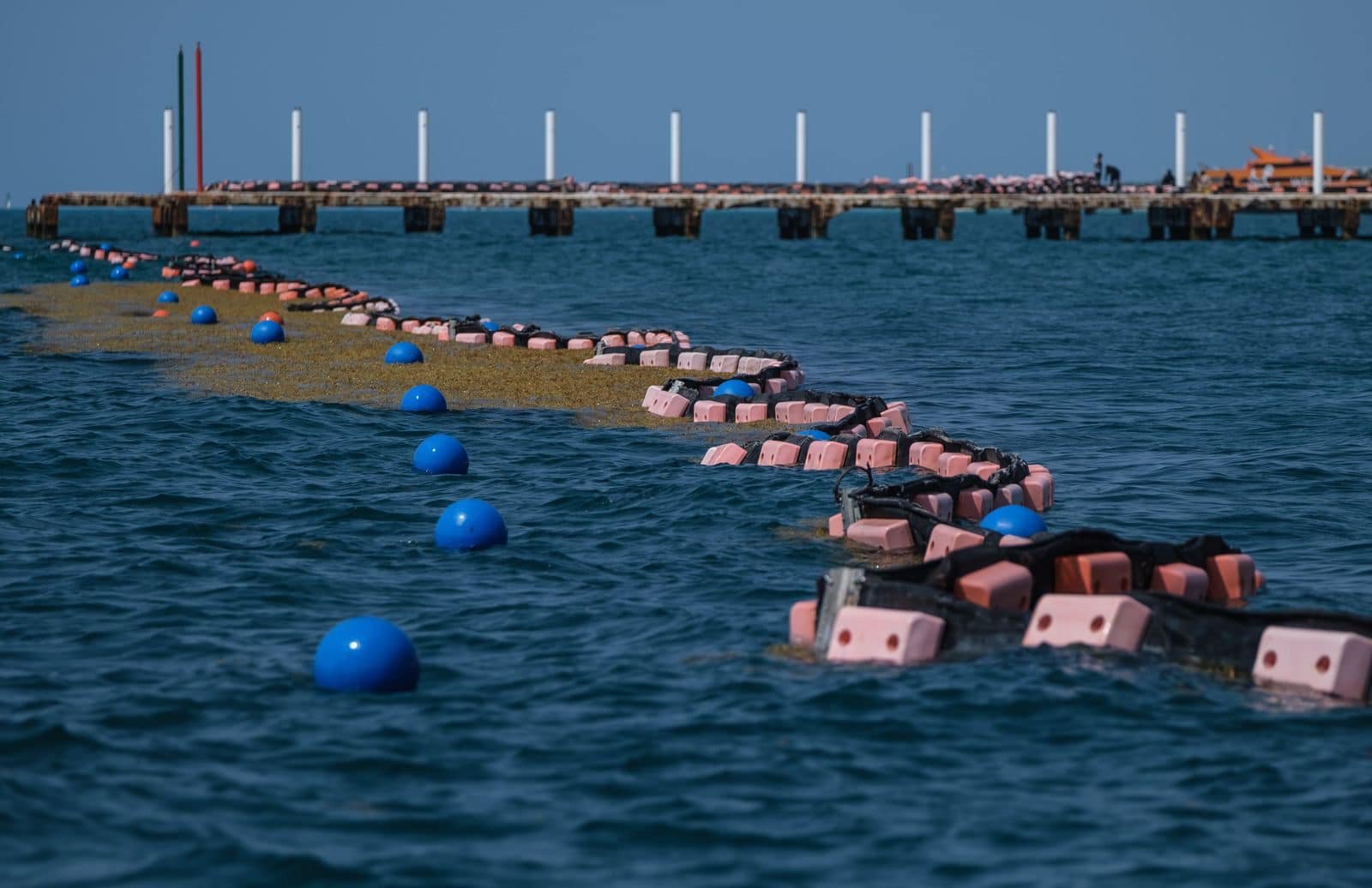
Quintana Roo, Mexico — The Government of Quintana Roo is evaluating the installation of two large-scale transoceanic sargassum barriers as part of a broader strategy to divert the macroalgae before it reaches the state’s beaches and to reduce its long-term environmental, health, and economic impacts.
The proposal was confirmed by Óscar Rébora Aguilera, head of the Secretariat of Ecology and Environment (SEMA). The potential barrier sites are Cozumel and Banco Chinchorro, one of the most ecologically significant reef systems in the Mexican Caribbean.
Technical challenges in deep water
According to SEMA, the feasibility of these offshore barriers depends on specialized studies of winds, marine currents, tides, and seabed depth. In some areas under consideration, depths exceed 900 meters, making conventional anchoring systems—such as those used along the Puerto Morelos coast—technically unviable. Engineers are therefore assessing alternative designs capable of withstanding strong currents while remaining stable enough to channel sargassum for collection in open water.
“The entire strategy revolves around how to contain the sargassum and make it easier to harvest before it reaches the coast,” Rébora Aguilera said.
Early arrivals and long-term trends
Governor Mara Lezama has instructed state agencies to keep sargassum response at the top of the environmental agenda, particularly given earlier-than-usual arrivals already observed this year.
While 2025 required record response efforts, it was not the worst year in terms of total volume. Authorities estimate 95,000 tons were handled, compared with 600,000 tons in 2018, the year that first brought global attention to the scale of the problem in the Mexican Caribbean.
Rébora Aguilera stressed that the massive Atlantic sargassum belt, currently estimated at 50–60 million tons, does not automatically translate into equal coastal landings. Sea surface temperature, prevailing currents, wind patterns, and seasonal climate variability all play decisive roles in determining where—and how much—sargassum ultimately reaches shore.
Environmental, health, and tourism impacts
When sargassum accumulates on beaches, it affects marine ecosystems, blocking sunlight from seagrasses and coral reefs and altering nearshore oxygen levels as it decomposes. On land, rotting sargassum releases hydrogen sulfide and ammonia, gases linked to respiratory irritation, headaches, and eye discomfort, raising public health concerns for residents and visitors alike.
From a tourism standpoint, the phenomenon has had measurable economic consequences for destinations such as Cancún, Playa del Carmen, Tulum, and Cozumel, where beach quality is a central pillar of the local economy. Hoteliers and tour operators have repeatedly warned that unmanaged sargassum can influence travel decisions and length of stay, particularly during peak seasons.
Collection, monitoring, and a circular economy approach
In parallel with offshore solutions, the state is intensifying monitoring and nearshore collection, working alongside federal authorities and coastal municipalities. SEMA also confirmed that the Integral Center for Circular Economy is entering its final planning phase, with construction scheduled to begin this year.
The facility is designed to transform sargassum from an environmental liability into a usable resource, with proposed applications including energy generation and industrial byproducts, once the biomass is properly treated to remove salts, heavy metals, and other harmful components.
Reinforced coastal defenses
As an immediate measure, Quintana Roo has expanded its existing network of nearshore barriers. An additional 7,500 meters of anti-sargassum barriers have been acquired this year, adding to the 9,500 meters already installed along vulnerable stretches of coastline.
The goal is twofold: intercept sargassum before it reaches the beaches and streamline its collection so it can be safely removed and repurposed. Together with the proposed offshore barriers, authorities hope these measures will form a layered defense—protecting ecosystems, public health, and the tourism-dependent economy that sustains much of the state.
As technical studies move forward, the viability of the Cozumel and Banco Chinchorro barriers could mark a turning point in how the Mexican Caribbean confronts one of its most persistent environmental challenges.
Discover more from Riviera Maya News & Events
Subscribe to get the latest posts sent to your email.