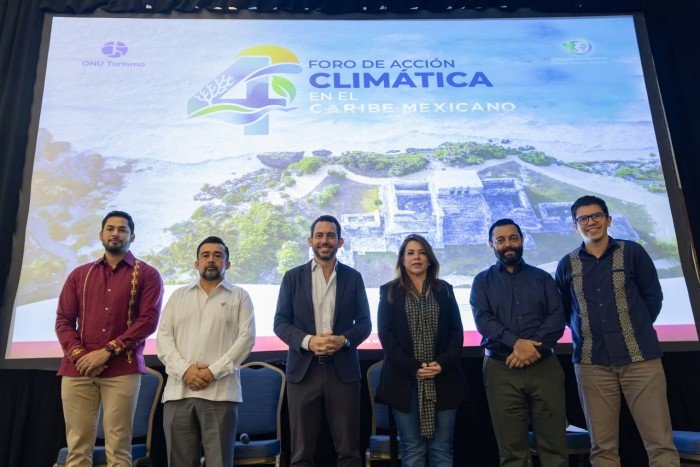
Cancún, Quintana Roo — The Quintana Roo state government held the fourth edition of the Climate Action Forum in the Mexican Caribbean on Wednesday at the Iberostar Selection Cancún hotel, bringing together tourism, government, academic and civil society representatives to discuss climate resilience.
The event, held under the theme “Governance in Action: Strengthening Climate Resilience in the Tourism System,” was organized by the state Tourism Department (SEDETUR) with the Environment and Ecology Department (SEMA), Grupo Iberostar, the German Agency for International Cooperation (GIZ) and SUSTENTUR.
Organizers framed the forum around the state’s New Agreement for Wellbeing and Development, its state tourism and climate change laws, and the commitments Quintana Roo took on by signing the Glasgow Declaration on Climate Action in Tourism.
Sargassum Strategy Backed by 777.9 Million Pesos
The National Tourism Promotion Fund (FONATUR) presented its Strategy for Addressing and Managing Sargassum in the Mexican Caribbean, which focuses on coordination between agencies and on finding industrial uses for the seaweed to protect tourist destinations. The strategy is backed by an investment of 777.9 million pesos and a federal decree creating the Circular Economy Development Pole (PODECIBI).
A panel discussion featuring SEDETUR, SEMA, Iberostar Hotels & Resorts and GIZ, moderated by SUSTENTUR, highlighted conservation gains that officials said place Quintana Roo first nationally in federal protected natural areas. They also cited progress on ecological land-use planning across 1,880,236 hectares in Benito Juárez, Othón P. Blanco, Tulum, Puerto Morelos and Isla Mujeres.
Officials pointed to existing financial and restoration tools, including a state parametric insurance policy covering 1,176 kilometers of coastline in 10 coastal municipalities against Category 3, 4 and 5 hurricanes. In 2026 the policy will expand to include rapid-response coverage for Cozumel Reefs and Puerto Morelos Reef national parks, triggerable from Category 1 storms for up to 4 million pesos. Authorities have also authorized restoration work along 33.59 kilometers of beaches in Benito Juárez, Playa del Carmen, Cozumel and Puerto Morelos.
Technical Workshops for the Tourism Sector
The forum included three technical workshops for tourism companies, hoteliers and service providers: “How to Measure and Reduce Our Carbon Footprint,” “Communication Strategies for Coastal Dune Conservation” and “Cancún Circular Tourism: Circular Economy Applied to Tourism.”
Officials credited private-sector participation with helping meet environmental targets, noting that the state now has 303 validated waste management plans and that regulatory actions prevented the improper disposal of 47,126,240 liters of wastewater.
The event closed with a session titled “Shared Resilience: Echoes and Lessons from the Forum,” followed by an official closing ceremony.
More Environment
- Tulum Cave Photo Makes Time’s Top 100 Photos of 2026
- Aerial Patrols Reveal 12 Vegetation Fires and Illegal Sawmill in Southwest Playa del Carmen
- Playa del Carmen Hit by Flash Flooding as 52mm of Rain Falls in 90 Minutes
- Quintana Roo Approves Three International Conservation Projects
- Residents Report Wastewater Trucks Dumping Sewage Near Cancún Housing Complex
More Cancun
- Quintana Roo Launches ‘Libres y Seguras’ Strategy to Prevent Violence
- Man Found in Car Trunk Sparks Major Police Response in Cancún
- Cancún Halts Hotel Zone Roadworks for Peak Winter Season
- Cancún Airport Tightens Security Ahead of Peak Season Amid Taxi Disputes
- Quintana Roo Printers Ask INE to Assign Election Printing to Local Workshops