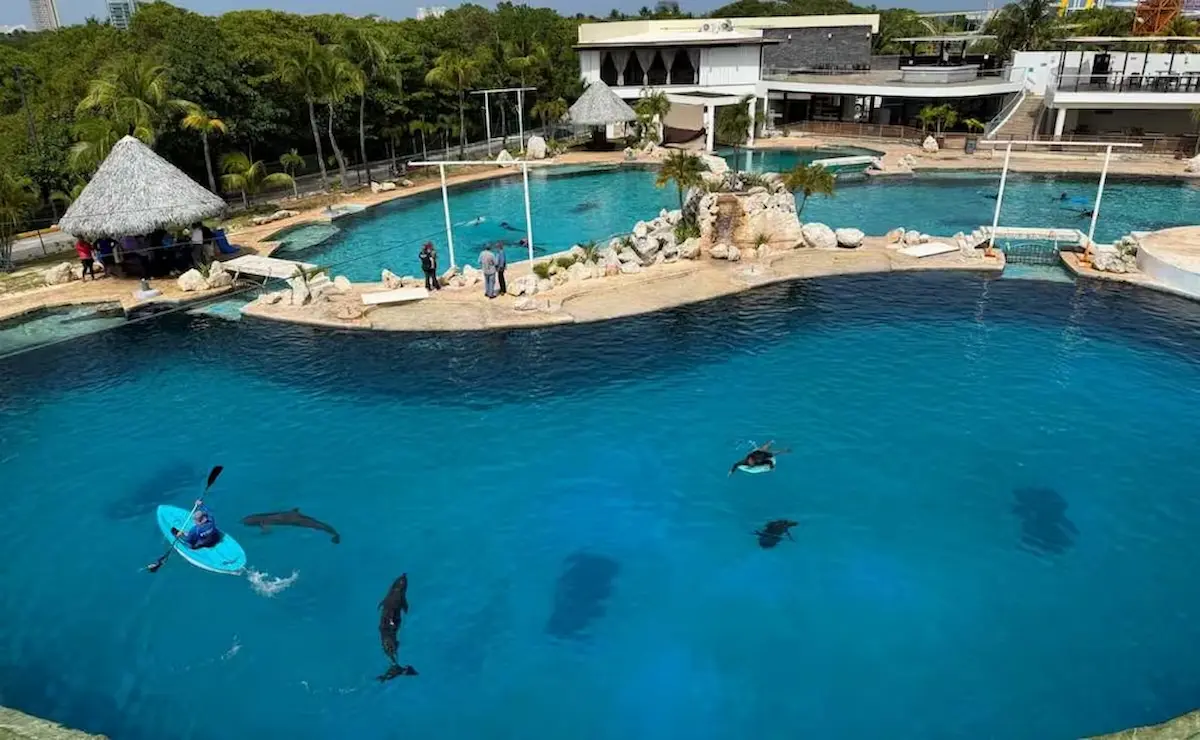
Cancún, Quintana Roo — Mexico’s environmental enforcement agency, Profepa, has ruled out moving nine dolphins from a shuttered dolphinarium in Cancún, saying the animals’ advanced age and health problems make relocation too risky at this time.
After two inspections on Aug. 11 and Aug. 12, the Federal Attorney for Environmental Protection (Profepa) said its priority is to ensure the dolphins’ well-being, improve conditions at the facility, which has been closed since October 2025, and determine case by case whether a transfer could be possible later.
The decision follows the release of images by the organization Veeleaf documenting the dolphins’ condition. Veeleaf has questioned the water quality, the use of chlorine and the impact those factors may have had on the animals.
Health conditions
The nine dolphins — Apolo, Flex, Diego, Mincho, Oceanía, Solei, Solomon, Saty and Squalo — are Indo-Pacific bottlenose dolphins (Tursiops aduncus) housed at Dolphin Connection Cancún, previously known as Dolphinaris. Profepa said their prognoses are “guarded” and that they suffer from serious diseases linked to their age.
According to the agency’s latest inspection report, Apolo and Flex have inflammation of the right cornea. Diego has corneal inflammation in both eyes, partial loss of his tail fin and severe chronic dental abrasion. Mincho has a carcinoma affecting about 70 percent of his tongue. Oceanía has chronic corneal inflammation and tongue ulcers. Saty has chronic corneal inflammation, a tongue ulcer and severe dental abrasion. Squalo has chronic corneal inflammation, dental wear and multifocal erosions. Solei has opacity in both eyes and ulceration and abrasion on her tongue. Solomon has corneal inflammation, tongue ulceration, lesions near his left eye and dental wear.
Profepa classified Mincho, Solei and Oceanía as being in “very critical” condition. The agency said there are currently no authorized or proven protocols for treating cancer in captive marine mammals, adding that Mincho is under permanent veterinary follow-up.
Transfer ruled out for now
“The dolphins take part daily in environmental enrichment sessions, handling and training routines with responsible personnel, aimed at providing physical stimulation and cognitive development so they can adapt to new conditions,” Profepa said. “Feeding is supervised for each animal. Stabilization is a gradual, complex process that depends on each animal’s condition, the nature of its illnesses and its response to veterinary and management measures.”
Profepa also noted that the species is not native to Mexican waters, so any eventual transfer would need to be analyzed carefully. An external medical opinion received May 14 concluded that “it is not advisable to carry out a transfer at this time” given the medical conditions described, the agency said.
Background and enforcement
The dolphinarium was inspected repeatedly between 2024 and 2025 and was finally closed in October 2025. Profepa reported that 16 dolphins had died at the facility between June 2018 and August 2025. Inspectors also detected eye damage and pathogens with zoonotic potential, including Escherichia coli and Salmonella, in both dead and living animals.
In July 2025, Profepa requested additional documentation and medical studies, and carried out water sampling and health tests on the nine remaining dolphins. The results showed that three were in very delicate condition and six had conditions requiring attention. Under the precautionary principle, Profepa closed the dolphinarium and seized the animals. Since the closure, none of the nine dolphins has died.
Ongoing measures
Profepa’s enforcement measures focus on medical care, biosecurity and water quality. Medical requirements include full physical exams, sample collection and clinical tests — initially daily and now monthly — as well as weekly medical summaries for each dolphin and isolation when bacteria or fungi are detected.
Biosecurity protocols include hygiene rules for staff in contact with the dolphins, separation of workers caring for sick animals from the rest of the team, and cleaning before and after handling the animals. Water quality measures call for daily dissolved oxygen readings, aeration when levels are low, checks of the life-support system, weekly coliform sampling and daily monitoring of temperature, pH and salinity. The facility is also required to maintain shade structures and clean the tanks daily.
Profepa chief Mariana Boy Tamborrell said the agency hopes that dolphins capable of making the move could eventually be transferred to a semi-open sea pen, but stressed that any relocation must not put their lives at risk. The decision would be made case by case with input from specialists.
More Environment
- Yucatán Peninsula Lost 285,580 Hectares of Jungle in 4 Years
- Quintana Roo Crews Clear 70,000 Liters of Water in Bacalar and Chetumal After Heavy Rains
- Yucatan Drafts Rules for Artificial Lakes After Worker Dies of Amoeba Infection
- Quintana Roo Wins SEMARNAT Approval to Restore 33.5 Km of Beaches
- Yucatán Monitors Low-Pressure System in Gulf of Mexico for Possible Cyclone
More Cancun
- Tropical Wave 36 Floods Northern Quintana Roo, Hits Tourism
- Cancún Residents Call Protest Against Aguakan Over Unsafe Roadworks on Avenida Colegios
- Cancún Real Estate Fraud Suspect to Face Trial at Liberty After Judge Rejects Pretrial Detention
- Park Hyatt to Open in Riviera Maya on December 3 With 148 Rooms
- Woman Killed by Gunshot to the Head in Cancún