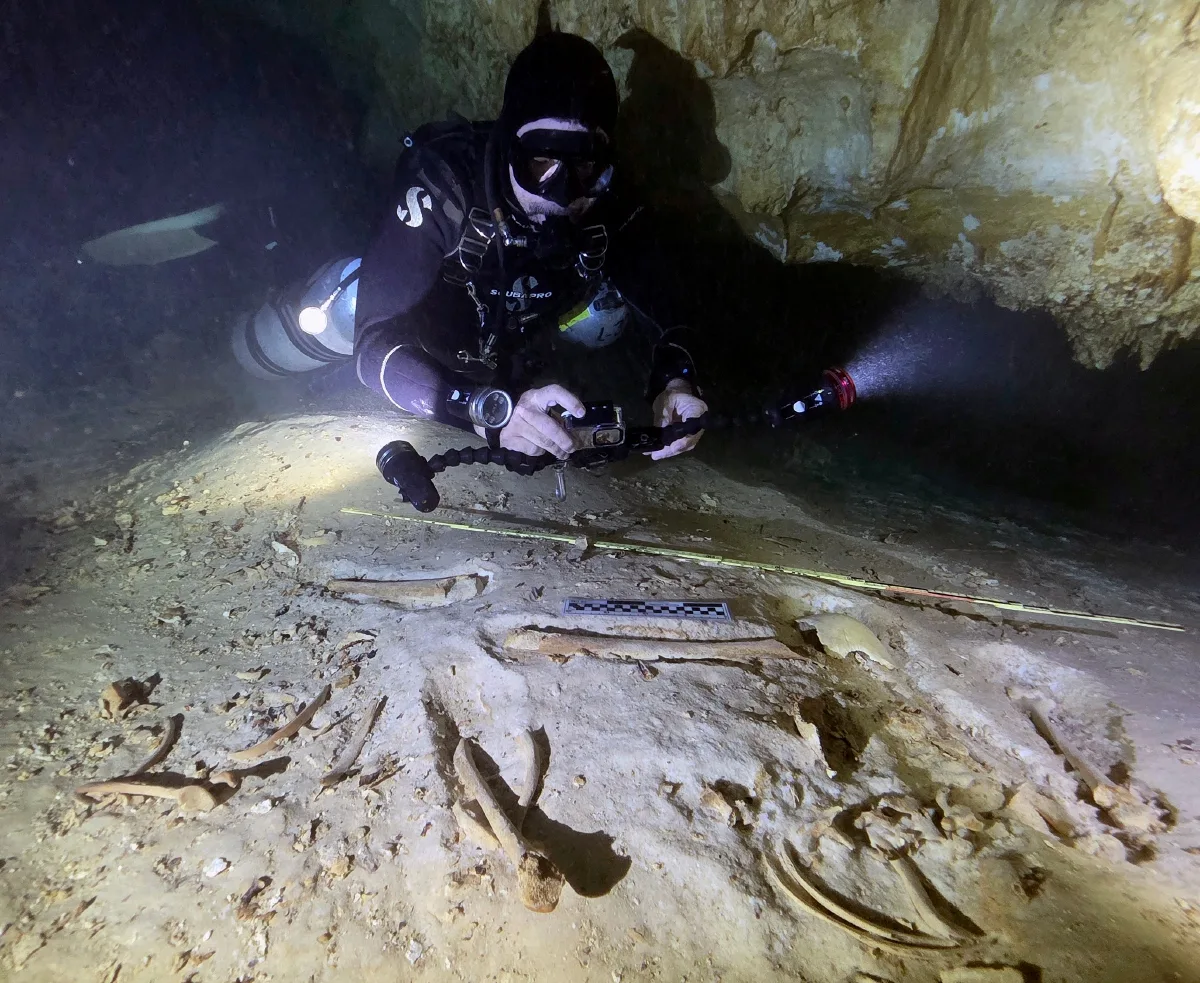
Tulum, Quintana Roo — Archaeologists have recovered a prehistoric human skeleton from an underwater cave system along Mexico’s Caribbean coast, adding to a growing collection of ancient remains that are reshaping understanding of early human settlement in the Americas.
Underwater archaeologist Octavio del Río, who works with Mexico’s National Institute of Anthropology and History (INAH), announced the discovery in a cave that flooded approximately 8,000 years ago at the end of the last ice age.
The skeleton represents the eleventh set of human remains found over the past three decades in the tourist corridor between Tulum and Playa del Carmen, an area now recognized as one of the continent’s most significant repositories of ancient human evidence. Some previously discovered remains in the region date back more than 13,000 years.
Del Río said divers located the skeleton eight meters deep inside a cave, approximately 200 meters from the entrance through flooded passages. Archaeologists recovered the remains in late 2025 using specialized divers and precision equipment.
“Given the location and depth, this body could only have been placed here when the cave was dry—at least 8,000 years ago,” Del Río explained. Professional diving is now required to access the site.
The skeleton was found in a narrow space beside an interior chamber, resting on a sediment dune. “This suggests a deliberate burial deposit, possibly associated with ritual practices,” Del Río said, noting that analysis has just begun.
The archaeologist described the emotional impact of such discoveries. “Finding fossil number eleven makes every researcher’s heart race,” he said, recalling his first discovery in 2002. “You can scream underwater too. Bubbles went everywhere.”
For specialists, each find helps reconstruct scenes from the distant past. “You project yourself to that moment, you start visualizing the cave… you start thinking about how that person got there, how they walked,” Del Río said about the interpretive process that accompanies cave discoveries.
Luis Alberto Martos, director of archaeological studies at INAH, said the fossil will contribute to understanding how early populations arrived on the Yucatan Peninsula when it was a plain with cliffs. It will help reveal “how they interacted with the environment or used caves for different functions.”
“We’re gradually assembling a broader puzzle of Yucatan’s prehistory,” Martos added.
The discovery occurs amid environmental concerns about the region’s underground river systems, which were affected by Maya Train construction projects. Federal authorities are now working to protect the area.
The Environment Department confirmed plans to declare the zone a protected natural area in 2026, while INAH pushes for cultural heritage recognition, considering the cenotes not just “archaeological windows” but “historical windows” preserving evidence from different eras.
Regional Context
Beyond human remains, researchers have found fossils of extinct megafauna in the cenotes, including giant sloths, pumas, saber-toothed tigers, and bears—evidence helping reconstruct the region’s prehistoric ecosystem.
Discover more from Riviera Maya News & Events
Subscribe to get the latest posts sent to your email.