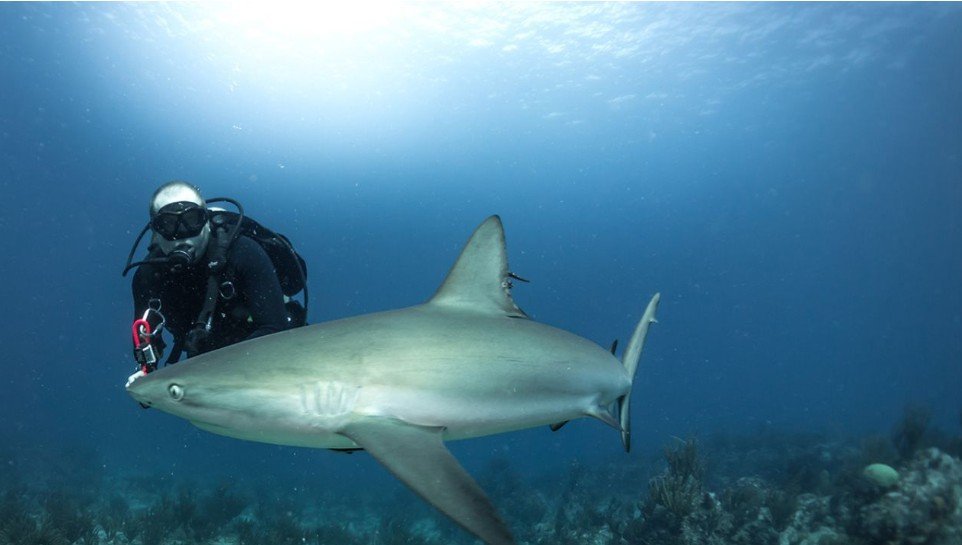
Playa del Carmen, Quintana Roo — Playa del Carmen has been designated an Important Shark and Ray Area (ISRA) in recognition of its role as a breeding ground for bull sharks, the nonprofit Saving Our Sharks announced.
The species, whose scientific name is Carcharhinus leucas, uses the region’s mangrove areas to give birth to its pups, said Pamela Vázquez, director of sustainability at Saving Our Sharks.
Vázquez said the designation stems from scientific research conducted in the area, including ultrasound studies by Dr. Mauricio Hoyos in collaboration with Pelagios Kakunjá and Saving Our Sharks, which documented the presence of pregnant female bull sharks.
“Playa del Carmen is specifically for reproduction, because pregnant females arrive there to give birth in the mangroves,” she said.
Sightings on the Rise
November marks the start of bull shark season in Playa del Carmen, when females arrive in the region to breed.
While divers previously saw between six and 10 sharks on a single dive, as many as 20 have been recorded in one dive since 2025.
Vázquez attributed part of the increase in sightings to conservation efforts led by the fishing community of Isla Mujeres, where families with up to three generations of shark fishermen have kept their fishing gear stored for four years.
Isla Mujeres once accounted for between 70 and 80 percent of Quintana Roo’s shark catch, she said, so the decision by local fishermen to suspend the practice has helped bring more sharks to different parts of the state.
Beyond Playa del Carmen, sightings have been reported in Cozumel, Punta Cancún and other areas of Quintana Roo.
Cozumel also holds an ISRA designation. In the Chacmuchuch lagoon, researchers have documented the presence of shark pups, while pregnant females have been recorded entering the Nichupté lagoon.
A Key Territory for Multiple Species
Vázquez said Quintana Roo is a significant territory for several shark populations rather than just one species.
Species identified in the state include the tiger shark, great hammerhead, smooth hammerhead, nurse shark, whale shark and bull shark.
A tiger shark tagged by Saving Our Sharks and nicknamed “Toño” was recently identified, and tracking him is expected to yield information about his movements.
The organization has tagged more than 60 sharks in Quintana Roo, but Vázquez said no estimate exists yet of how many currently inhabit the state’s waters, since determining that would require a multi-year population study.
Amid the rise in sightings, she urged residents and visitors to follow protocols for encounters with the animals and to avoid deliberately seeking them out.
More Tourism
- Mexicana de Aviación Adds 24 Winter Flights to Tulum as Rivals Pull Out
- Punta Allen Road Rehabilitation Reaches 80 Percent Completion
- Cancún Business Council Launches Push to Diversify Quintana Roo’s Economy Beyond Tourism
- Playa del Carmen to Build Tactical Operations Center to Boost Fifth Avenue Security
- Cancún Restaurants in the Red as Power Outages Add to Mounting Losses
More Playa del Carmen
- Five Zones in Playa del Carmen Lose Urban Jungle to Construction Boom
- Hurricane Isaías to Bring Rain and Heat to Cancún and Playa del Carmen This Weekend
- Environmentalists Submit Citizen Initiative to Protect Playa del Carmen’s Chen Zubul Site From Submarine Power Line
- Sheinbaum Acknowledges Little Progress in Talks With Vulcan Over Calica
- Fitch Downgrades, Then Upgrades Playa del Carmen Credit Rating Over Missed Payment