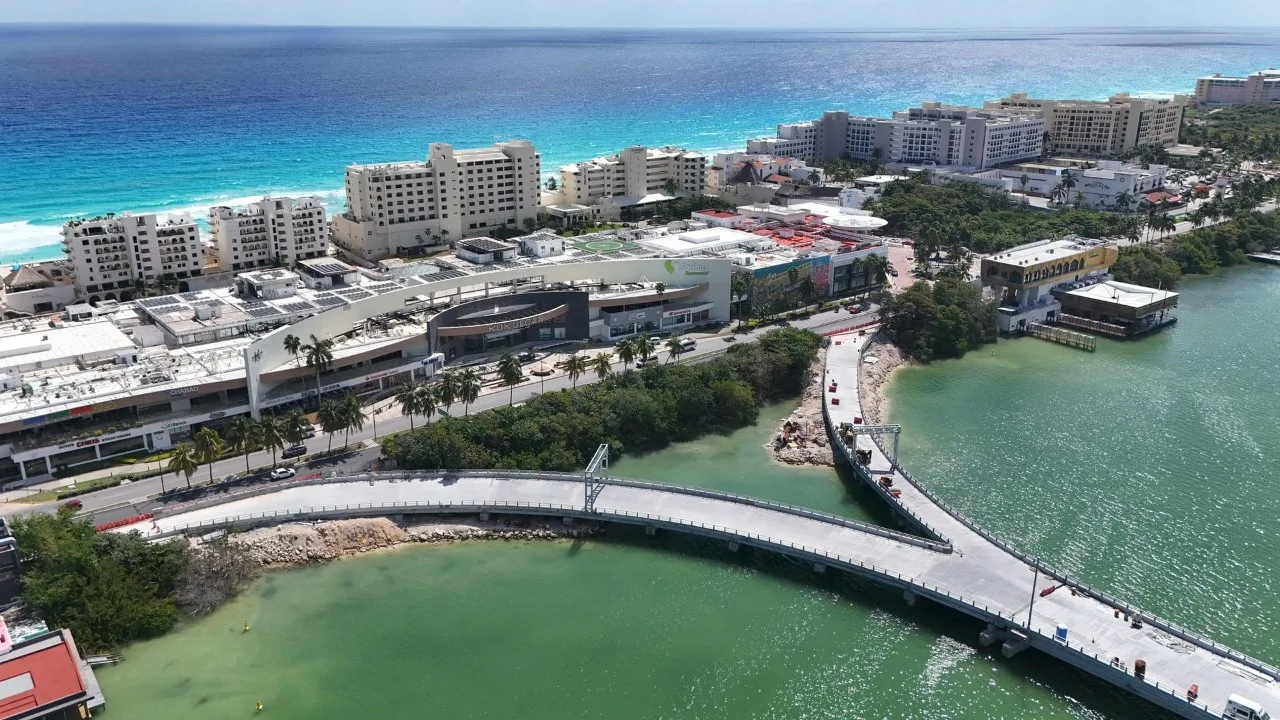
CANCUN — The final "Achilles' heel" delaying the inauguration of Cancun's Nichupté Vehicular Bridge is the intersection with Boulevard Kukulcán, the critical connection point to the city's saturated hotel zone. According to the public works analysis channel Proyectos Milenarios, this section has become a logistical and engineering nightmare.
In its latest video analysis of the mega-project, which is now in its final stretch, the channel reports that this specific junction is the section with the least progress, lagging far behind the overall project completion rate of 96 percent.
"Completing a three-lane elevated highway along the nation’s busiest, narrowest, and most crucial boulevard is proving to be a logistical and engineering nightmare," the analysis states. The complexity stems from the need to relocate vital underground infrastructure—including fiber optics, drinking water networks, and high-voltage power lines supplying the mega-resorts—without completely disrupting daily tourist and worker traffic. "This high-precision maneuver, akin to urban surgery, is what's taking up the expected time," the video explains.
This junction represents the last major construction challenge for the project, which has faced prior delays. Earlier issues included dealing with extremely unstable terrain and karst caverns at the bottom of the Nichupté Lagoon that were not detected in pre-construction studies.
One affected area was "La Joroba," the bridge's highest section, which rises 15 meters above the water to allow for lagoon navigation. Support points in this area required reinforcement after experiencing subsidence in piles, cracks in heads, and movements in supports due to the weak karst soil.
Another earlier delay occurred during the construction of an anti-tank metal bridge near a mangrove area, where flawed soil mechanics studies failed to detect a large cavern in the bridge's planned route.
The video reports that a month ago, in the first half of February 2026, the bridge structure was finally completed from end to end after engineers placed the last structural slab, creating an uninterrupted main road. The project has now entered the critical phase of asphalt laying and, crucially, structural load testing.
For load tests on a bridge of this scale, engineers must park entire fleets of dump trucks, each loaded to maximum capacity with tens of tons of gravel and heavy material, simultaneously along the bridge spans. Ultra-precise laser sensors then measure the deflection, or how much the structure deforms under the maximum simulated weight. These mandatory tests ensure the viaduct can withstand not only heavy traffic but also hurricane-force winds.
Due to the rigor of these static and dynamic tests and the evident delay at the hotel zone distributor, the new official opening window has been pushed back to spring 2026. "State authorities and the Ministry of Infrastructure, Communications and Transportation now project that the ribbon-cutting ceremony will take place between the last week of March and the first week of April," the analysis notes, adding that the latest information mentions the entire month of April without a specific date.
Progress varies significantly across different sections of the project. The land area and the immense crossing towards Colosio Avenue were practically finished at 99 percent completion even before the full structure was joined. The section built with the top-down system in the mangrove area also reached 99 percent completion. The cable-stayed metal arch bridge, constructed to cross the undetected cavern, is 98 percent complete.
In stark contrast, the intersection with Boulevard Kukulcán was only at 84 percent progress and, to date, remains below 90 percent complete.
The bridge's opening date has been postponed multiple times, from an original promise in 2024, to 2025, and finally to the beginning of this year. In this final stage, crews are carrying out paving work on the road surface and installing curbs, parapets, storm drainage, lighting, and signage. The implementation of Intelligent Transportation Systems (ITS) to optimize vehicular traffic is also underway.
Discover more from Riviera Maya News & Events
Subscribe to get the latest posts sent to your email.