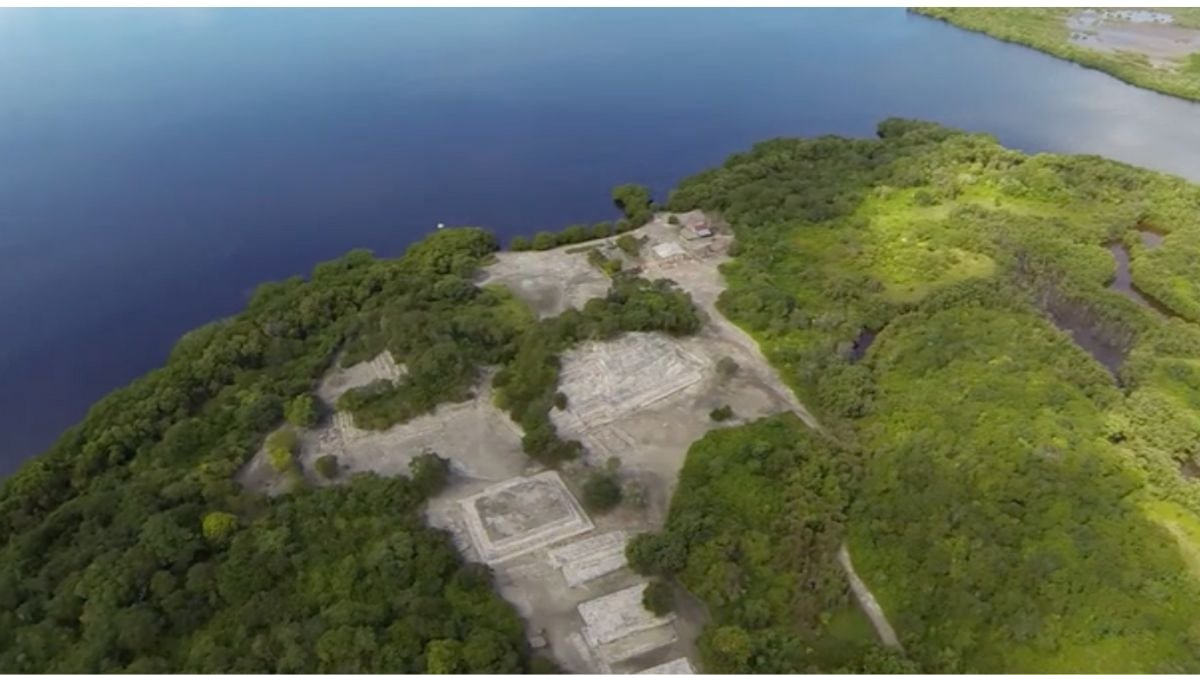
Jaina Island, Yucatán — Jaina Island, located on the western coast of the Yucatán Peninsula, remains inaccessible to the public and is a vast territory hiding multiple secrets of the Maya world that flourished between 600 and 1100 AD.
However, some of the archaeological pieces recovered in recent years have been on display since this year at the Maya Archaeology Museum of the Camino Real in Hecelchakán, 40 km from Jaina, reopened after its museographic update.
“It is known that Jaina must have been a relevant settlement, as it controlled an important area on the mainland, although we still do not fully understand what dynamics it had with other settlements,” Adriana Velázquez Morlet, head of the INAH Campeche Center, told Excélsior.
She also highlighted that for a long time it was thought that Jaina was a kind of necropolis, that is, a place where people were taken solely for burial.
“But today we know that was not the case, as it was a city that had temples, palaces, a ball court and, yes, many burials, although we still do not know the reason, but possibly it is because the island is in the west of the peninsula, which is the direction of the dead.”
Jaina was a city with a port, Velázquez Morlet points out, and surely many people came there to trade “and, even now, it is known that many of these figurines were not made on the island, because there was no clay or means to make them there, but they were produced along the entire Gulf coast, in Veracruz, Tabasco, and Campeche, information that we are including in the museum.”
Another topic that archaeologists have recently explored in Jaina is the role of women, asserts Velázquez Morlet.
“I believe that this collection (from Jaina) shows that the role of women was more important than previously thought. There is their traditional role as protectors of the home, of children, as keepers of knowledge and protectors of the home, but they were also women who participated in politics, were dignitaries, and became rulers. So, several of the figurines we have show noble women who possibly held important positions.”
There are also new theories about some women who appear to have a kind of rope around their neck, she says.
“We are not sure that was the case, but specialist Mary Miller proposes that they were noble women who had been taken captive, and this is relevant because there are many women represented in the Jaina figurines who have these ropes around their necks. So, there is still much to investigate in this regard, but it is an interesting idea,” she explains.
When asked what remains to be studied in Jaina, Velázquez Morlet responds: “Jaina was a very important place, it had an emblem glyph and there were important cities, such as Xcalumkín, that depended on Jaina; it must have been an important settlement that controlled an area on the mainland, but we still do not fully understand what dynamics it had with other settlements.”
“However, what Dominique Michelet proposed was that from Jaina a territory was controlled and that those peripheral cities had second-order rulers, that is, tax collectors or administrators, as in Xcalumkín,” she explains.
Another little-known element of Jaina is an articulated female figurine, characterized by having movable limbs joined by a cord.
“We have two of those figurines, one in the Maya Archaeology Museum of the Fort of San Miguel, in Campeche, and another in the Hecelchakán Museum. They are called dolls because of their resemblance to a doll, but in reality we do not know what their purpose was.”
“This type of piece was always deposited in burials and, possibly, they are representations of spirits or figures that accompanied the person in life to perform rituals, so we should not see them as toys, because they were surely made for other purposes, but we still have much to investigate,” she concludes.
Discover more from Riviera Maya News & Events
Subscribe to get the latest posts sent to your email.