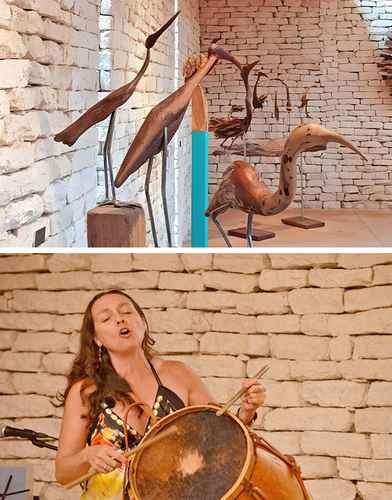
Tulum, Quintana Roo — The Regional Museum of the Eastern Coast (Mureco), affiliated with the National Institute of Anthropology and History and located in Tulum, Quintana Roo, has inaugurated the exhibition De plumas, aves y ancestros, which brings together works by Argentine sculptor Pablo Guichet, created with wood fragments recovered from the sea.
The display, arranged in the Yaxché room of Mureco, exhibits 12 pieces by the artist, 10 of them sculptures alluding to herons, pelicans, seagulls, and flamingos, and two masks.
The feathers, simulated from remains of wood recovered by Guichet on the shores of the Quintana Roo sea, function as articulating concepts, alluding to the flight of these animals and to feather art that, since ancient times, has been developed in the country.
The pieces incorporate stainless steel structures, worked with direct welding technique, achieving a balance between visual lightness and structural stability. Mujer semilla stands out, a large-format mask that integrates a germinating coconut, conceived as a symbol of life, renewal, and continuity.
Trained at the National School of Fine Arts Prilidiano Pueyrredón, now the National University of the Arts, in Buenos Aires, Argentina, Pablo Guichet (born 1973) is a sculptor and visual artist with more than 30 years of career. He has been a set designer, art director in cinematographic projects, and creator of installations in Mexico and in the aforementioned South American nation.
De plumas, aves y ancestros will remain open until April 12 at the Museum of the Eastern Coast. Admission is free; however, because it is located within the Jaguar Park, its access fees must be covered. Hours: Tuesday to Sunday from 9 a.m. to 5 p.m.
Discover more from Riviera Maya News & Events
Subscribe to get the latest posts sent to your email.