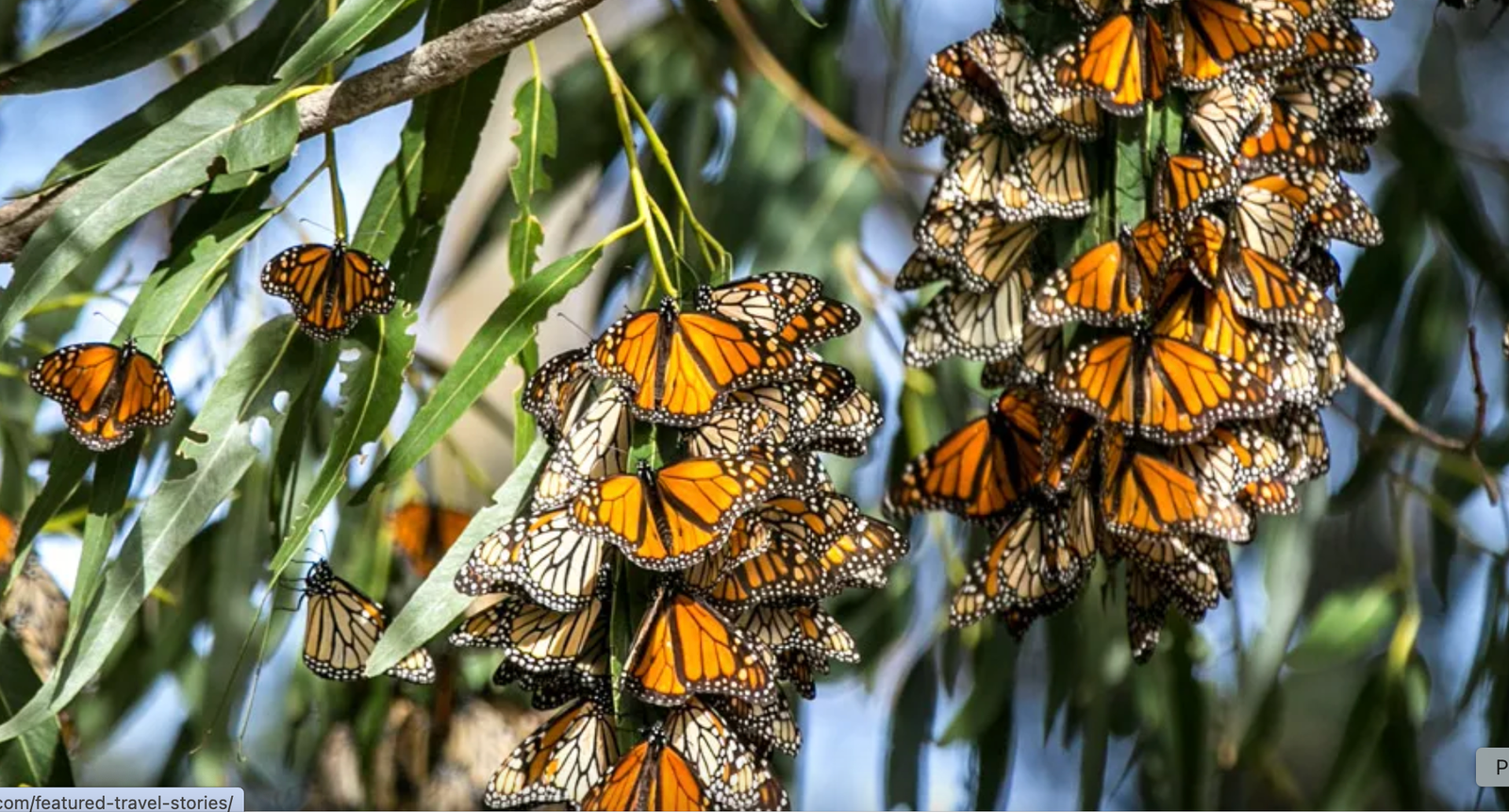
YUCATAN, Mexico – Majestic and fragile all at once, the monarch butterfly (Danaus plexippus) has long symbolized transformation, resilience, and the power of connection between nations. Its striking orange-and-black wings have inspired awe for centuries—but beyond their beauty, monarchs perform one of nature’s most astonishing feats: a multi-generational migration spanning more than 4,000 kilometers from Canada and the United States to the temperate fir forests of central Mexico.
Each fall, millions of monarchs set off on a journey that no single butterfly will ever complete. The migration unfolds over several generations—each traveling a leg of the route—until a special “super generation” of long-lived monarchs completes the return to Mexico’s oyamel fir sanctuaries in Michoacán and the State of Mexico. There, sheltered in the cool mountain forests of the Monarch Butterfly Biosphere Reserve, they cluster by the millions, creating a living tapestry that UNESCO calls “a natural phenomenon of universal value.”
A Migration That Unites Three Nations
The monarch’s journey links Canada, the United States, and Mexico in a single ecological chain—one that depends on cooperation across borders. Yet this delicate network faces increasing pressure from deforestation, habitat loss, pesticide use, and climate change. The decline of milkweed, the only plant monarch caterpillars can eat, has been especially damaging.
In response, communities, researchers, and conservation groups across North America have joined forces to safeguard the species. Their efforts range from planting milkweed corridors across the U.S. Midwest to strengthening forest protections in central Mexico.
But now, new discoveries suggest the story of the monarch migration is still unfolding—with the Yucatán Peninsula emerging as an unexpected new chapter.
Monarchs in the Mexican Caribbean
During the State Week of Science and Technology, the community group Alas Mayas presented groundbreaking findings titled “The Monarch Butterfly Through the Route of the Mayab.” Their research revealed that some monarch butterflies are veering off the traditional central route—and reaching the Yucatán Peninsula, and even Cuba.
From their base in the Sian Ka’an Biosphere Reserve, guide and naturalist Zendy Euán shared that two tagged monarchs—nicknamed Nemo and Paola—were tracked via microchip technology as part of an international monitoring program.
“Paola is already in Veracruz, and Nemo, who entered Yucatán 15 days ago, is currently in Cuba,” Euán explained, showing a GPS map of their recorded flight paths.
The butterflies entered the peninsula through Celestún and continued along a coastal route encompassing Holbox, Cancún, and Isla Mujeres, before some crossed over to the Caribbean island of Cuba. This new data—developed in collaboration with Cuban researchers—suggests a possible alternate migratory corridor linking North America and the Caribbean.
Reproduction Confirmed in Isla Mujeres
What began as curiosity among local observers has evolved into an internationally recognized finding. After six years of community monitoring, researchers have documented that monarch butterflies are not only passing through the Yucatán Peninsula—they are also reproducing here.
According to Juan Flores Valadez, representative of the Community Initiative for Bird Conservation (ICCA) and member of Alas Mayas, all life stages—egg, larva, chrysalis, and adult—have been confirmed in Isla Mujeres and surrounding areas of southeastern Mexico.
“The issue of the monarch butterfly here in the Yucatán Peninsula is a novel topic that can inspire knowledge, curiosity, and participation,” said Flores Valadez. “It could even spark a local sighting season, much like that of the whale shark.”
Field observations have recorded aggregations of more than 300 monarchs in San Juan del Río, Yucatán, and another group of around 100 in Cacao, Quintana Roo, strengthening the hypothesis that this region serves as a reproductive hub.
Citizen Science and Community Collaboration
The work of Alas Mayas has resulted in the formal creation of the Community Monitoring Network for the Monarch Butterfly in the Yucatán Peninsula, uniting observers, photographers, academics, and residents across Yucatán, Campeche, and Quintana Roo, as well as the islands of Cozumel, Contoy, Alacranes Reef, and Isla Mujeres.
This regional network is now part of a larger international study led by Dr. Cristina Dockx, which officially incorporates southeastern Mexico and the Caribbean into the monarch’s migration map. The project emphasizes the importance of local data collection and the power of citizen science.
“Science doesn’t only happen in laboratories; it also happens on beaches, in gardens, and on rural roads,” said Flores Valadez, encouraging the public to contribute sightings through the platform iNaturalist from October 1 to December 1.
Tracking Butterflies with Nanotechnology
In parallel, new advances in nanotechnology have revolutionized how scientists track the monarchs’ epic flights. After years of testing, researchers at Cellular Tracking Technologies developed a solar-powered Bluetooth micro-transmitter called BlüMorpho—weighing just 60 milligrams, roughly the size of a grain of rice.
In September, 430 of these micro-tags were carefully attached to healthy monarchs using tiny drops of eyelash glue—a harmless method allowing scientists to follow the insects’ movements in real time. The first tagged butterfly to reach Mexico, identified as MW026, completed a 43-day journey from Lawrence, Kansas, traveling over 2,200 kilometers before arriving at the Monarch Butterfly Biosphere Reserve in early November.
Using a mobile app called Project Monarch, citizen scientists can now detect nearby tagged butterflies, building what researchers describe as “the largest wildlife tracking network in the world.”
“This technology will help identify key stopover sites and improve conservation planning,” explained the Cape May Point Science Center, one of the project’s collaborators.
A Living Bridge of Nature and Culture
For many in Mexico, the monarch is more than a species—it is a symbol of spiritual renewal and cultural continuity. Their arrival each autumn coincides with the Día de Muertos, when they are believed to carry the returning souls of loved ones. This profound link between nature and tradition reinforces respect for all forms of life.
Protecting the Flight of Life
Conservationists stress that protecting the monarch’s journey requires shared responsibility—across nations and within local communities. Actions such as planting milkweed, avoiding pesticides, and supporting ecotourism can make measurable impacts.
In the Yucatán Peninsula, these efforts now have renewed urgency. The discovery of active breeding colonies means the region is no longer just a resting point—it’s an essential link in the monarch’s continental odyssey.
“Every time a monarch takes flight,” said one Alas Mayas volunteer, “it reminds us that life is movement, adaptation, and connection.”
Whether spotted in the high forests of Michoacán or along the beaches of Isla Mujeres, the monarch butterfly continues to embody hope and resilience—a fragile yet powerful reminder that our ecosystems, like their wings, are strongest when interconnected.
Discover more from Riviera Maya News & Events
Subscribe to get the latest posts sent to your email.