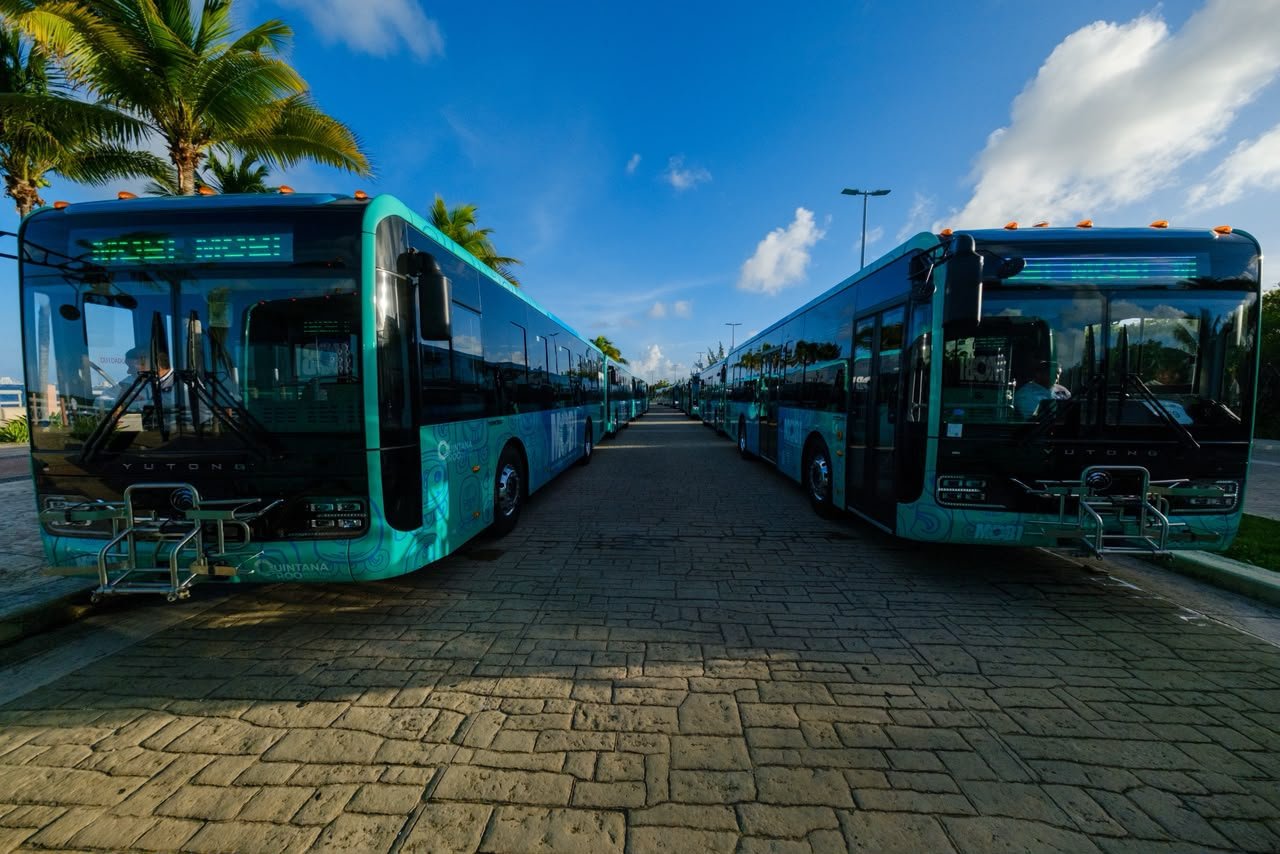
Cancún, Quintana Roo — The Quintana Roo Wellbeing Mobility system, known as MOBI, is set to expand its Cancún operations significantly with 100 new Yutong hybrid buses and four routes that will enter service in stages during the final quarter of 2026.
Governor Mara Lezama Espinosa led the presentation and send-off ceremony for the new units at Malecón Tajamar, an event that will take MOBI’s Cancún fleet from 38 buses to 138.
The new routes are Ruta 17; Villas del Mar 3–KM 0; Villas del Mar 3–Puente Nichupté; and La Rehoyada–Zona Hotelera. Depending on the route, trips will run between 45 and 75 kilometers.
Four Routes to Launch Before Year’s End
Officials said the rollout will happen in phases, with free introductory service periods on each route.
- Ruta 17: operations begin October 19–26, with one week free of charge.
- Villas del Mar 3–Puente Nichupté: free service November 2–9.
- Villas del Mar 3–KM 0: free service November 16–23.
- La Rehoyada–Zona Hotelera: operations begin November 30 to December 7.
MOBI currently runs two Cancún routes, 27 Puente Nichupté and 27 Kilómetro 0. With the four additions, the system will operate six routes by the end of 2026.
Rafael Hernández Kotasek, head of the Quintana Roo Mobility Institute (IMOVEQROO), said the project aims to bring fleet, routes, fares, payment methods, technology and oversight under a single framework.
More Than 322,000 Potential Users
According to the project’s technical summary, the four new routes have a potential beneficiary population of 322,821 people and are expected to serve an estimated 118,911 homes, 225 schools and 9,963 businesses.
The routes will connect residential areas with some of Cancún’s main mobility hubs, including IMSS hospitals, schools, the city center, Puerto Cancún and the Hotel Zone. They will also reach high-traffic destinations such as Plaza Las Américas, Plaza Kukulkán, La Isla, Plaza Caracol, the ADO bus terminal, Parque Km 0, Puente Nichupté, Playa Tortugas and Parque Kabah.
Official estimates put combined demand for the four routes at 80,188 passengers per day, with travel times expected to drop by roughly 19 minutes.
The corridors with the highest expected demand are Tulum, Kabah and José López Portillo avenues, along with Luis Donaldo Colosio and Kukulcán boulevards — roads that carry much of the traffic between the city’s neighborhoods, downtown and the Hotel Zone.
Hybrid Buses to Be Monitored in Real Time
The new Yutong units use hybrid technology, combining electric and combustion propulsion to cut energy consumption, emissions and noise. The buses also feature air conditioning, full accessibility, five security cameras, GPS, Wi-Fi, USB ports, bicycle racks, information screens and validators for MOBI payment methods.
Operations will be supported by real-time monitoring and a connection to the C5 security command center and the system’s Control Center as part of its service oversight plan.
With the 100 additional units, MOBI will reach 138 buses, equal to about 23.4 percent of Cancún’s public transport fleet. By the close of 2026, roughly one in four public transit buses on the city’s streets will be part of the MOBI system, according to figures presented at the event.
Benito Juárez Mayor Ana Paty Peralta, Congressman Jorge Sanén and business leaders from the transport sector attended the presentation.
More Government
More Cancun
- Hotels in Cancún and Puerto Morelos Restore Coastal Dunes With Native Plants
- Canada Arms Trafficking Suspect Arrested in Cancún
- Cancún to Repave 2.6 Kilometers of Avenida De los Colegios in January 2027
- Cancún Loses 20 Restaurants So Far This Year, Industry Group Says
- Quintana Roo Police Arrest Two Guatemalan Fugitives With Interpol Red Notices