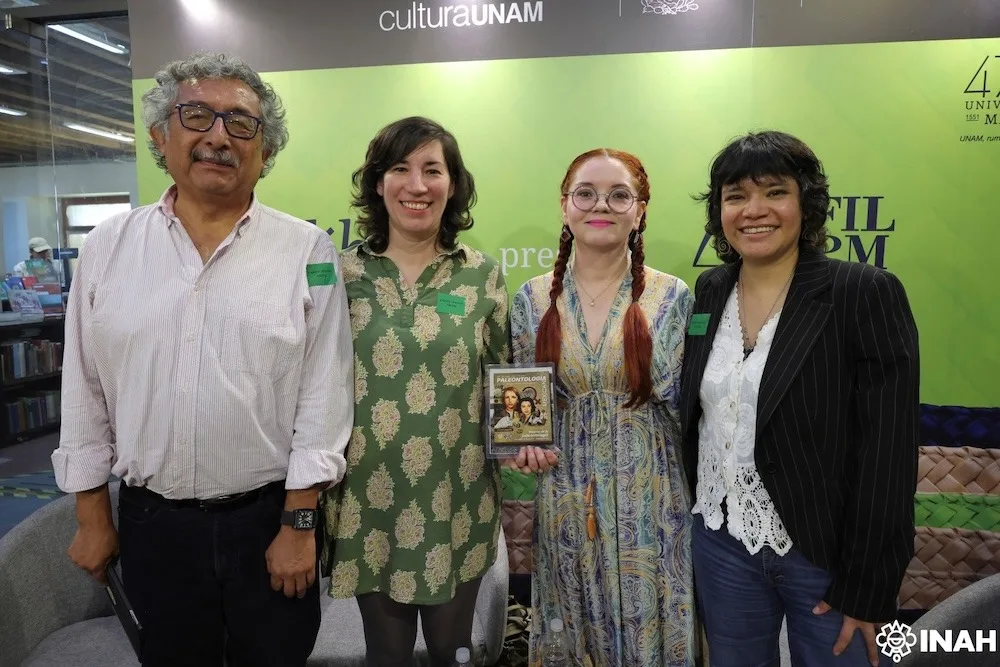
Mexico City — The specialized study of microscopic fossils, known as micropaleontology, stands out within Mexico's geosciences as a discipline predominantly developed by women. This contrasts with other paleontological specialties, as well as geology and Earth sciences broadly, which remain male-dominated. The trend is attributed to the laboratory-based nature of micropaleontological work, as opposed to fieldwork.
The observations were made by three academics from the National Autonomous University of Mexico's Institute of Geology (IGl): Pilar Navas-Parejo, Sandra Ramos Amézquita, and Lucero Morelos Rodríguez. They spoke at the Palace of Mining during the International Book Fair, highlighting the contributions of Mexican biologist Palmira Brunner Liebshard (1940–2018), a pioneer in the study of conodonts in the country whose proposals remain valid.
Conodonts are tiny, extinct marine creatures that inhabited oceans millions of years before dinosaurs. They were soft-bodied and are now known through microscopic fossils of their teeth. This group has become a key tool for assessing the potential of oil deposits, making its study significant, though research in Mexico remains limited and largely conducted by women.
An essay dedicated to Brunner Liebshard, written by senior IGl researcher Pilar Navas-Parejo—currently the only person in Mexico dedicated to conodont study—and IGl historical archive head Lucero Morelos Rodríguez, analyzes her professional life. The authors note her trajectory has been partially relegated in the history of Mexican micropaleontology.
The text is part of the special issue "Women in Paleontology" of the journal Paleontología Mexicana, published since 1954 by the UNAM Institute of Geology. For the first time, in a co-edition with the National Institute of Anthropology and History's Council of Paleontology (Conpal), the issue gives recognition to women who have contributed to the geosciences, particularly paleontology.
The issue also highlights the careers of Marie Curie and Rosalind Franklin, alongside contributions from other lesser-known researchers, and underscores their impact on the development and diversity of geosciences. It further emphasizes the need to broaden approaches in science communication by incorporating more diverse voices in terms of discipline, language, and nationality.
This is exemplified by the article “Representation of women in geology and paleontology in popular science books: a critical look at biases of discipline, language, and geographic origin.” Based on an analysis of 13 books published in the last decade in English and Spanish, which feature biographies of scientists from various regions, the study evaluated the visibility of Spanish-speaking geologists and paleontologists.
The review of 194 female scientists across 18 disciplines detected a cross-cutting geographical and linguistic bias: 31.8 percent of those referenced are American, and 10.4 percent are British. Only 5.7 percent are from Spanish-speaking countries, equivalent to 11 scientists: five Spanish and six Latin American, from Argentina, Chile, Colombia, Costa Rica, Mexico, and Venezuela.
Another text addresses opportunities for women in paleontology, noting an increase since 2000. However, it states women continue to face disadvantages, including gender stereotypes, inequalities in funding, limited access to academic networks, and difficulties balancing academic and personal life, which has relegated them to lower-level positions. In fieldwork, they additionally face prejudice regarding physical capabilities and risks in remote areas.
Sandra Ramos Amézquita, editor of Paleontología Mexicana, commented that the volume of material received about women in paleontology was so great it exceeded the available space. She announced a second issue on the topic, scheduled for release in mid-2026.
Eduardo Corona Martínez, president of Conpal, stated that the publication is part of efforts to recognize the work of female scientists. He defined gender parity as more than just numbers, but as listening to their voices, respecting their actions and contributions, and giving them space with voice and vote—fully recognizing them as academic peers.
The first special issue has been in circulation since January 2026, is available in digital format, and is free to access.
Discover more from Riviera Maya News & Events
Subscribe to get the latest posts sent to your email.