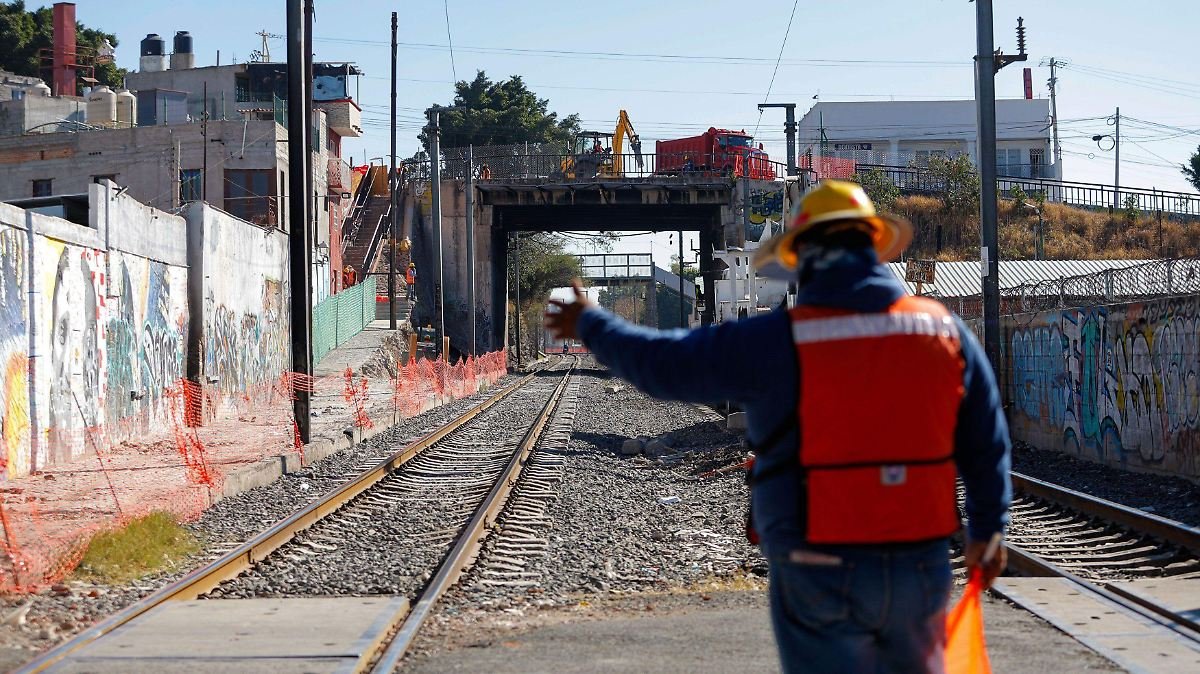
Mexico City — The federal government announced Tuesday that it plans to build 38 new passenger train stations by 2030.
The goal is for these terminals to be fully accessible and located no more than 800 meters from other forms of transportation, making transfers easier in what is known as the “last mile,” according to the Institutional Program of the Integrated Public Transport and Train Agency 2026–2030.
The agreement, published in the Official Gazette of the Federation (DOF), specifies that by the end of the six-year term, the country will reach a rate of three new stations for every ten million inhabitants.
The document explains that this objective will be supported by the construction of more than 3,000 kilometers of new passenger rail lines, connecting different regions of the country through a modern railway system.
“With the implementation of more than 3,000 kilometers of passenger rail lines and the construction of 38 stations, it is estimated that, by the end of 2030, the indicator will show three stations for every ten million inhabitants,” the program states.
According to the Ministry of Infrastructure, Communications and Transportation (SICT), the planned stations will be concentrated along the AIFA–Pachuca, Mexico City–Querétaro, Querétaro–Irapuato, and Saltillo–Nuevo Laredo corridors.
Expansion is also planned for other strategic routes, including Querétaro–San Luis Potosí, San Luis Potosí–Saltillo, Irapuato–Guadalajara, Guadalajara–Tepic, Tepic–Mazatlán, Mazatlán–Los Mochis, Los Mochis–Guaymas, Guaymas–Hermosillo, and Hermosillo–Nogales.
The program also calls for standardizing railway systems to ensure proper operation across different lines. To achieve this, the federal government plans to develop an integrated architecture that harmonizes power, telecommunications, and signaling systems, allowing trains to operate efficiently on shared infrastructure.
In terms of mobility, the Integrated Public Transport and Train Agency proposes that the new stations serve as connection hubs with buses, urban transport, and other services through modal transfer areas, with the aim of reducing travel times and improving access for users.
All stations must meet universal accessibility standards. In communities with lower demand, the agency plans to install stops that will expand the railway system’s coverage by 2030.
More Development
- Semarnat Approves Artificial Reefs and Sand Relocation for Akumal Hotel
- Chetumal Plans 836 Million Pesos in Stormwater Works to Curb Flooding
- Mara Lezama Delivers 288 Infonavit Homes in Puerto Aventuras as Quintana Roo Targets 76,000
- Fonatur Doubles Maya Ka’an Budget to 20 Million Pesos
- Study Finds Cancún’s Laguna Manatí Mangrove Could Qualify for Carbon Credits