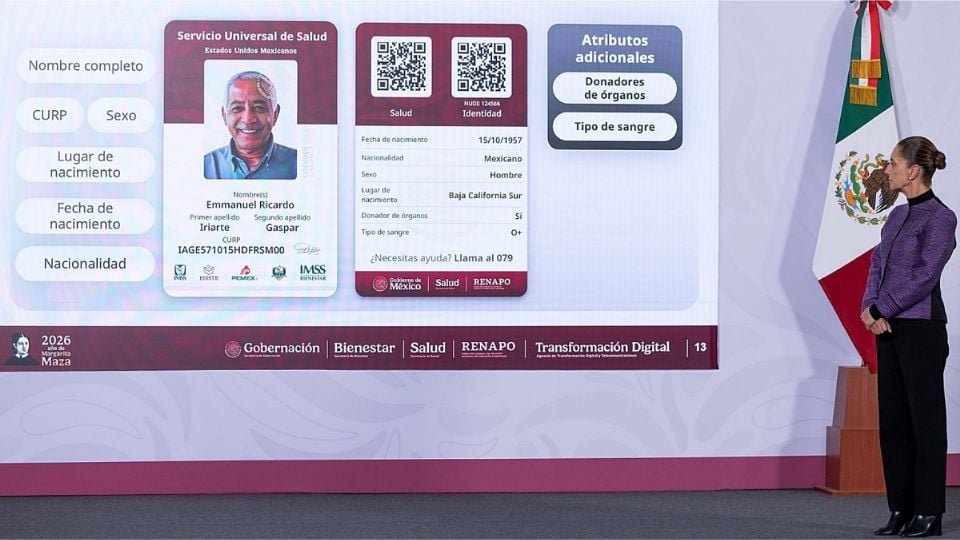
Mexico City, Mexico — The Mexican government, led by President Claudia Sheinbaum, officially presented the Universal Health Service Card on Tuesday, a new document designed to guarantee access to medical care across all public institutions in the country.
During the morning conference on Tuesday, November 20, Eduardo Clark, Undersecretary of Sectoral Integration and Coordination of Medical Care Services, explained that this card will serve as a unique health identification for Mexicans.
Purpose of the Universal Health Service Card
The new card will allow the population to access medical services from IMSS, ISSSTE, IMSS Bienestar, Pemex, Armed Forces health institutions, and national health institutes, regardless of previous affiliation or place of residence.
The central objective is to simplify procedures, eliminate institutional barriers, and advance toward a truly universal health system. For its implementation, the federal government will allocate an investment of 3.5 billion pesos.
Physical and Digital Card: Main Characteristics
The Universal Health Service Card will be available in two formats:
- A physical version, designed to be carried in a wallet.
- A digital version, which can be consulted through a mobile application starting in April.
The physical card will include data such as full name, CURP, sex, date and place of birth, nationality, as well as relevant medical information like blood type and organ donation decision.
On the back, it will feature two QR codes:
- One to validate eligibility.
- Another to locate the nearest health unit.
Additionally, it will integrate a contact number for telephone assistance through 079.
The digital version will replicate this data and add functions such as displaying the eligibility institution and assigned clinic, facilitating orientation within the health system.
Unique Clinical Record and Continuous Medical Care
One of the most relevant points of this strategy is the creation of a unique electronic clinical record, directly linked to the card.
This record will concentrate the complete medical history, including studies, prescriptions, and appointments, even if the person changes institutions or residence. It will also allow scheduling medical appointments and clearly knowing which unit to go to for consultations or procedures.
According to authorities, this system will facilitate information exchange between institutions, optimizing resources and guaranteeing continuous and coordinated medical care throughout the country.
Registration for the Universal Health Service Card
Secretary of Welfare, Ariadna Montiel Reyes, reported that the registration process will be similar to that of the Welfare Programs. For this purpose, 2,365 modules and 9,791 stations will be enabled throughout the national territory.
Requirements for registration:
- Adults: official identification with photograph and CURP.
- Minors: birth certificate with CURP, proof of address, and official identification with CURP of the father, mother, or guardian.
Procedure:
- Document review.
- Consent signing and contact registration.
- Photograph and fingerprint capture.
- Notification via SMS or call to 079 to pick up the printed card.
- Final delivery of the physical document.
With this new card, the Mexican government seeks to strengthen the right to health, improve institutional coordination, and ensure that medical care reaches the entire population more efficiently.
Discover more from Riviera Maya News & Events
Subscribe to get the latest posts sent to your email.