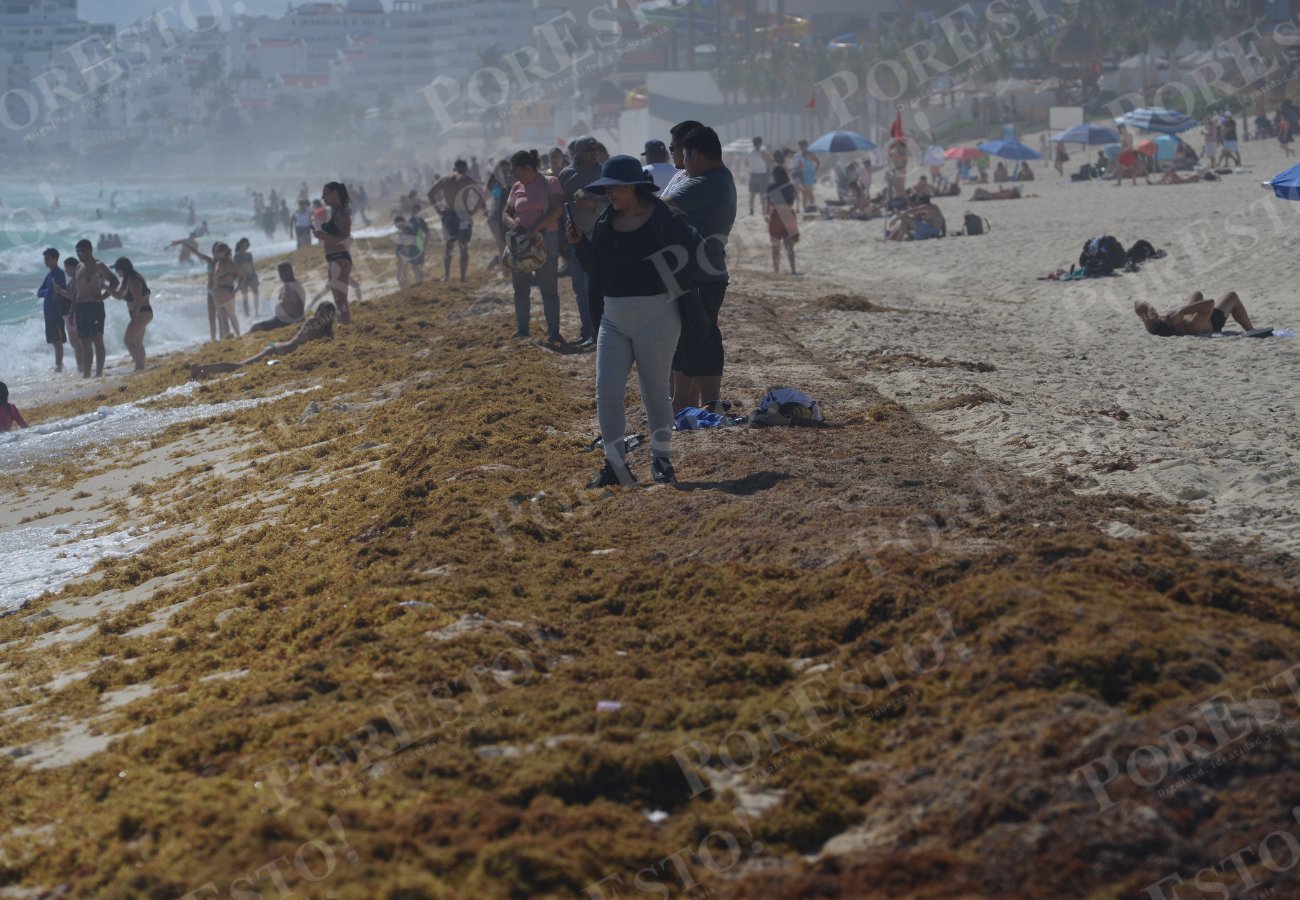
Cancún, Quintana Roo — The Mexican Navy’s (Secretaría de Marina) sargassum displacement forecasts indicate that approximately 15 tons of macroalgae are expected to arrive on the city’s beaches within the next 24 hours.
Coastal currents are reported to be moving north and northeast, with speeds ranging from 0.5 to 1.7 knots at various points along the coast.
Biologist José Manuel González explained that this type of early arrival is not typical, as the phenomenon normally reaches its peak intensity between April and October. Therefore, the influx recorded in January is atypical and is believed to be linked to variations in ocean currents associated with climate change.
Yesterday, some beaches in Quintana Roo woke up with extensive strips of sargassum accumulated on the sand, forcing cleanup crews to be reinforced early in the morning and generating dissatisfaction among bathers and merchants, who demand firmer and long-term solutions for a phenomenon that increasingly appears less seasonal and more constant.
In Cancún, Delfines beach presented a wide accumulation of macroalgae, a situation that caused doubts among national and foreign tourists about entering the sea. In Playa del Carmen, affected areas included Playacar, Pelícanos, and the 72nd street beach.
Some visitors even removed the sargassum with their hands, given the scarce personnel from the Benito Juárez municipality—at least yesterday—to carry out cleaning tasks, unlike what was observed in Isla Mujeres and Playa del Carmen.
This problem has affected the coasts of Quintana Roo since the beginning of January, with growing repercussions on the tourism sector, the regional economy, and the social dynamics of coastal communities.
The biologist added that since the beginning of the month, Playa del Carmen, Tulum, Puerto Morelos, Cozumel, and Benito Juárez have recorded influxes driven by atypical meteorological conditions and southerly winds (surada), which drag the macroalgae from the open sea toward the coastline.
“It was known that the southerly wind would enter, and yet, sufficient precautions were not taken,” he stated.
According to the Citizen Sargassum Observatory and the Quintana Roo Sargassum Monitoring Network 2026, constant evaluations are carried out to identify which beaches present accumulation and which remain free of the algae, in addition to issuing recent reports and an updated calendar on cleanup actions, collection strategies, and the behavior of the season.
For her part, the Secretary of Sustainable Environment and Climate Change, Samantha Álvarez Hernández, explained that, unlike northerly winds—which usually move accumulated material away from the coastal strip—the southerly wind causes both sargassum and large volumes of marine debris to arrive on the beaches, deteriorating their image and affecting the natural environment.
Faced with this scenario, she indicated that in recent days a permanent operation has been maintained on all the municipality’s beaches, with the deployment of machinery, tools, and operational personnel, with the objective of addressing the influx in a timely manner and keeping the sands in optimal conditions for residents and visitors.
Furthermore, continuous monitoring is carried out in coordination with the Navy, with the aim of starting the installation of anti-sargassum barriers in a timely manner ahead of the next season of massive arrivals, in addition to collaborating with hotels that already have their own infrastructure for containing the macroalgae.
Despite having monitoring systems that alert scientific and environmental authorities, sufficient preventive actions were not implemented from the open sea to mitigate the impact, which has generated questions about advance planning at the state and federal levels.
Specialized organizations and environmental agencies have prediction tools based on satellites and ocean current models; however, according to environmentalists, the alerts were activated with little margin for this event. Although there is no single responsible party, criticism points to a lack of coordination between environmental, naval, and tourism authorities to anticipate exceptional scenarios like the one recorded this January.
Discover more from Riviera Maya News & Events
Subscribe to get the latest posts sent to your email.