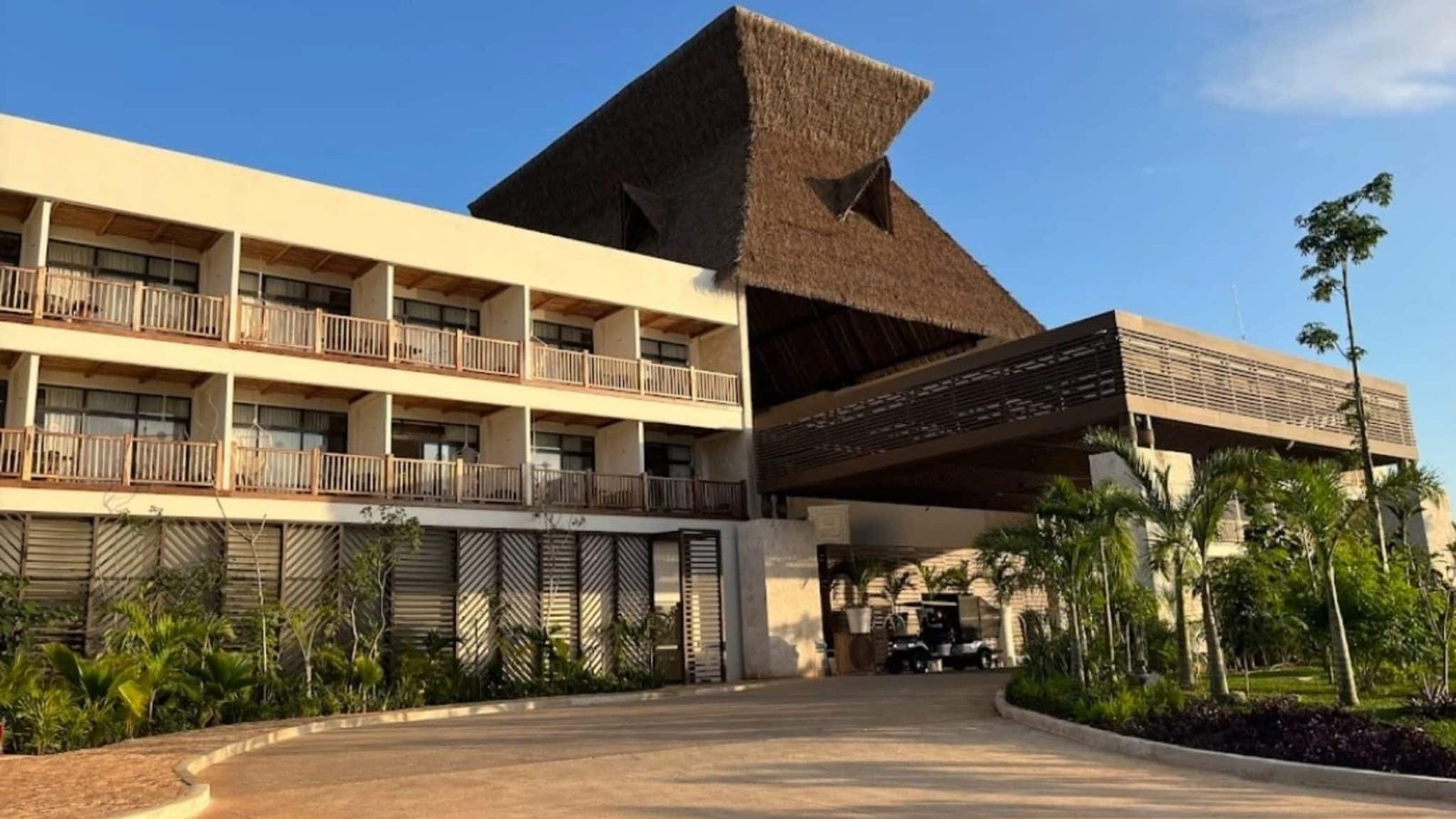
Southeast Mexico — One year after beginning operations, the Maya Train hotels in southeastern Mexico are facing one of their most difficult periods compared to initial lodging projections. Of the seven complexes managed by Grupo Mundo Maya, none have come close to the average occupancy levels of the national tourism sector, which hovers around 60%, let alone the records of the Mexican Caribbean, where hotels maintain figures above 80%.
The records from Grupo Mundo Maya show that the hotels in Tulum, Nuevo Uxmal, and Tulum Airport did not even reach 11% of their projected annual capacity. Since their opening one year ago, the seven Maya Train hotels have collectively received 60,038 guests, a low figure considering their total capacity is 3,372 people per night.
High Capacity, Few Guests
In terms of infrastructure, the Maya Train hotels were designed to serve thousands of tourists. The largest capacity is the Tulum Hotel, with space for 996 people per night; followed by Edzná, Chichén Itzá, Nuevo Uxmal, and Palenque, all with capacity for 420 guests; Calakmul, with 372; and Tulum Airport, with 324. Together, the seven hotels can accommodate up to 3,372 people per night. However, actual demand has been far from this.
The most critical case is that of the Nuevo Uxmal Hotel in Yucatán. Since its opening in February 2025, it has received only 3,243 guests, translating to an average annual occupancy of just 2.8%. In its first month of operation, the complex reported only 48 visitors, and although in September it reached its highest point with 1,283 guests, in October it fell again to 270.
The Tulum Hotel, despite being the largest in the chain and located in a strategic area within the Jaguar Park, also failed to take off. In 11 months it received 11,341 visitors, equivalent to an average of 1,031 people per month and an annual occupancy of just 3.4%. A similar situation is faced by the Tulum Airport Hotel, which recorded 3,532 guests since its opening, with a monthly average of 321 people, meaning an average occupancy of 3.3%.
Other complexes, although with better numbers, also remain well below tourism sector standards. The Edzná Hotel received 6,268 guests, representing 4.1% occupancy; Chichén Itzá added 8,196 visitors, i.e., 5.4% occupancy; and Calakmul reached 11,016 guests, with an average occupancy of 8.2%.
The best performance was by the Palenque Hotel in Chiapas, which accumulated 16,442 visitors. Even calculating its operation over a 12-month period, its average occupancy is 10.9%.
Millions in Promotion, Few Results
The general director of the Maya Train, Óscar David Lozano Águila, reported that the months with the highest influx to the Maya Train hotels were July and August, with 9,397 and 10,568 visitors, respectively. However, even in these months considered “strong,” occupancy levels remain far from tourism industry standards.
Given this scenario, Grupo Mundo Maya has attempted to position these complexes within the tourism market and, for this purpose, allocated 73.9 million pesos during 2025 to advertising campaigns, dissemination strategies, and promotion in various media, with the goal of giving visibility to the hotels, integrating them into the Maya Train routes, and making them an attractive option for national and international tourism.
As part of this strategy, the government launched integrated tourist packages that included round-trip flights with Mexicana, the state airline, accommodation in the Maya Train hotels, and transfers on the railway, with prices ranging from 17,000 to 24,000 pesos per person. The bet was to sell not just a room, but a complete touring experience of the southeast.
To this offer was added the so-called “New Year’s Express,” a special long-distance trip with which they sought to position the Maya Train as a tourism product in itself, beyond its transportation function. The tour promised an exclusive experience to ring in the new year aboard the train, with appetizers, toasts, and commemorative activities. However, it was notable that the New Year’s dinner did not take place in any of the group’s hotels, but in a hotel of an American chain in Mérida.
Return on Investment Until 2027
The Maya Train hotels are part of a tourism ecosystem that involved an investment exceeding 10,964 million pesos. These works were conceived as pieces of the railway project that provide strategically located lodging alternatives to capture train travelers, boost local economies, and consolidate new tourism hubs in the southeast.
However, that impact has not yet materialized. Today, the project’s mission is not just to have completed infrastructure, but to ensure that promotion, connectivity, and the experience offered translate into real and sustained occupancy. According to authorities, that break-even point is expected by 2027, when the return on investment could begin to be reflected.
The Great Contrast: Boom in the Mexican Caribbean
While the Maya Train hotels struggle to fill rooms, the Mexican Caribbean is having a good start to the year. In the first week of January, hotels in the main tourist destinations of Quintana Roo reported occupancies above 80%, according to official data from the state Tourism Secretariat.
Overall occupancy was 83.6%, while hotel occupancy by tourist destination in the Mexican Caribbean was led by the Riviera Maya with 88.4%, followed by Puerto Morelos (81%), Cancún (80.6%), Tulum (79.3%), Costa Mujeres (79.5%), Isla Mujeres (78.7%), and Cozumel (78.3%). Even Costa Maya, one of the destinations with lower flow, reached 59.9%.
To this good performance is added a high diversity of source markets: 37.2% of tourists come from the United States, 36.3% from Mexico, 10% from Canada, and the rest is distributed among countries in Europe and South America.
Similar Rates, Different Demand
The rates of the Maya Train hotels are not far from those handled in more emblematic destinations of the Mexican Caribbean. For example, one night in a master suite at the Tulum Hotel costs 5,832 pesos, while a deluxe room is around 3,166 pesos.
In comparison, the average nightly rate in Cancún is 146 dollars (about 2,628 pesos); in Playa del Carmen, 141 dollars (2,538 pesos); and in Tulum, 165 dollars (2,970 pesos), according to official figures from the Quintana Roo Tourism Secretariat.
That is, the prices are not radically different. In some cases, they are even lower than those of the most successful destinations. But the difference lies in demand, positioning, real connectivity, perceived experience, and traveler confidence.
While the Mexican Caribbean starts the year with full rooms, saturated flights, and constant economic spillover, the Maya Train hotels continue waiting for the tourists that, in theory, were supposed to arrive en masse.
Capacity of the Maya Train Hotels
- Tulum: 996 people
- Edzná: 420 people
- Chichén Itzá: 420 people
- Nuevo Uxmal: 420 people
- Palenque: 420 people
- Calakmul: 372 people
- Tulum Aeropuerto: 324 people
Total combined capacity: Up to 3,372 people per night among the seven hotels.
The Cost of Staying at a Maya Train Hotel
Hotel Tulum
- Master suite: $5,832
- Jr. suite: $4,289
- Deluxe double: $3,166
- Deluxe King: $3,166
Hotel Tulum Aeropuerto
- Deluxe individual: $1,421
- Master suite: $4,848
- Jr. Suite: $2,340
- Deluxe double: $2,090
- Deluxe Queen: $1,755
Hotel Chichen Itzá
- Master suite: $4,621
- Jr. suite: $3,400
- Deluxe double: $2,509
- Deluxe King: $2,509
Hotel Calakmul
- Master suite: $3,560
- Jr. suite: $2,619
- Deluxe double: $1,933
- Deluxe King: $1,933
Hotel Edzná
- Master suite: $3,102
- Jr. suite: $2,282
- Deluxe double: $1,685
- Deluxe King: $1,685
Hotel Nuevo Uxmal
- Jr. suite: $2,831
- Deluxe double: $2,090
- Deluxe King: $2,090
Hotel Palenque
- Master suite: $4,067
- Jr. suite: $2,992
- Deluxe double: $2,208
- Deluxe King: $2,208
Discover more from Riviera Maya News & Events
Subscribe to get the latest posts sent to your email.