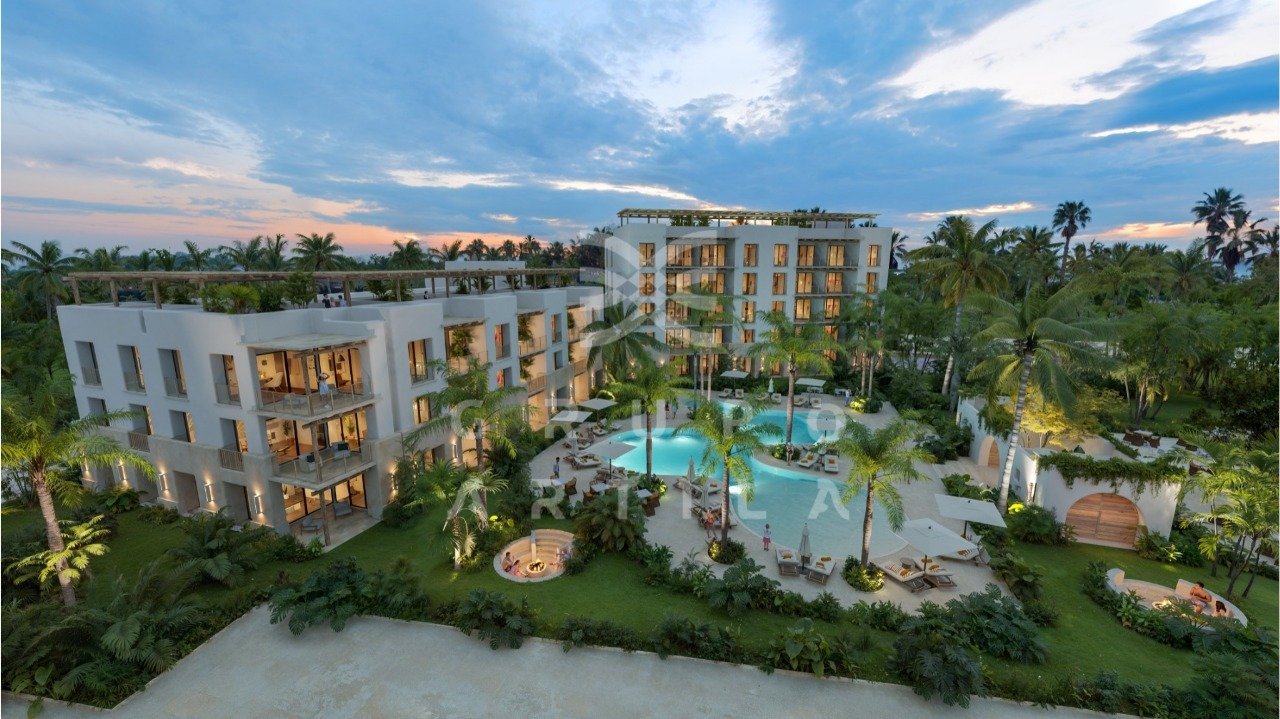
Isla Mujeres, Mexico — The revelation of a new mega-tourism project in Isla Mujeres, driven by the powerful agency Mundaca Real Estate and backed by a trust managed by Banco Actinver, immediately raised alarms among specialists and residents of the island. The development, designed by Artigas Arquitectos and promoted by Grupo Artila, represents a high-caliber alliance between local real estate firms, prestigious national companies, and private capital operating under a solid financial scheme, but surrounded by opacity and social concern.
The scale of the project, presented as a strategic real estate investment, opens the door to profound environmental and urban impacts on an island already facing saturation, ecological deterioration, and growing pressure on public services.
Environmentalists warn that accelerated growth without transparent studies or public consultation could trigger irreversible damage to marine ecosystems, rising housing costs, alteration of community dynamics, and transformations that would primarily benefit large investors while costs fall on the local population.
Development Characteristics: Luxury, Scale, and Amenities
The project announced as “La Salina, a new coastal community” envisions the construction of a luxury tourist residential complex facing the Caribbean Sea on the eastern coast of Isla Mujeres. According to information presented to authorities, the initial phase includes 32 residential units distributed in two condominium towers: Tower A with five levels and 20 apartments, and Tower B with three levels and 12 apartments, plus an additional Tower C of three levels intended for services and storage.
Together, the buildings would occupy a 7,583 m² plot in the area known as the Salinas neighborhood, midway along the island. Each apartment will be large (between approximately 106 and 170 m² for 2 or 3-bedroom units) and feature spacious terraces to take advantage of panoramic ocean views. The developer promotes the complex’s style as a “modern and naturally luxurious” residential experience with organic materials, open indoor-outdoor design, and high-end finishes, oriented to capture sunrise light and sea breezes.
The luxury tourism focus is evident in the offered amenities. The complex will include resort-style pools, terraces with loungers, tropical gardens, and shaded lounge areas, as well as parking and children’s play spaces, all within a private environment for residents. Additionally, purchasing a residence provides membership to an exclusive beach club called “Punta Limón Sun Club,” a coastal retreat with spa and entertainment services, infinity pool facing the sea, jacuzzi, specialty local restaurant-bar, massage areas, yoga deck, gym, and sauna, among other facilities.
This set of features reflects that the construction is planned in a luxury segment, aimed at both high-income owners and tourists (e.g., through vacation rentals), with the promise of a privileged lifestyle on the island.
In terms of public discourse, promoters emphasize a vision of development supposedly sensitive to the environment. Mundaca Real Estate describes the project with a “respectful approach to growth” in Isla Mujeres, assuring that La Salina will use durable, low-maintenance materials, hire local labor, purchase supplies from Mexican providers, and “contribute to ecological initiatives linked to the local salinas.”
They also maintain that the scale and design of the complex “align with the island’s character and its long-term well-being.” These statements, aimed at showing corporate social responsibility, seek to legitimize the project before the community and authorities, though they have been met with skepticism by critical sectors.
Official Permits, Licenses, and Environmental Impact Study
A key point is the status of permits and authorizations. To date, the megaproject does not have all definitive licenses to begin construction.
At the federal level, the company submitted the Environmental Impact Statement (MIA) to the Ministry of Environment and Natural Resources (Semarnat) in mid-2025, a mandatory procedure given the project’s location in a coastal zone and the development’s magnitude. That study (identified with file number 23QR2025TD038) was in the “file integration” stage at the General Directorate of Environmental Impact and Risk, meaning under technical analysis without formal approval or denial yet.
As of now, there is no public announcement of MIA resolution by Semarnat. In other words, federal environmental authorization remains pending, conditioning the legal start of works.
At the municipal level, the Isla Mujeres City Council headed by Mayor Atenea Gómez Ricalde has not reported granting a construction license or definitive land-use change for this specific project. By regulation, the municipal government must subordinate its permits to first having Semarnat’s environmental impact authorization and compliance with the valid Local Ecological Zoning Program (POEL).
The “Las Salinas” area is considered urban but with wetlands and federal coastal zone presence, imposing restrictions. Similarly, no specific state authorization has been publicly announced; it is worth recalling that in Quintana Roo, environmental impact assessments for tourism projects fall under federal government (Semarnat) jurisdiction, while compliance supervision also falls to the Federal Attorney for Environmental Protection (Profepa).
Experiences from other developments in the region show that starting work without environmental permits can lead to closures and sanctions. Profepa has suspended coastal projects that advanced without environmental impact approval, for example closing illegal constructions and piers in Isla Mujeres in previous years. In this case, the promoters themselves have opted for the formal channel by submitting the MIA; however, until it is approved, the La Salina project lacks proper environmental permit.
Nor has obtaining concessions in the Federal Maritime Terrestrial Zone (Zofemat) necessary to utilize the beach strip been reported, a procedure usually managed once environmental impact is authorized. In summary, the project does not yet comply with all official approvals, awaiting Semarnat’s resolution and corresponding local licenses. Any start of works before these authorizations would be illegal; for now, there are no signs of physical construction on site, beyond “pre-sale” promotion conducted by Mundaca.
Possible Ecological Impact: Expert and Environmentalist Alerts
The development’s location in the “La Salina” area raises concern among experts and environmental organizations due to the sensitivity of island ecosystems and the already fragile carrying capacity of the island. Isla Mujeres has three inland lagoons known as Salina Grande, Salina Chica, and Salina Norte, coastal water bodies semi-isolated from the sea that historically were natural salt flats.
With urban and tourism expansion on the island since the mid-20th century, these wetlands have suffered alterations in their properties and now show signs of deterioration. A recent diagnosis revealed that 59% of islanders perceive the salinas in poor environmental condition, identifying main problems as garbage pollution, illegal sewage discharges, bad odors, and waste dumps in their surroundings.
Although they still maintain some water quality with low organic pollution, the salinas have lost part of their ecological balance. However, they retain importance as wildlife habitat; at least eight species of resident or migratory birds have been recorded in Salina Norte, including the brown pelican (Pelecanus occidentalis), which is listed as a Threatened species under NOM-059 for fauna protection. This indicates that the island wetlands still provide refuge to species of interest and environmental services (flood control, water filtration, landscape value).
Environmentalists fear that constructing large towers and the arrival of more residents/tourists will exert additional pressure on these coastal and lagoon ecosystems. On one hand, the work will involve clearing secondary vegetation on the plot and possibly earth movements for foundation, which could alter underground water flows typical of the island’s karst zone. Any change in infiltration could affect levels of adjacent salinas or worsen waterlogging problems.
Moreover, proximity to the coast poses risks of marine impact; if construction runoff is not adequately controlled, sediments or pollutants could reach the Caribbean Sea, affecting the nearby Mesoamerican Reef or seagrass beds surrounding the island. Organizations like Ocean Conservancy and local groups have generally warned that the boom of coastal developments in the Mexican Caribbean increases sedimentation and wastewater discharge to the sea, contributing to coral deterioration.
Specifically in Isla Mujeres, concern exists that a complex of this size will generate more wastewater and garbage. The island lacks an efficient storm drainage system and sewage sanitation is limited, so a population increase could translate to higher risk of discharges into the marine subsurface if infrastructure is not improved in parallel.
Another sensitive point is freshwater availability. Water management specialists note that Isla Mujeres suffers chronic potable water scarcity; the municipality (with just over 22,000 inhabitants) depends on a submarine aqueduct from the mainland, and often the flow is insufficient for local neighborhoods. Ironically, water usually arrives reliably to hotels for tourists, while residents receive service “by drops” with frequent cuts.
In this context, the arrival of dozens of luxury condominiums with pools, gardens, and high per-visitor consumption could worsen water demand on an island where the resource is already critical. The same applies to electrical energy; Isla Mujeres is supplied via submarine cabling from Cancún and has recorded blackouts during peak seasons; an additional development will increase electrical load, forcing network expansions to avoid service drops.
Environmental organizations like Moce Yax Cuxtal and university experts have emphasized the concept of limited carrying capacity of small islands, suggesting that before authorizing new megaprojects, comprehensive evaluations of floating population thresholds that Isla Mujeres can support without collapsing its services and destroying its natural environment should be conducted.
“We cannot keep thinking only about the tourism business without considering ecological consequences,” commented a biologist member of the civil association Isla Verde in a local forum.
This specialist warned that unchecked growth represents a “gradual ecocide,” loss of green cover, overexploitation of the subterranean aquifer, coastal erosion, and impact on local fauna (such as sea turtles that nest on the island’s eastern beaches).
In fact, the east coast where La Salina is located is an arrival zone for loggerhead and white turtles; an increase in artificial lighting and human traffic could disorient the chelonians and decrease safe nesting sites, according to volunteers from turtle camps. These voices request strict mitigation measures if the project advances: modernized water treatment plants, rainwater collection systems, height limitations to not alter the island landscape, and a real commitment to fund ecological recovery of affected Salinas.
On the other hand, developers counterargue that La Salina will be a “sustainable” project; in their publicity they highlight use of eco-efficient technologies (e.g., LED lights, solar panels, rainwater harvesting) and state they will support community programs for mangrove and lagoon cleanup.
They have even indicated their intention to collaborate with municipal authorities in remediation of the Salinas, a topic that coincides with recent official efforts for environmental sanitation in Isla Mujeres. It remains to be scrutinized whether such promises materialize; for now, independent experts remain reserved: they fear proposed measures will not compensate the ecological footprint of introducing dozens of new luxury homes in such a sensitive space.
“The best way to protect is to avoid building in fragile zones; the second best, minimize the project’s size,” opines a researcher from UNAM in Puerto Morelos, suggesting that 32 condominions perhaps exceed what is ideal for that area. In summary, the expectation of ecological impact is subject to debate; the developer insists on its “harmonious” design, while environmentalists warn that any sum of impacts (however small it may seem) could push island ecosystems beyond their recovery capacity.
Between Interest and Concern
In the social sphere, the project has also generated echo. Is there opposition or protest from the community?
So far, no specific mass public protests against La Salina have been recorded, unlike other controversial tourism developments in Quintana Roo (where citizen demonstrations have been seen); in Isla Mujeres the response has been more discreet. However, this does not mean unanimous acceptance; inhabitants of nearby neighborhoods and local activists do express concerns in community spaces and social media.
In informal conversations, some islanders express fear that construction will end up privatizing beach access in that sector or further saturating the island’s roadways.
“What do we locals gain with another rich people’s condominium? We won’t even be able to enter those beaches, and they will make everything more expensive for us,” lamented a resident of La Gloria neighborhood in a community Facebook group. This sentiment of possible exclusion reflects resentment that can grow if the project’s benefits do not permeate the general population.
Regarding formal public consultations, municipal authorities have not convened specific hearings about the megaproject. Legally, the federal MIA process includes a citizen consultation phase; Semarnat publishes a project summary in the Ecological Gazette, and any person or organization can request a public information meeting or submit written comments. There are no confirmed reports that such a meeting has been held for La Salina.
It is possible that few islanders were aware of the environmental procedure in time and form to demand consultation, given that these notices go unnoticed if not widely disseminated.
Representatives of environmental NGOs in Cancún have criticized that many projects are approved “in the dark” due to lack of early social participation.
In Isla Mujeres, the Ecology councilmember stated in September that “we will be vigilant that citizen voice is heard in any important development,” without directly mentioning La Salina.
For its part, the City Council has recently promoted installation of Neighborhood Committees in various neighborhoods (including Salina Chica) to “listen and attend to the population’s real needs.” In those neighborhood tables, some citizens have expressed concerns about uncontrolled land sales and arrival of constructions that exceed the place’s service capacity. Local authorities have taken note of requests such as ensuring new projects include storm drainage improvement, respect green areas, and avoid blocking public access to the coast.
However, to date no specific popular consultation on whether the community agrees or not with this tourism megaproject has been conducted.
An aspect to highlight is divided perception within the island itself. While certain sectors like merchants, taxi drivers, or tourism service providers view favorably any investment that attracts more visitors and economic spillover, another sector particularly original families and young local professionals fears that Isla Mujeres will lose its essence under the weight of foreign developments.
“We don’t want to become another Cancún, full of soulless buildings,” expressed a letter signed by a neighbors’ collective addressed to the City Council last August. In it, they asked to halt “real estate depredation” until updating urban development plans with sustainability criteria and public consultation.
This document, fragments of which leaked to the press, did not explicitly mention La Salina but spoke of a “condominium project in preparation in wetland area,” in clear allusion. The letter requested that citizens be informed about said project and transparency on whether it complies with the law.
There has been no public response from the municipality to that request yet, but it illustrates that latent opposition exists, though not manifested with street marches.
Finally, it is worth noting that the island has seen several irregular developments in recent years (houses and rentable rooms built without basic services in the continental zone and some popular neighborhoods) that have caused discontent due to lack of planning.
In contrast, La Salina aims to be an “ordered” and premium development; part of the community is awaiting whether this could bring some indirect benefit, for example employment in its construction or opportunities in maintenance, security, etc., or investments in infrastructure that indirectly improve local conditions. In meetings with neighbors, municipal officials have suggested that “large projects also allow us to manage more resources for services.” Nevertheless, many inhabitants remain skeptical and feel their opinions have not been sufficiently consulted.
The challenge will be reconciling the population’s needs with the developer’s interests, something that for now hangs in the balance of public opinion.
Response from Municipal, State, and Federal Authorities
Authorities, for their part, have handled the topic with caution and general messages. At the municipal level, Mayor Atenea Gómez has reiterated on various occasions that “Isla Mujeres’ development must go hand in hand with environmental protection and people’s well-being.” While she has not made specific declarations about La Salina in the press, her administration has shown interest in reinforcing urban regulation, for example conducting operations to close irregular works in the municipality’s Continental Zone and halt illegal land sales.
This sends the signal that projects outside the law will not be tolerated. Regarding the specific case, municipal officials have indicated (unofficially) that if the development complies with all environmental and urban requirements, the City Council could not deny the license, since legally they would have to grant it for being on private land and within urban zone marked in the development plan, as long as it does not violate heights or densities. However, they also affirm they will be vigilant that impacts are mitigated and the company contributes improvements to infrastructure. The possibility of requiring the developer to invest in drainage or urban equipment as a condition has been mentioned.
At the state level, the Quintana Roo government headed by Governor Mara Lezama promotes the so-called “New Agreement for Well-being and Development,” which seeks balance between economic growth and environmental care. In this line, the state Secretary of Ecology and Environment (SEMA) has participated in work tables with Isla Mujeres municipality to reinforce environmental vigilance in fragile zones.
In fact, in early November 2025 SEMA and the City Council launched a joint plan to recover the Chacmuchuch lagoon (a wetland on the continental part), announcing cleanup, reforestation, and environmental education. Although Chacmuchuch is outside the main island, the message applies; the state administration wants to show commitment to protecting coastal ecosystems.
SEMA head Óscar Rébora declared on that occasion that “it’s not only about conserving an ecosystem, but caring for a space that gives life and well-being to families.”
This rhetoric would likely extend to Isla Mujeres’ Salinas; i.e., the State would hardly publicly support a project that destroys a wetland without compensation measures.
There has been, however, no express pronouncement from SEMA on La Salina. It is assumed they will await the federal MIA result to opine; the state government would have involvement, through the Quintana Roo Attorney for Environmental Protection (PPA), in monitoring any work that starts and in eventual environmental inspections during construction.
At the federal level, Semarnat maintains discretion while evaluating the MIA. According to law, the agency must technically review if the project is environmentally viable and, if approving it, could impose conditions (e.g., limit vegetation removal volumes, require treatment plants, periodic monitoring, etc.). A notable precedent, in November 2025, Semarnat denied environmental authorization to two tourism projects in Quintana Roo (a condo-hotel in Holbox and a restaurant in mangrove zone of Cancún) upon finding deficiencies in their studies.
This demonstrates that current federal environmental policy, under Secretary María Luisa Albores, does not automatically approve all developments, and prioritizes protection of critical ecosystems.
If La Salina presented omissions in its Impact Statement (e.g., lack of information on present fauna, or waste management), it could face a similar negative ruling. For now, Semarnat has not listed greater details publicly; it is only known that the environmental authorization request was received.
Another relevant federal entity is the National Commission of Natural Protected Areas (Conanp), since Isla Mujeres borders the Yum Balam Flora and Fauna Protection Area (which includes neighboring Isla Contoy) and forms part of the Costa Occidental de Isla Mujeres, Punta Cancún and Punta Nizuc National Park region (regarding reefs).
Although La Salina is not within a natural protected area, any impact on the sea could affect zones under Conanp custody. So far, Conanp has not issued a known position.
In synthesis, authorities move with dual message: support tourism investment vital for local economy but emphasizing “sustainability.” Facing society, the City Council and State insist that “there will be no development at the environment’s expense.”
The test of fire will come if Semarnat approves the MIA; there it will be seen how demanding imposed conditions are and how local authorities guarantee their compliance; citizen trust in institutions is at stake.
Transparent and balanced handling would be ideal: clearly informing impact study results, opening participation spaces if doubts exist, and ensuring the developer adequately compensates any ecological affectation. Otherwise, risk exists that the community perceives with disappointment that private interests are prioritized over common well-being, undermining credibility of involved governments.
Beyond the natural environment, La Salina entails social risks that urban development experts and inhabitants warn of. One is tourism gentrification; Isla Mujeres has experienced in recent years a strong transformation process, from being a quiet fishing village and local families to becoming an international tourism pole with proliferation of luxury hotels, villas, and condominiums.
Projects like La Salina fit precisely in this trend of touristification, where foreign investors develop properties aimed at wealthy visitors or residents, elevating real estate values and cost of living in general.
A feared effect is rising housing and service costs for locals; by introducing condominiums with sale prices from half a million dollars, area land value increases. This usually translates to rent increases and surrounding land prices, making it difficult for middle or low-income island families to access housing in their own locality. Studies in Quintana Roo indicate that tourism gentrification has provoked up to 50% increases in rents in places like Cancún and Playa del Carmen, displacing original residents to peripheries.
In Isla Mujeres, where space is limited (barely 4 km long), physical displacement is complex—there is no “periphery” to go except crossing to the continent—but socioeconomic displacement can occur; new price dynamics force locals to undersell their properties and move to more affordable zones (e.g., to the Continental Zone or other cities).
Along with housing increase come more expensive products and services; businesses oriented to new luxury residents/visitors’ purchasing power tend to displace small shops or traditional markets. Gourmet restaurants, boutiques, and exclusive services elevate average cost of food, local transport, and leisure, making them inaccessible for many islanders. Already today, residents complain that in certain parts of the island “a coffee or beer cost like in New York”; introduction of more premium developments could accentuate this economic gap.
Another social risk is loss of local identity and community cohesion; island culture with its customs, traditional festivities (like the Virgin of Carmen festival), central square gatherings, etc. can be diluted if floating or foreign population grows disproportionately. Some fear Isla Mujeres becomes a kind of Mexican “Santorini,” where original inhabitants were displaced and “the city is a bunch of boutique hotels” in foreign hands.
Neighbors point to already visible cases: certain Center streets where families previously resided are now dominated by Airbnb and tourist businesses, totally changing the neighborhood’s character. If La Salina fills mostly with outside owners or temporary tourists, it will contribute little to daily community life: it could become an exclusionary enclave, with fences and private security, generating separation from the rest of the population.
Likewise, there is pressure on existing public services; the island already suffers lack of adequate infrastructure in several areas: the sanitary drainage system is deficient, water supply is intermittent, roadways are narrow and oversaturated with golf carts and motorcycles congesting streets, inhabitants suffer occasional power cuts and a solid waste plant almost at capacity.
Isla Mujeres is “an island collapsed by a deficient drainage system,” with golf cart fleets exceeding road capacity. A development like La Salina threatens to worsen these service problems, as pointed out by a report:
“This project threatens to worsen problems like lack of basic services” on the island.
For example, more inhabitants and tourists imply more garbage; if collection and final disposal are not expanded, accumulation will occur (the island has had emergencies due to excess garbage in high season). More users imply greater drainage load (increasing risk of leaks or sewage collapses, which can end in the sea).
Even public security could suffer; although Isla Mujeres has low crime rates, disorderly growth can bring opportunistic crimes, social conflicts, or need for more vigilance that the local police limited in number may not cover.
At institutional level, some critics speak of governmental double discourse; the island is promoted as a “Magic Town” with its culture and tranquility, but projects that could break precisely what makes it magical are authorized. They have described the situation as “bread for today and hunger for tomorrow”—attracting tourism investments gives short-term profits, but if long-term the island loses its quality of life, it could scare away even the tourism seeking an authentic place.
Therefore, urban planners suggest conducting social impact assessments (SIA) before projects of this nature—something uncommon but increasingly necessary to measure how they will affect population dynamics, social fabric, and local economy, and thus propose adequate management measures.
La Salina is not just a real estate project, but a catalyst that stirs deep debates about what development model Isla Mujeres wants. Its luxurious sea-front apartments represent the aspect of a globalized and exclusive destination; on the other hand, the reservations and fears it generates encapsulate the urgency to preserve identity and sustainability of a centuries-old island community.
The outcome—whether successful integration of this complex with distributed benefits or its imposition generating negative effects—will depend on decisions taken by authorities and developers in coming months, and on the voice that the island society itself manages to articulate to defend its interests and environment. For now, the La Salina megaproject remains in regulatory pause, under scrutiny by both officials and citizens, becoming a symbol of the crossroads between tourism progress and conservation of the paradise that Isla Mujeres has been for locals and outsiders.
Discover more from Riviera Maya News & Events
Subscribe to get the latest posts sent to your email.