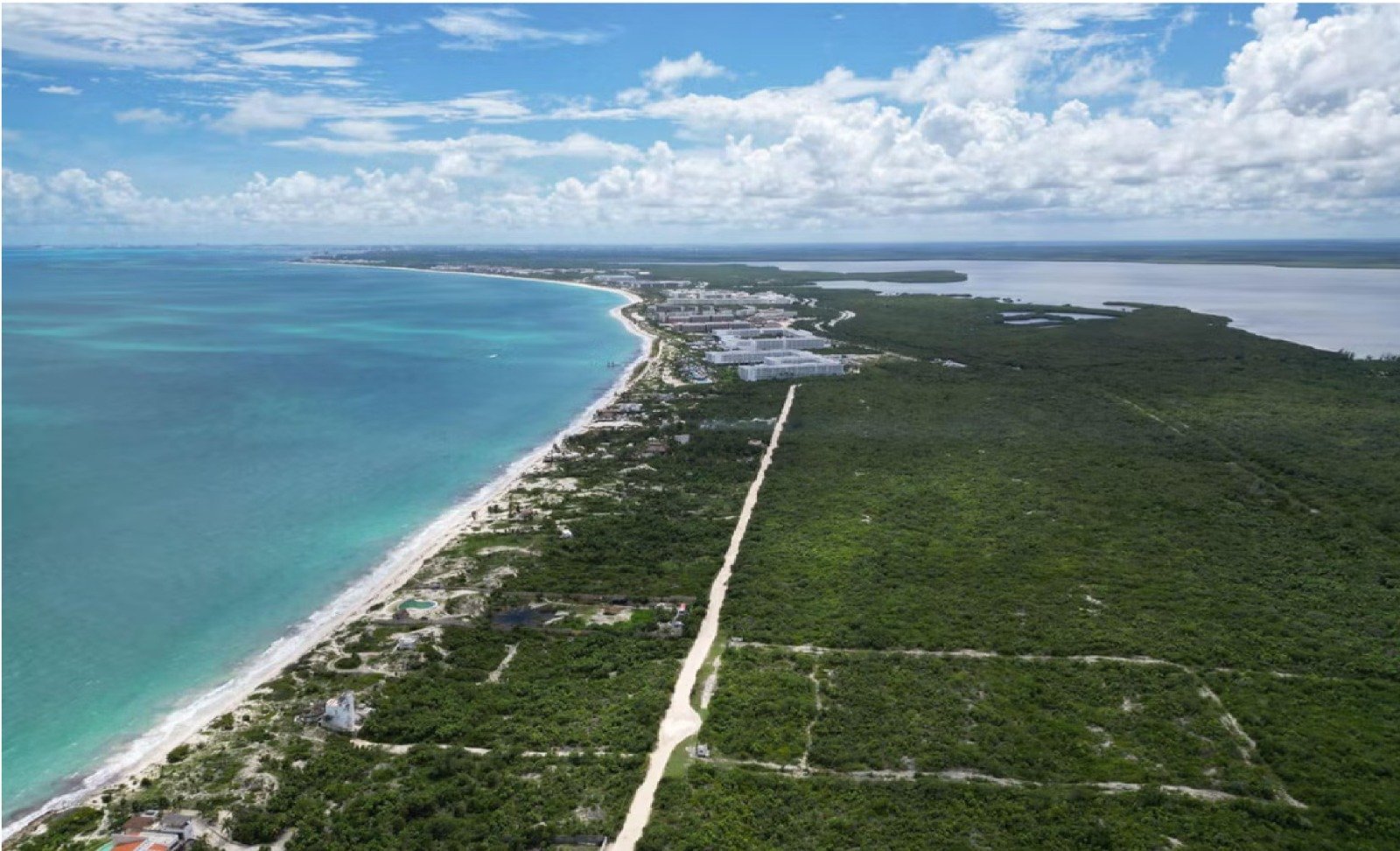
Isla Mujeres, Quintana Roo — A conflict over land ownership is brewing in the Isla Blanca area, threatening to derail plans for a major tourism corridor that officials have touted as the next Cancun. About 300 property owners, both Mexican and foreign, say they face administrative restrictions that prevent them from carrying out cadastral and registry procedures and real estate transactions on land they claim has been recognized as private property for decades.
The dispute centers on plans to build new road infrastructure connecting Costa Mujeres with Isla Blanca, a zone in the municipality of Isla Mujeres that hosts some of Mexico’s most valuable real estate projects and represents the next phase of growth for Cancun and Costa Mujeres. The new roads would dramatically increase the value of thousands of hectares between existing hotel developments and future tourism projects being promoted by the federal Tourism and Economy ministries.
The conflict escalated in March 2026, when Jose Alberto Alonso Ovando, head of Quintana Roo’s Sustainable Urban Development Secretariat, issued a directive ordering state agencies, Isla Mujeres municipal authorities, the Public Property and Commerce Registry, the Municipal Cadastre Directorate, and the Notaries Council of Quintana Roo to refrain from any transactions, registrations, or acts related to the properties in question, arguing they may be federal land.
Property owners say no formal declaration, final administrative resolution, court ruling, reversion proceeding, or individual notification has ever determined that the land ceased to be private property as of 2026. They say they hold deeds, documented chains of title, federal decrees more than 50 years old, property tax receipts, cadastral records, municipal service payments, federal maritime-terrestrial zone concessions, and other administrative acts that have historically recognized their ownership rights.
Affected owners point to an institutional contradiction: while some responses obtained through transparency mechanisms indicate the land is not part of the state’s patrimony, various administrative orders have paralyzed real estate operations, registrations, and procedures in the area.
The uncertainty threatens billions of pesos in planned tourism investment. International experience shows that major infrastructure and development projects require clear land tenure rules. When disputes arise over the legal nature of properties, risks affect not only individual owners but also investors, financial institutions, buyers, developers, and future tourism projects.
No one disputes the economic potential of Isla Blanca or the strategic value of a new road connection, which is part of President Claudia Sheinbaum’s 100 commitments. The question is whether the tourism corridor’s expansion can ignore private property rights by converting land into federal territory without due process.
Property owners say they have all the documentation to support their claims and that the administrative freeze on their assets occurred without a definitive ruling from a competent authority. They are preparing a legal strategy to defend their rights.
At stake is not just a road or a new tourism destination, but legal certainty over thousands of hectares in one of the country’s most economically valuable and investment-rich corridors.
More Development
- Semarnat Approves Artificial Reefs and Sand Relocation for Akumal Hotel
- Chetumal Plans 836 Million Pesos in Stormwater Works to Curb Flooding
- Mara Lezama Delivers 288 Infonavit Homes in Puerto Aventuras as Quintana Roo Targets 76,000
- Fonatur Doubles Maya Ka’an Budget to 20 Million Pesos
- Study Finds Cancún’s Laguna Manatí Mangrove Could Qualify for Carbon Credits
More Cancun
- Man, 25, Killed Outside Cancun Home; Dog Shot, Suspect Caught
- Uber Driver Murdered in Cancun’s La Joya: What We Know
- Cancún Opens Registration for Janal Pixan 2026 Catrina and Altar Contests
- Cancún Launches 2026 Ocular Prosthetics Program With Free Evaluations
- Air France Marks 15 Years of Paris-Cancún Flights