Quintana Roo, Mexico — Quintana Roo maintains, for the fifth consecutive year, the first place nationally in the incidence of the crime of human trafficking, a problem that the state government has recognized as an absolute priority. Governor Mara Lezama has instructed a frontal policy to dismantle the criminal structures that operate mainly behind bars, table dance clubs, and illicit businesses that function as centers of sexual exploitation.
In that effort, the State Attorney General’s Office, headed by Raciel López Salazar, has executed multiple raids, seizures, investigations on its own initiative, and case files integrated with a human trafficking perspective, achieving rescues of victims and the dismantling of operational cells. However, the corrupting power of these networks has proven to have deep tentacles, capable of infiltrating key administrative areas.
Investigation that shakes the state administration
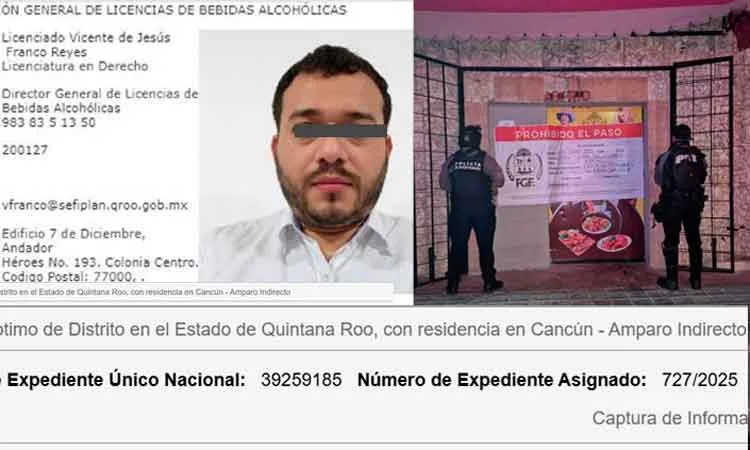
An inter-institutional investigation between prosecutors’ offices, anti-corruption areas, and verification agencies brought to light a link that, until recently, operated in silence: a former official of the Secretariat of Finance and Planning identified as Vicente Franco, allegedly linked to a network that granted illegal provisional permits to bars and restaurants associated with human trafficking.
According to the investigation, Franco charged 50,000 pesos to issue express permits that allowed these establishments to immediately reinstall themselves after being raided or seized by the Attorney General’s Office. They operated in an itinerant manner, moving from one location to another without stopping operations and relying on these permits to file injunctions against the seizure orders.
The permits, a supposedly exceptional and regulated mechanism, were used as a legal shield to obstruct the actions of the investigative authority, thwarting entire operations and allowing the reactivation of businesses linked to sexual exploitation just hours after being shut down.
An inexplicable fortune and a network involving other names
The investigation maintains that Vicente Franco would have accumulated more than 40 properties placed in the names of family members and an alleged frontman identified as Polet. The main hypothesis indicates that these assets derive from resources generated by human trafficking and the systematic collection for these provisional permits.
He did not operate alone. The investigation places him as part of a structure headed together with a woman named Leticia, identified as the direct operator of the establishments that reopened almost immediately after each seizure.
The authorization mechanism: Sefiplan in the spotlight
The provisional permits managed by Franco should have, according to internal procedure, the authorization of the head of Sefiplan, and derive from a request for an alcohol license.
So far, the taxpayers who have appeared before the authority have totally contradicted the former official’s version, denying his complaint about the use of false documents and confirming payments made unofficially, whose financial route has already been traced by investigators.
Furthermore, messages and conversations obtained from mobile devices reinforce the hypothesis of a structured network that used Sefiplan as a way to neutralize the operations of the Attorney General’s Office.
Attorney General’s Office does not yield: the fight continues
Despite the obstacles, the Quintana Roo Attorney General’s Office maintains its strategy firmly. Raciel López Salazar has reiterated that no act of corruption will allow the operation of businesses linked to trafficking and that public servants involved in cover-ups, influence peddling, or irregular issuance of permits will face legal consequences.
Governor Mara Lezama has fully backed these actions and has warned that her administration will not tolerate institutional protection networks that allow trafficking to continue operating under injunctions or permits granted outside the law.
A blow to the network, but not the end
The revelation of the Vicente Franco case confirms that the fight against human trafficking is not only fought in operations or inside clandestine bars: it is also fought inside public offices where corruption can become the key that keeps a multi-million dollar criminal industry alive.
It is worth mentioning that in recent months authorities from the three levels of government have dismantled a dozen criminal groups dedicated to trafficking, with the recovery of at least 100 victims. Although much remains to be done, society’s demand is clear: that this type of official who abuses their position does not go unpunished.
Discover more from Riviera Maya News & Events
Subscribe to get the latest posts sent to your email.