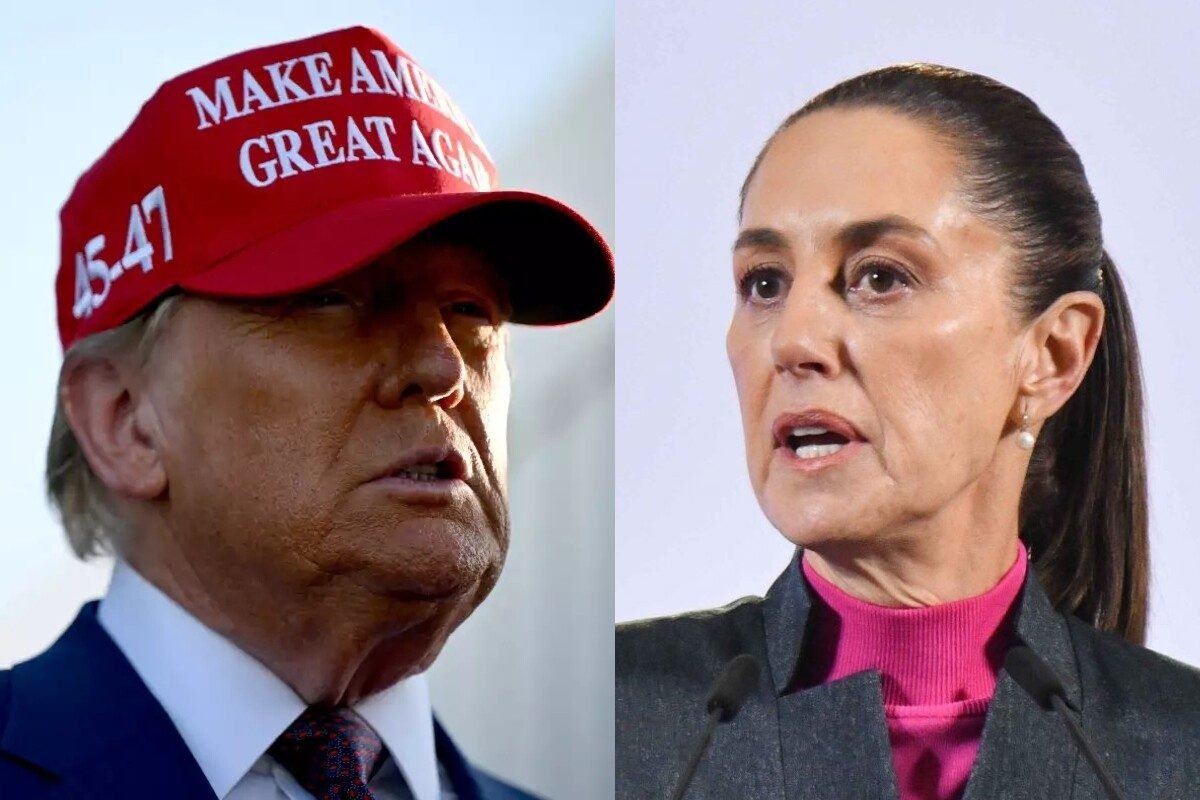
Washington, D.C. — When two governments that share more than 3,000 kilometers of border meet face-to-face for the first time amid a climate of public threats and strategic decisions, the ceremony becomes a stage and the agenda, a battlefield.
The brief meeting that this Friday brought together Donald Trump, Claudia Sheinbaum, and Canadian Prime Minister Mark Carney —taking advantage of the global pull of the World Cup soccer draw— is not a mere protocol gesture: it was preceded by months of open tension, warnings, and a question as explosive as it is simple: how far is Washington willing to go in its fight against cartels if Mexico does not allow military entries?
THE FIRST MEETING: SYMBOL AND TEST
That the first in-person meeting between Trump and Sheinbaum takes place around the soccer celebration —an event designed for celebration and for the international showcase— is not a coincidence or a diplomatic accident: it is a calculated maneuver. For Trump, the event offered image, audience, and the perfect framework to project toughness to his electorate; for Sheinbaum, the opportunity to show firmness about Mexican sovereignty in the face of an internal political burden that demands clear answers to the intensification of violence. The gesture, therefore, is double: a shared photo that attempted to normalize the relationship and, at the same time, a test of political resistance in the face of U.S. pressure.
THE THREAT THAT IS NOT PRONOUNCED AT THE PODIUM
For months the White House has let circulate the idea —through statements, leaks, and public declarations from the president himself— that no option is off the table to stop the flow of fentanyl and other drugs into the United States.
Among those “options” has been installed the possibility, real or instrumental, of deploying U.S. military personnel on Mexican soil. The mere possibility alters the board: it redefines alliances, consolidates nationalist sectors in Mexico, and forces its institutions to respond with a single voice in defense of sovereignty. Sheinbaum has been clear: cooperation yes —intervention with troops, no. That line is the axis of the public discourse she will take to Washington.
WHAT IS BEHIND THE RUMOR: PLANNING, TRAINING, AND LEAKS
The journalistic reports that have circulated describe something more than words: they point to internal planning and preparatory exercises on U.S. territory that, in their most aggressive hypothesis, seek capabilities to act in cross-border scenarios. That does not equate to a deployment order, but it does to a dangerous disease: the normalization of the military option as an instrument of foreign policy against illicit networks. Planning —when it exists— not only conditions future decisions, it also guides narratives and creates political realities that are later difficult to deactivate.
POSSIBLE SCENARIOS (AND THEIR COSTS)
The public discussion and leaks allow outlining, with varying degrees of probability, four operational scenarios that could have been discussed in the corridors of the Kennedy Center and in Washington offices:
- INTENSIFIED COOPERATION WITHOUT MILITARY PRESENCE. Washington receives greater access to intelligence and supports with logistics, training, and technical support from its territory. Costs: low diplomatically, limited operationally.
- JOINT OPERATIONS WITH EXPLICIT PERMISSION. Mexico authorizes specific actions carried out in coordination —but under Mexican control— by combined forces. Costs: difficult politically in Mexico (perception of subjugation), more tactical efficacy if there is a real agreement.
- COVERT ACTIONS UNDER INTELLIGENCE AUTHORITY. A package of discreet, restricted operations designed to minimize public visibility. Costs: legal and political risk if leaked; difficult to control in the medium term.
- UNILATERAL INTERVENTION OF NORTH AMERICAN TROOPS. Extreme scenario: deployment of forces with offensive objectives within Mexican territory. Costs: deep diplomatic crisis, possibility of institutional confrontation, economic damages, increase in violence, and legitimization of the nationalist discourse that Sheinbaum and her allies combat today. This scenario, moreover, would reopen historical wounds and generate repercussions throughout Latin America.
MEXICO’S RESPONSE: SOVEREIGNTY AS A RED LINE
The Mexican government has proposed an explicit and repeated formula: intelligence exchange and technical collaboration, but “no intervention, cooperation without subordination, and the sovereignty of our territories.” That phrase, said another way, is not just a diplomatic slogan; it is the basis of the Executive’s political strategy to stop any external pressure and maintain internal cohesion. Sheinbaum has sought to combine pragmatism (deliveries of capos, judicial and intelligence cooperation) with a message of public firmness that avoids ceding the initiative of the national narrative. At bottom, the Mexican political calculation is elementary: admitting foreign troops would mean a symbolic triumph of the external adversary and would open internal wounds difficult to close.
THE EXCHANGE OFFER: CAPOS, PRISONS, AND THE JUDICIAL COVER
On the bilateral board have also emerged concrete gestures: deliveries of detainees to the United States and judicial cooperation agreements that attempt to function as bargaining chips. Mexico has already sent batches of alleged capos in criminal processes and negotiates the possibility of more transfers to U.S. prisons as part of a broader cooperation package. Those shipments are, for the White House, tangible cards that Mexico is collaborating; for the Mexican Government, a mechanism to mitigate pressure without losing territorial control. But those measures do not substitute the strategic question: the presence of troops is another category.
THE INTERNAL FACTOR: PROTESTS, POLARIZATION, AND THE MAGA NARRATIVE
In Mexico, the political juncture has become porous: while the government seeks to control the nationalist narrative, sectors of the far right and currents akin to MAGA attempt to capitalize on social dissatisfaction and project the image of a failed state that justifies external interventions. In parallel, polls show that, in the face of the perceived incapacity of the State to contain violence, a segment of public opinion —in some cases majority in specific regions— could view foreign help favorably, even military. That fracture is a political risk for Sheinbaum: she must manage a domestic opposition that accuses her of being soft and, at the same time, avoid any gesture that seems like surrender to Washington.
ECONOMY AND CROSSED NEGOTIATION: TARIFFS, USMCA, AND STRATEGIC PRESSURE
The negotiation does not occur in a vacuum. The review of the trade treaty (USMCA), tariff threats, and selective levies are instruments that Washington has used again in its pressure strategy. Trump has integrated the commercial, the migratory, and the security into a single negotiation formula: “everything for everything.” The result is a transactional relationship where sovereignty and security become chips on the table. For Mexico, the logic of reciprocity is dangerous: accepting economic conditions in exchange for concessions in security equates to paying with productive fabric for public security, an equation with long-term social and political risks.
GEOPOLITICAL AND HUMANITARIAN RISKS
A North American military operation in Mexico —or even the credible threat of one— would have effects that go beyond bilateral diplomacy:
- REGIONAL EFFECT: Other countries in Latin America would view with suspicion the normalization of interventions; relations would tense, and the sovereignty narrative would fly through the air.
- INSTITUTIONAL TENSIONS: The international legal apparatus and multilateral forums would be the scene of diplomatic clashes and litigation.
- SOCIAL IMPACT: Internal displacements, increase in collateral violence, and a possible radicalization of criminal groups that would seek to fragment or respond by armed means.
- ECONOMIC COST: Reciprocal tariffs, flight of investments, and a blow to tourism, in addition to the direct expense of any military operation.
WHAT DOES TRUMP REALLY WANT —AND WHAT CAN HE ACHIEVE?
In political analysis, the threat of intervention performs multiple functions: it is a promise for his political base, a pressure mechanism to renegotiate trade agreements, and a way to force concessions in security matters. However, the real efficacy of the military route is debatable: isolated blows against criminal structures have tended to fragment organizations and, in some cases, temporarily increase violence. The complexity of the phenomenon —social roots, illegal economy, corruption, and external demand for drugs— is not resolved with military apparatuses. In that sense, Trump’s threat fulfills more a political function than a technical solution.
THE DAY AFTER THE MEETING
Regardless of the closed content of the conversations that took place in Washington, the final photo will bring immediate effects: it will calibrate expectations, give arguments to those who support the hard line, and, very probably, intensify the public debate in Mexico about to what point the country cedes sovereignty in exchange for security. If the official result is an agreement in terms of greater intelligence exchange and judicial mechanisms, there will be relief in diplomatic corridors; if any opening toward military presence is perceived, tension will skyrocket and the bilateral crisis will escalate.
FINAL READING: SOVEREIGNTY, STRATEGY, AND THE LIMIT OF FORCE
The first face-to-face between Trump and Sheinbaum is not simply the sum of two political biographies; it is the clash of two strategies on how to face a transnational problem: one —the American— that looks with military tools and short-term pressure; the other —the Mexican— that reclaims sovereignty and bets on ways of cooperation that do not imply subordination. Between both extremes there is a slippery terrain where not only policies are negotiated, but symbols: territorial integrity, the capacity of the State to protect its citizens, and mutual respect between neighboring countries.
The result of that negotiation —be it softer rhetoric, a reinforced cooperation package, or a sustained escalation— will mark the course of the North American relationship in the region and, above all, will outline how far the powerful can go when the sovereignty of one country seems to cross with the security of the other.
Discover more from Riviera Maya News & Events
Subscribe to get the latest posts sent to your email.