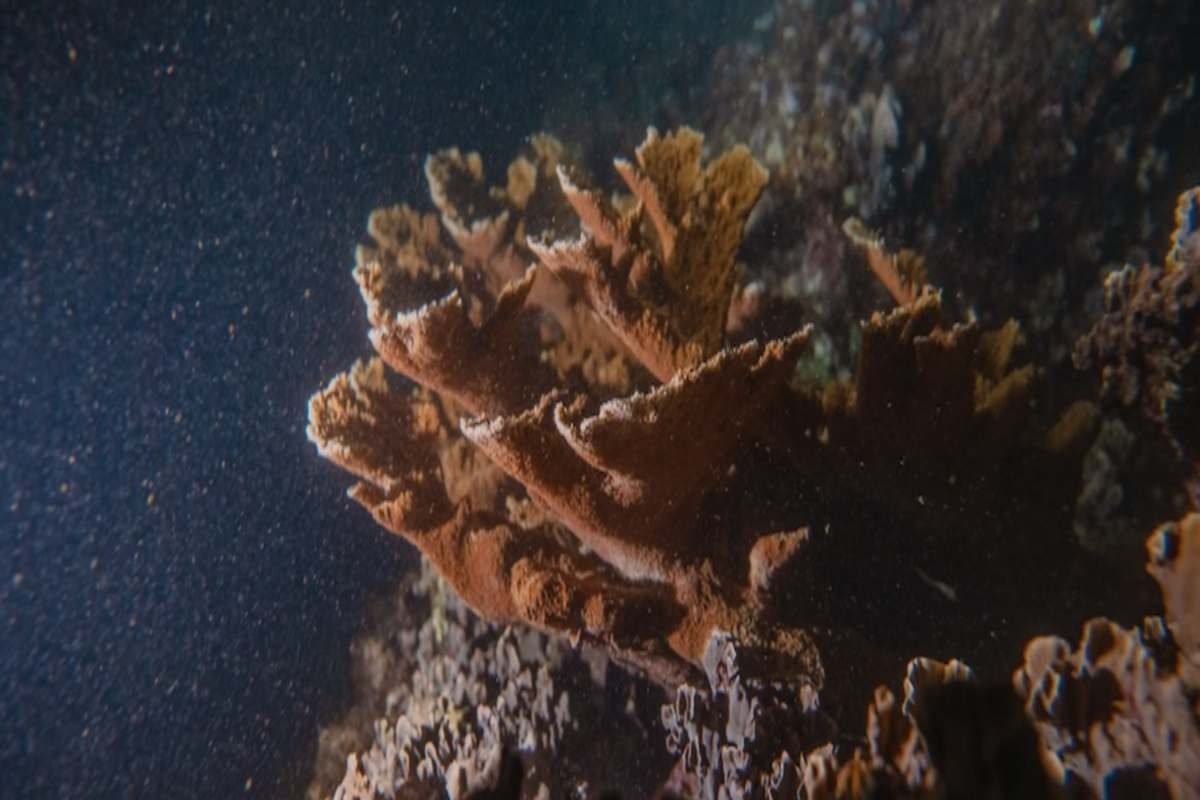
Cozumel, Mexico — Eight years of monitoring reveal that one of the Caribbean's most emblematic corals, the elkhorn coral, is losing synchronicity in its spawning in the waters off Cozumel. Researchers and volunteers have documented the near absence of simultaneous reproduction events, putting both natural and assisted fertilization at serious risk.
A Silent Night on the Reef
During summer nights following the full moon, volunteers and researchers descend into the Caribbean Sea off the coast of Cozumel, a Mexican island located off the Yucatán Peninsula. Their goal is to witness the spawning of the elkhorn coral (Acropora palmata), an event that should occur with ritualistic punctuality. Underwater, the coral's branches reach upward, illuminated by flashlights in the dark water. The team waits for the release of gamete packets—eggs and sperm—that should rise like pink snow.
They wait for an hour. Then two. Then three. Nothing happens.
This repeated absence is the central finding of an eight-year in-situ monitoring effort. The research shows that the elkhorn coral has lost the synchrony that sustains its sexual reproduction in Cozumel. Instead of dozens of colonies releasing gametes simultaneously to enable fertilization, researchers documented an almost complete absence of spawning. They observed only isolated signs of "setting" and no simultaneous events between colonies, a situation that makes even assisted fertilization impossible.
Rigorous Research Reveals a Reproductive Collapse
The research, published in October 2025 in the scientific journal Diversity, was led by Johanna Calle Triviño, a member of the Wave of Change initiative, in collaboration with Ernesto Arias González of the Center for Research and Advanced Studies of the National Polytechnic Institute, along with local organizations and volunteers.
The team monitored 33 colonies on three public beaches on the west side of the island—La Caletita, Tikila, and Playa Corona—during critical periods in the summer. The protocol involved night dives during August and September, between sunset and midnight, on the nights following the full moon.
To rule out the possibility that the coral had simply stopped producing gametes, the researchers also analyzed the internal tissue of the corals. The results were conclusive: internally, the coral does mature. The problem is that the colonies appear to have entered "survival mode," dedicating their energy to resisting stress instead of reproducing.
The consequence is stark. In Cozumel, the colonies no longer form the continuous ridges that characterize the species. The surviving colonies are separated from one another. This reproductive failure means the reef ages silently: it remains standing but loses continuity and biodiversity. Without corals, coastal communities lose the natural defense that protects them from hurricanes.
Due to a drastic population decline of over 95% since the 1980s, the species is listed as Critically Endangered by the International Union for Conservation of Nature (IUCN). Experts warn that saving these reefs requires more than protecting individual colonies; it necessitates restoring the environmental conditions necessary for synchronized reproduction. Locally, they are urgently calling for measures to reduce artificial light, mitigate physical damage to colonies, improve water quality, and implement sexual restoration programs to increase colony density.
The Cornerstone Architect of the Reef
Johanna Calle, who studied marine biology at the University of Bogotá, became obsessed with corals, describing them as "fascinating" organisms. "Forget mammals and all that, what I wanted was to live in the underwater cities that are the coral reefs," she recalls.
The elkhorn coral is nicknamed "the architect of the reef." Its branches act as living infrastructure, providing homes, shelter, and a protective barrier for biodiversity. If it disappears, not only is one species lost, but the very framework upon which many others depend is also lost.
Its reproduction is complex. The elkhorn coral is hermaphroditic, producing eggs and sperm that it releases in gamete packets. Spawning is a collective concert; the coral has mechanisms that prevent self-fertilization and requires its gametes to meet those of a genetically distinct colony.
Success hinges on a very small window: release occurs only once a year, during summer, between August and September, two to ten days after the full moon. The gametes survive for only about an hour on the surface. From this encounter, tiny larvae—planulae—are born, drifting until they find a place to settle and begin building the reef.
"It’s a complicated process," says Calle. "Of every million gametes released, perhaps only one will reach adulthood," she estimates.
A Cocktail of Global and Local Stressors
The stressors affecting Cozumel's elkhorn coral are divided into global factors and local pressures. These act in concert, forcing colonies into survival mode.
Global factors are linked to climate change. Rising sea surface temperatures are a critical factor causing heat stress, which can disrupt the light and tidal signals necessary for spawning. "In 2023, we recorded temperatures as high as 33 degrees Celsius at the study sites. That's far too high," Calle states. She compares it to the human body running a high fever. "The change is too rapid for [almost] any organism to adapt," she concludes.
Rising temperatures are compounded by seasonal drops in sea level, which can leave shallow colonies exposed to the sun. Extreme weather events like hurricanes cause physical damage and fragmentation. Ocean acidification further affects processes like calcification and tissue repair.
Local factors also play a key role. Cozumel has approximately 85,000 inhabitants but is home to the busiest cruise port in Mexico. In 2025, 1,300 cruise ships carrying 4,732,250 passengers arrived, according to data from the Quintana Roo Port Authority (APIQROO).
Artificial light at night from hotels, boats, and docks disrupts the lunar connection corals need for synchronized spawning. "For me, light is one of the triggers [of this process], but it's not the only one," Calle warns.
The study also notes direct mechanical damage from swimmers using corals as steps and entanglement in fishing gear. However, the most worrying factor, according to Calle, is water quality. Nutrient pollution from wastewater runoff and hydrocarbon pollution from heavy maritime traffic push corals into chronic stress, disrupting basic hormonal functions, including reproduction.
Chronic Pressure and the Allee Effect
Germán Méndez, a marine biologist and founder of the Cozumel Coral Reef Restoration Program, has dived in Cozumel for over 40 years. "Cruise ships have been a burden on Cozumel and have affected its entire ecological environment," he states.
Since the 1980s, white band disease has plagued Caribbean corals. Méndez identifies it as a main historical cause of the decline of Acropora palmata. These diseases contributed to a 95% reduction in the species' populations in the Caribbean.
The most recent blow came in 2018 with stony coral tissue loss disease (SCTLD). Méndez asserts the disease arrived via cruise ships and was devastating: "in just one year, it killed 60% of the island's corals." For him, the overwhelming problem is the chronic erosion from a tourism model that overwhelms infrastructure, leaking waste into the sea.
"Cozumel is an island that measures only 60 kilometers long by 12 kilometers wide, and we don't have the infrastructure to handle mass tourism. Even if they try to portray it that way, it's not true," he adds.
Academic research indicates a cruise ship with 3,000 passengers can generate 794,000 liters of black water, 3,780,000 liters of gray water, 94,500 liters of oily water, and eight tons of solid waste on a seven-day trip. A study titled "The Dark Side of Cruise Tourism in Cozumel" indicates such a ship consumes the equivalent of 12,000 cars per day using "fuel oil," a fuel banned on land for its high toxicity.
Disease, pollution, and stress reduce colony size and weaken them, leaving them too dispersed for successful spawning—a phenomenon known as the "Allee effect." Low density turns reproduction into an unlikely gamble.
A Lesson from Jamaica and a Window of Hope
In contrast, researchers observed that on mainland reefs such as Punta Venado and Arrecife Cuevones, elkhorn coral maintained a synchronized annual spawning pattern during the same study period.
A parallel story emerges from Jamaica, which saw nearly 97% of its Acropora palmata colonies die after a mass bleaching event in 2023. When Hurricane Melissa made landfall in October 2025, it became the most devastating storm in Jamaica's history. However, the hurricane's force swept away dead material and macroalgae, exposing the crusty coralline algae that larvae prefer. Two weeks later, researchers observed juvenile corals taking advantage of the space. The 3% of surviving, thermotolerant individuals remained as a seed for recovery.
Jamaica also offered a lesson in management: in small, co-managed marine sanctuaries, surveillance and response were more agile than in large, unmonitored areas. "[In Jamaica] they are small marine protected areas, easy to monitor with support from the public and private sectors and the community. Not like here in the Mexican Caribbean Biosphere Reserve," Calle points out.
In Cozumel, there is no need to wait for a hurricane to open a window of hope. The conditions coral needs—natural light cycles, clean water, space free of macroalgae, and sufficient coral density—can be influenced from land.
"This is a crucial moment here in Cozumel," says Germán Méndez. "We believe we still have time to act through changes in public policy and active conservation and restoration management. The window of opportunity is closing, but some corals are still alive on our shores; let's save them before it's too late."
Discover more from Riviera Maya News & Events
Subscribe to get the latest posts sent to your email.