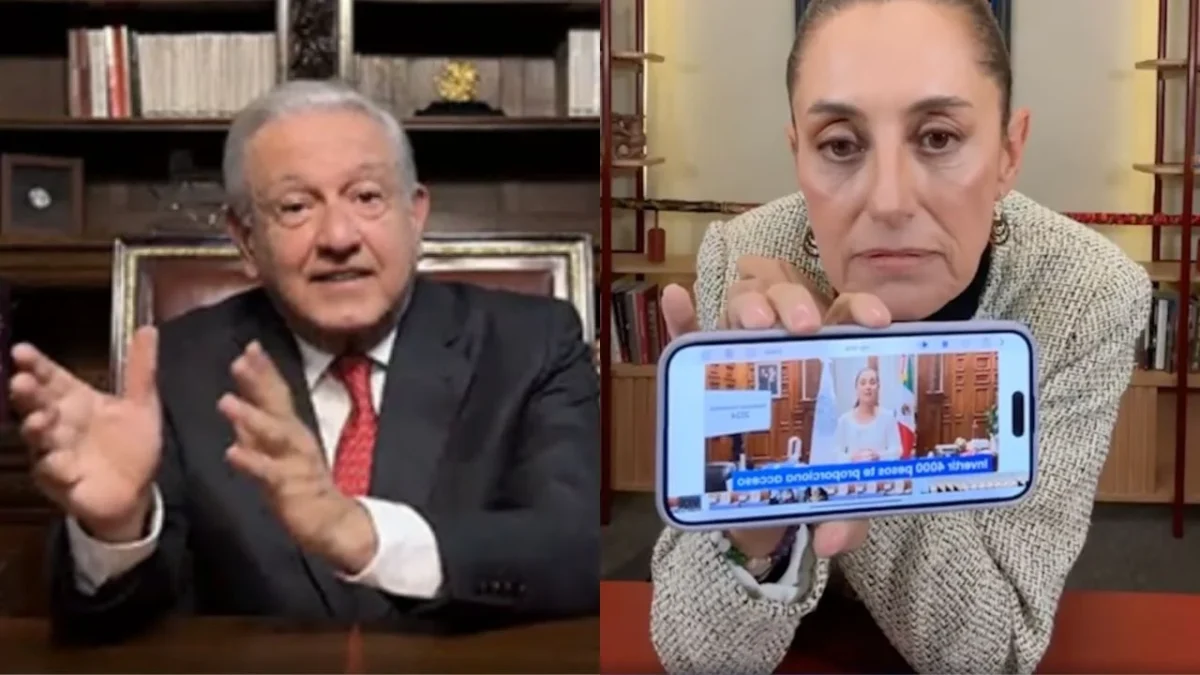
Cybercriminals are targeting Mexico with deepfake attacks, using videos and audio generated by artificial intelligence (AI) to deceive citizens into making false investments by impersonating high-level public figures. Globally, INTERPOL has classified these synthetic media as a growing threat to global security, prompting experts to call on governments to strengthen measures against this crime.
On Wednesday, President Claudia Sheinbaum warned about AI-generated videos that clone her voice and image to attempt to defraud the population with supposed government investments, such as in Pemex. Along with her, the image of Supreme Court President Hugo Aguilar has been used, and in past years, those of Andrés Manuel López Obrador and Carlos Slim, among others.
‘DO NOT PAY ATTENTION TO THEM’: SHEINBAUM ON DEEPFAKES
During her morning press conference, President Sheinbaum stated that all videos showing her or other officials calling for investments are false and created with AI: “Do not pay attention to them.”
On this issue, INTERPOL warns in its report Beyond Illusions: Unmasking the Threat of Synthetic Media to Law Enforcement that organized crime groups are using AI to commit financial fraud, identity theft, and fraudulent investment schemes.
Unit 42, the threat intelligence and cybersecurity research team of Palo Alto Networks, one of the largest digital security companies, highlights that it has detected AI fraud campaigns in various countries, including Mexico, Canada, France, Italy, Turkey, the Czech Republic, Singapore, Kazakhstan, and Uzbekistan, demonstrating the global reach of this threat.
For Unit 42, the similarity of web domains and methods used by cybercriminals leads to the conclusion that it is the same criminal group, not locally focused gangs.
“Each of these fraudulent websites is part of a much broader campaign and not isolated sites created for occasional scams,” says the report The Dynamics of Deepfake Scams.
ANALYSIS
Specialist Claudia Del Pozo, founder and director of Eon Institute, stated that governments must properly punish the harmful use of AI. She warned that “one no longer has to be an AI expert to create an AI fraud scheme; more or less anyone can achieve it.”
In an interview with 24 HORAS, she stated that the challenge now is that “generative AI video content creation tools have restrictions so they cannot use the face of a known person, a famous person.” She warned that these practices will not disappear, “and rather it is up to us as an audience to be more critical and especially up to the media to help us distinguish what is real and what is false, and up to regulators to properly punish.”
Meanwhile, Julio César Vega Gómez, general director of the Mexican Internet Association, declared to this newspaper that these videos are neither generated nor promoted by companies related to the internet.
REPRIMAND SENT TO GOOGLE MEXICO
On Monday, the president of the Senate’s Political Coordination Board (Jucopo), Adán Augusto López, sent a reprimand to Hugo Martínez McNaught, head of Government Relations and Public Policy at Google Mexico, for “allowing” the use of the platform with false messages from President Claudia Sheinbaum, created with artificial intelligence.
“This is the result of the profit-seeking intent of practices carried out by organized crime and has nothing to do with the purposes of the companies through which these videos circulate,” clarified Vega Gómez.
CALL TO REPORT DEEPFAKES TO CYBER POLICE
In recent months, both the National Commission for the Protection and Defense of Financial Services Users (Condusef) and the Digital Agency for Public Innovation (ADIP) of Mexico City have issued alerts to the population about deepfakes, videos generated with AI to defraud using the image of public figures.
In June, Condusef indicated that criminals are illegally using the identity and image of public figures and financial content creators, with artificial intelligence tools, to give credibility to false advertisements and obtain money or personal data.
While in September, ADIP called on the population to review the content they consume on the internet, identifying if videos have artificial voices, blurry pixels, unnatural eyes and mouths, or incongruent lighting, as well as to report any deepfake fraud attempts to the Mexico City Cyber Police.
Discover more from Riviera Maya News & Events
Subscribe to get the latest posts sent to your email.