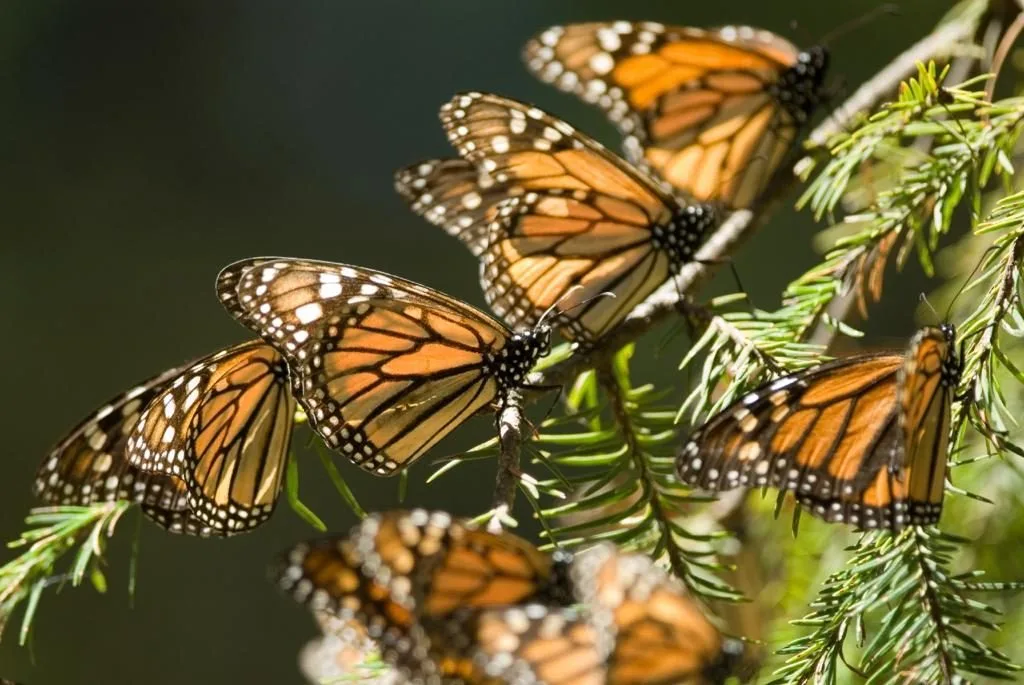
Mexico City — Climate change threatens the habitat of monarch butterflies, with scientific models predicting a southward shift due to rising temperatures and food availability, potentially altering the species’ mass migration patterns.
Each year, millions of monarch butterflies travel thousands of kilometers from breeding grounds in Canada and the United States to overwintering sites in central Mexico. Researchers now warn that their habitat could move south as a consequence of climate change.
The study, coordinated by researchers Francisco Botello and Carolina Ureta from the National Autonomous University of Mexico (UNAM), follows years of warnings about drastic declines in migratory monarch numbers due to habitat loss, parasites, and reduced availability of host plants. Their findings appear in the journal Plos Climate.
Monarch butterflies (Danaus plexippus) depend on milkweed plants of the Asclepias genus, which provide egg-laying sites, food, and toxic compounds that protect caterpillars and adult butterflies from predators. Climate change could affect the availability of these plants and alter migration triggers like temperature.
Researchers used computational models to predict suitable habitat locations in Mexico for monarch eggs and caterpillars, as well as for tropical milkweed plants, in 2030, 2050, and 2070. The results forecast a decline in suitable habitat of between 8% and 40% by 2070.
Monarch habitat would shift southward, driven by climate changes and the geographic distribution of these plants, concentrating egg-laying sites and food plant availability more in southern Mexico and fracturing existing migration routes.
Delayed Flowering Also Due to Climate Change
The publication of this study coincides with another report in the journal Plos One, which warns that tropical flowers are blooming weeks later than usual due to climate change.
Researchers from the University of Colorado-Boulder conducted this work, finding that climate change has caused some tropical plants to flower earlier or later than usual—sometimes by weeks or even months—after analyzing the flowering of about 8,000 flowers over more than two centuries.
These changes in plant reproductive behavior could have broad ecological consequences, particularly for pollinators and herbivores, the researchers confirmed. They noted that this issue has generally been considered less concerning in tropical regions, where temperatures fluctuate less throughout the year, so it might not be a key factor in flowering timing.
The researchers compiled data from museum collections of more than 8,000 flowers collected between 1794 and 2024, representing 33 tropical species with different annual flowering periods.
Comparing the collection dates of each flower revealed that the flowering periods of these species have shifted over time by an average of two days per decade.
The most extreme examples include Ghana’s rattlebox shrubs, whose flowering period advanced by 17 days between the 1950s and 1990s, and Brazilian amaranths, which now flower 80 days later than in the 1950s.
Similar magnitude changes have been reported in temperate and boreal flower species, contradicting the hypothesis that tropical flowers are less susceptible to climate-induced changes in their reproductive habits.
The researchers emphasized that the ecological impacts are not yet clear, but these shifts in flowering times could threaten dependency relationships between plants, pollinators, and seed-dispersing frugivores, increasing the likelihood that changes in flowering periods affect tropical ecosystems overall.
Discover more from Riviera Maya News & Events
Subscribe to get the latest posts sent to your email.