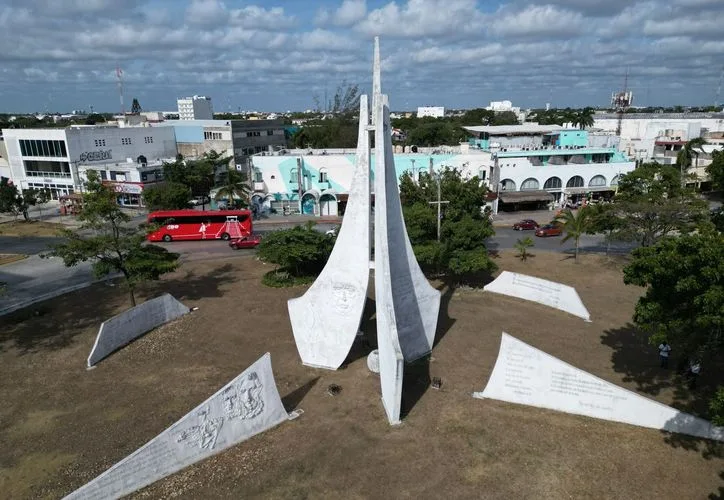
Cancún, Quintana Roo — The historical and architectural heritage of Cancún faces silent deterioration that threatens to erase the city’s memory, according to a local architect and cultural heritage committee member.
José Francisco Romero López, an architect and member of the City Council’s Cultural Heritage Committee, argues that preserving public spaces should be a priority for the dignity of residents, who are the rightful “enjoyers” of these monuments.
This stagnation in preservation efforts appears paradoxical given existing legal protections. Romero López notes that in September 2016, authorities unanimously approved the first Inventory of Tangible Cultural Heritage, which protects 38 material expressions including the Municipal Palace, monumental fountains, and the Sor Juana Aqueduct.
Although its publication in the Official Gazette makes it a mandatory law, the reality on the streets differs significantly.
“Sometimes we think that because they’re made of stone or metal, they don’t scream or need to eat and are therefore safe, but everything deteriorates,” Romero López said. “Today, intangible heritage like dance receives much attention, but the monuments are there, like in the backyard, suffering permanent neglect.”
He identified what he called the “dictatorship of the automobile” as one factor that has most damaged the relationship between citizens and their history. Current urban design has turned monuments into inaccessible “islets” surrounded by heavy traffic.
The architect lamented that emblematic works like the History Monument or the Tulum Avenue Aqueduct show graffiti and withered landscaping, while the Casa Lima—a 1968 stronghold that fuses regional materials with concrete—survives with what he called “flimsy” museographic efforts based on photocopies and cardboard.
“The monument exists to create social space, but today young people don’t even see them because we pass by at 80 kilometers per hour,” Romero López emphasized. “We cannot surrender to forgetfulness; we must recover these spaces to build citizenship.”
The situation becomes more complex amid growing real estate pressure threatening the foundational zone. The specialist warns that the original Supermanzanas model, designed with walkways and plazas for pedestrian use, risks being undermined by projects prioritizing car use and excessive vertical density.
For Romero López, the city center should maintain a human scale of maximum five levels, leaving skyscrapers for corridors like Bonampak or Colosio. In this context, he criticizes how the vacation rental boom is displacing Cancún families, turning the urban core into a “dead historic center” after 8 p.m., similar to what occurs in other regional cities.
“The city’s dynamics are very fast and we need to stay connected,” he concluded. “Material heritage is a sacred debt, and citizens will only respect it again when the government demonstrates it won’t surrender to maintenance neglect.”
Discover more from Riviera Maya News & Events
Subscribe to get the latest posts sent to your email.