
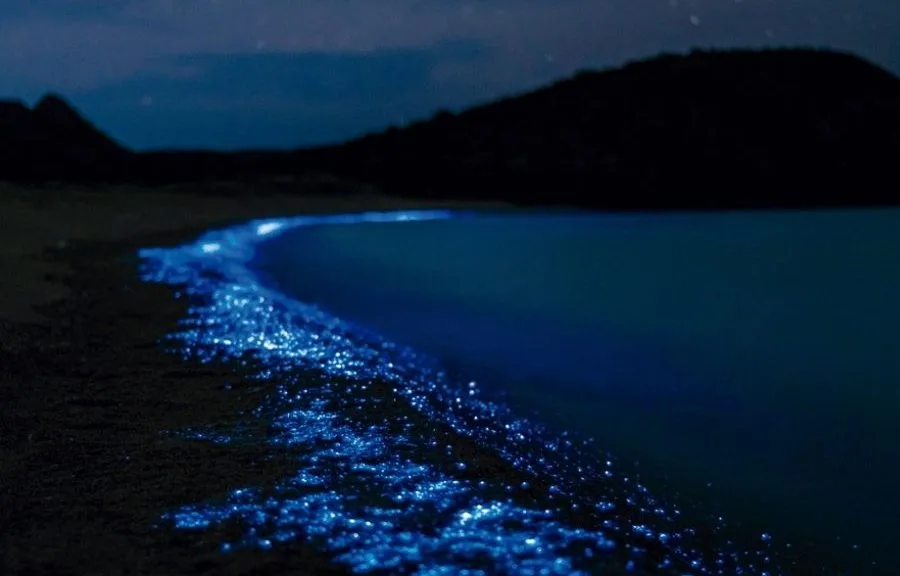
ISLA HOLBOX, Quintana Roo — Holbox is best known for sandy streets, shallow turquoise water and sunset golf-cart traffic, but one of the island’s most memorable natural attractions happens after dark.
On moonless nights, especially during the warm summer months, the water around parts of Holbox can flash with a blue-green glow when disturbed by movement. The phenomenon is called bioluminescence, and it is caused by tiny marine organisms, often dinoflagellates, that produce light through a chemical reaction. National Geographic explains that bioluminescent dinoflagellates create light through a luciferin-luciferase reaction, while marine researchers note that many dinoflagellates flash when mechanically stimulated by movement in the water.
In practical terms, that means the glow appears when waves break, a kayak paddle moves through the water, or someone gently swirls a hand or foot in the shallows.
When to Go
Bioluminescence can sometimes be seen outside peak season, but the best viewing in Holbox is generally during the warmer, darker nights of summer. Local travel operators and Holbox guides most often point to the period from June through September, with July and August frequently described as especially favorable months.
That does not mean every summer night will be spectacular. Bioluminescence depends on plankton concentration, water movement, weather, cloud cover, sea conditions and light pollution. Some nights produce an obvious glow. Other nights are faint. Occasionally, visitors see very little at all.
The moon matters almost as much as the month. The darker the night, the easier it is to see the glow. A new moon or nights close to it are best. A bright full moon can wash out the effect, making even active bioluminescence look weak.
Where to See It
The best-known viewing area is Punta Cocos, on the western end of Holbox. It is one of the most popular places for bioluminescence tours because the water is shallow and calm, and the area is far enough from the brighter lights of town to offer darker viewing conditions. Punta Cocos is widely identified as a place where the glow can be observed on dark nights.
Some visitors and guides also mention Punta Mosquito, another natural area of Holbox, though access and conditions can vary. In either case, visitors should remember that Holbox is part of the Yum Balam natural protected area, and sensitive dunes, wetlands, mangroves and wildlife habitat should be treated with care.
Tour or Go on Your Own?
Visitors have two basic options: join a guided tour or go independently.
Local operators offer nighttime bioluminescence experiences by walking tour, golf-cart transport or kayak, often combined with stargazing. Prices vary by operator and season, but many basic tours are advertised around 400 pesos per person, while other tours may cost more depending on transportation, group size and inclusions.
A guided tour can be useful for first-time visitors because guides know the darker areas, the best timing and the rules for visiting responsibly. It is also the safer option for anyone unfamiliar with Holbox at night, especially after rain, when the sandy roads can flood.
Going independently is possible, especially to Punta Cocos, but visitors should bring a small light for walking, avoid shining it directly into the water, and be cautious on the roads and beach after dark. Many people aim to arrive after 8:30 or 9 p.m., though some tours recommend later viewing, closer to 10 or 11 p.m., when the sky is darker and town lights are less intrusive.
Why the Water Glows
The glow is not magic, though it does a pretty good impression.
Many bioluminescent plankton produce light as a defense mechanism. Scripps Institution of Oceanography explains that dinoflagellates can flash when disturbed, a response thought to startle predators or draw attention to whatever is trying to eat them.
That is why the glow often appears as sparks or streaks when the water moves. A wave breaks. A fish darts by. A footstep disturbs the shallows. The plankton respond with tiny bursts of light.
Responsible Viewing Tips
The most important rule is simple: enjoy the glow without damaging the place that creates it.
Use insect repellent before walking to the beach, but avoid entering the water covered in repellent, sunscreen, lotions or oils. These products can contaminate shallow water and harm marine life.
Do not shine phone lights, flashlights or camera flashes directly onto the water. Bright light makes the glow harder for everyone to see and disturbs the nighttime environment.
Do not collect water, disturb wildlife, walk through dunes or leave trash behind. Holbox’s appeal depends on fragile natural systems, and bioluminescence tourism only works if those areas remain healthy.
Visitors should also manage expectations. Bioluminescence is a natural event, not a scheduled show. The best approach is to choose a dark night, go with patience and treat even a faint glow as what it is: a brief encounter with one of the stranger and more beautiful tricks of the sea.
More Environment
- Deer at Calle 88 Raises Alarm Over CFE Cozumel Cable Plan
- Yucatán Leads Mexico’s Octopus Production With More Than 28,000 Tons
- Xcalak Residents Warn of Dead Fish and Contaminated Water as Sargassum Piles Up
- Mexico Seizes Three Boats at Arrecife Alacranes Over Illegal Activities
- Pink Flamingos Find Refuge in Cancún’s Nichupté Lagoon, Officials Say