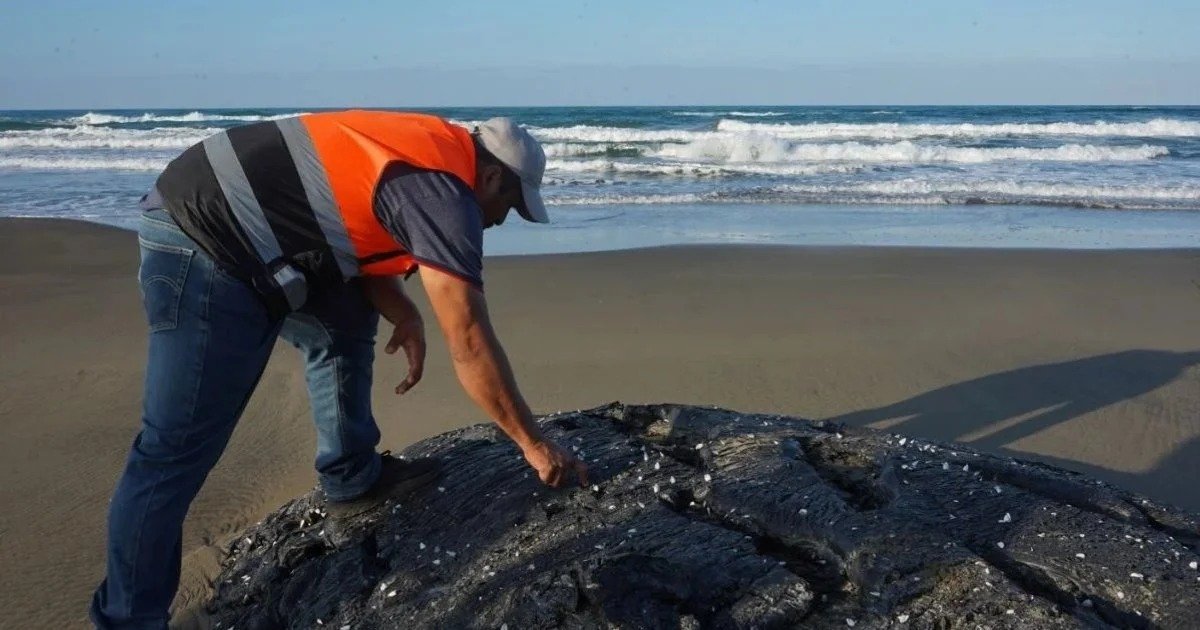
Mexico — Eleven days after a hydrocarbon spill began contaminating kilometers of coastline in the states of Veracruz and Tabasco, the Ministry of Environment and Natural Resources (Semarnat) reported that "inter-institutional coordination" actions are underway to address the environmental emergency.
The ministry stated that, although the incidents "have not been linked to Pemex (Petróleos Mexicanos) operations," the state-owned company initiated containment and cleanup actions at sea. This included deploying its vessel Oil Rec, installing barriers, and conducting recovery work "that allowed the expansion of the slick to be controlled." Furthermore, beach cleaning brigades were launched with the support of fishermen, local authorities, and communities in the region.
Since the beginning of March, environmental organizations and residents have reported the presence of tar affecting at least 39 towns and 230 kilometers of coastline in those states. After receiving no initial response from authorities, locals began cleaning the beaches themselves, as their livelihoods—including fishing and tourism—and the area's biodiversity were impacted.
Source of Contaminant Under Evaluation
In a press release, Semarnat stated that "the source of the contaminant is still being evaluated." The agency explained that reconnaissance flights with aircraft, surface maritime patrols, drones, satellite mapping, and studies of ocean currents have been employed to assess the possible expansion of the material and establish containment and mitigation measures.
Due to "weather conditions and variations in ocean currents," oil slicks have been detected on beaches in the Gulf of Mexico, particularly in the areas of Alvarado and Coatzacoalcos, Veracruz, and along the coast of Tabasco. In the case of Dos Bocas, the spill's spread is evolving differently than initially predicted for this scenario.
The federal agency stated that once the source of the pollutant is identified, authorities will proceed in accordance with applicable legislation to sanction the responsible company and ensure the repair of environmental damage.
According to Semarnat, after the first reports in early March, technical personnel from the Agency for Safety, Energy and Environment (ASEA) carried out verification tours of port facilities and coastal areas. During these inspections, "no leaks were detected in terminals or infrastructure near the coast"; however, in some beach sections, "hydrocarbons with different degrees of weathering" were identified.
The response actions are being carried out through the Unified Command Center of Veracruz, which includes the Secretariat of the Navy, Pemex, Civil Protection, the Environmental Attorney's Office, and the Port and Fishing Community, in coordination with authorities from Tabasco and Veracruz.
Governor Pledges Cleanup Before Holiday Season
The governor of Veracruz, Rocío Nahle García, assured that the hydrocarbon detected on the state's coasts will be removed before the start of the Easter holidays. The governor stated that some oil spills have continued to reach the shores of some beaches in Veracruz but assured it is a small amount compared to what was recorded in recent days.
She added that due to strong winds expected for the weekend, the tar could increase in some areas that have already been cleaned. "Very small traces have already arrived in Boca del Río," she said. "It's not much that has been arriving, we're going to have a northerly flow, so we're going to wait."
Nahle García stated on Thursday that the fuel came from an oil tanker, owned by a private company, which was conducting exploration activities in the waters of the neighboring state of Tabasco. The fuel first spread to beaches in southern Veracruz due to ocean currents in the Gulf of Mexico. Sources close to Pemex corroborated this version of events.
Fishing Sector Reports Million-Dollar Losses in Alvarado
Jaime Santiago Rojas, president of the Federation of Fishing Cooperative Societies in Alvarado, explained that in just a few days many of the nets used by fishermen were covered in tar, rendering them completely unusable. He emphasized that each net has a value exceeding 150,000 pesos due to its size and that the days fishermen have been unable to work due to the hydrocarbon floating in the water must also be taken into account.
"We had a material loss of approximately 2 or 3 million pesos in fishing equipment," he said. "Nets and ropes are what were most damaged." He expressed confidence that the federal and state authorities involved would soon provide support to all those affected.
Discover more from Riviera Maya News & Events
Subscribe to get the latest posts sent to your email.