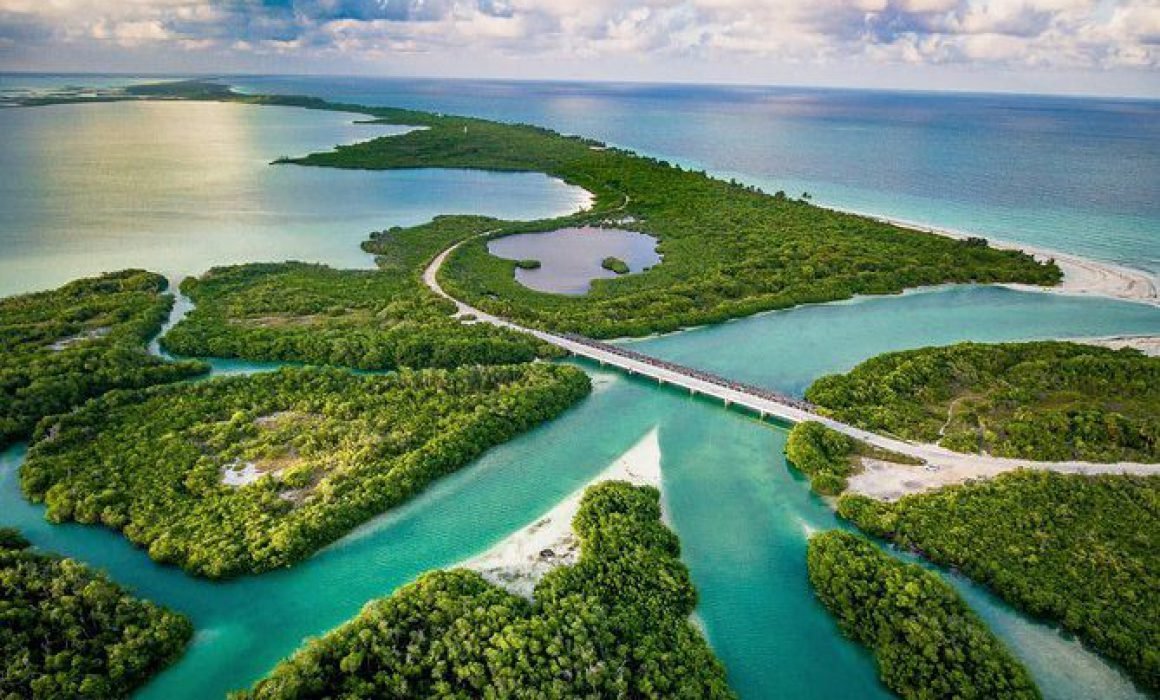
CHETUMAL, Quintana Roo — Poetry, pre-Hispanic music, and academic reflection came together deep within the Sian Ka’an Biosphere Reserve as students and faculty from the Autonomous University of the State of Quintana Roo (UQROO) commemorated the reserve’s 40th anniversary. The event, held on January 26 at the Santa Teresa station—often described as the heart of the protected area—highlighted a central message: safeguarding Sian Ka’an requires not only science and policy, but also culture, memory, and community engagement.
Marking four decades since its establishment in 1986, the anniversary served as both a celebration and a reminder of what is at stake in one of Mexico’s most ecologically important regions.
A Ceremony Rooted in Ancestral Expression
UQROO’s participation placed Maya cultural heritage at the center of the commemoration. The university’s group Jobón Pax performed music using pre-Hispanic instruments, filling the forest clearing with sounds that predate modern conservation frameworks by centuries.
Among the pieces performed was Yuum Cháak, dedicated to the Maya rain deity. As if underscoring the symbolic power of the moment, a light drizzle began to fall during the performance. Another piece, áalkab kéej, traditionally associated with dance, renewal, and growth, reinforced the deep relationship between nature and Maya ceremonial life.
For organizers and participants alike, the setting mattered. Santa Teresa station is not simply a logistical hub within the reserve—it is a place where scientific monitoring, ranger activity, and cultural memory intersect.
Poetry as Environmental Testimony
The program also featured original poetry by academic Ever Marcelino Canul Góngora, who shared previously unpublished works centered on the environment, wild flora, and fauna of the region. His poems, he explained, are part of a forthcoming book that seeks to document nature not only through data, but through language and emotion.
Canul Góngora noted that UQROO’s presence in Sian Ka’an forms part of a long-standing collaboration with the National Commission of Natural Protected Areas (CONANP), the federal body responsible for managing Mexico’s protected natural areas.
This collaboration, he said, reflects a broader vision of conservation—one that values interdisciplinary work and recognizes that protecting ecosystems also means protecting the cultural narratives tied to them.
What Makes Sian Ka’an So Important
Sian Ka’an, which means “Origin of the Sky” in the Maya language, is one of the largest protected areas in the Mexican Caribbean. Covering more than 528,000 hectares of terrestrial and marine environments, the reserve spans parts of several municipalities in southern Quintana Roo and forms part of a vast ecological corridor that connects coastal, wetland, and jungle systems.
In 1987, just one year after its creation, Sian Ka’an was designated a UNESCO World Heritage Site, recognizing its outstanding universal value. The designation reflects not only the area’s biodiversity, but also the integrity of its ecosystems, many of which remain relatively undisturbed.
The reserve encompasses:
- Tropical forests that are part of the Mesoamerican Biological Corridor
- Mangrove systems that protect coastlines and serve as nurseries for marine life
- Freshwater and brackish lagoons, including the Muyil and Chunyaxché systems
- Coral reefs and seagrass beds along its Caribbean coastline
Perhaps most uniquely, Sian Ka’an sits atop an extensive network of underground rivers and cenotes, part of the same karst system that defines much of the Yucatán Peninsula. These subterranean waterways connect inland forests with the sea, meaning that pollution or disturbance in one area can have cascading effects far beyond its source.
A Haven for Flora and Fauna
Authorities and researchers consistently emphasize Sian Ka’an’s role as a biodiversity stronghold. The reserve is home to hundreds of species of birds, mammals, reptiles, amphibians, and fish, many of them threatened or endangered.
Among the most emblematic species are:
- The jaguar, a keystone predator whose presence signals healthy ecosystems
- The West Indian manatee, which depends on clean, calm coastal and lagoon waters
- Several species of sea turtles, which nest along protected beaches
- Crocodiles, tapirs, spider monkeys, and an extraordinary diversity of migratory birds
Flora within the reserve is equally significant, ranging from towering hardwood trees in inland forests to salt-tolerant mangroves and delicate aquatic plants in freshwater wetlands. Together, these plant communities stabilize soils, regulate water cycles, and store carbon—services that are increasingly critical in the face of climate change.
Conservation Under Pressure
Despite its protected status, Sian Ka’an is not immune to external pressures. Urban expansion, tourism development outside reserve boundaries, climate change, and pollution all pose ongoing challenges.
Rising sea levels threaten mangroves and coastal lagoons, while changes in rainfall patterns can disrupt freshwater systems. Meanwhile, groundwater contamination—often originating far from the reserve—can travel through underground rivers and emerge within protected zones.
These realities make the work of CONANP, academic institutions like UQROO, and local communities especially important. Conservation in Sian Ka’an is not a static achievement, but a continuous process that requires monitoring, education, and adaptive management.
Education as a Conservation Tool
UQROO’s involvement in the anniversary event reflects a broader role the university plays in environmental research and training in southern Quintana Roo. Through fieldwork, community outreach, and collaboration with federal agencies, the institution helps prepare future scientists, educators, and policymakers to engage with the region’s environmental challenges.
University representatives stressed that bringing students into direct contact with places like Sian Ka’an fosters a sense of responsibility that cannot be taught in classrooms alone. Experiencing the reserve—its sounds, landscapes, and living systems—helps translate abstract concepts like biodiversity and sustainability into lived understanding.
Culture, Science, and the Future
As the anniversary ceremony concluded, the underlying message was clear: Sian Ka’an’s future depends on the integration of multiple ways of knowing. Scientific research provides data and management strategies, while cultural expressions—music, poetry, and ritual—anchor conservation efforts in identity and history.
For many Maya communities, the landscapes now designated as protected areas have long been places of meaning, subsistence, and spiritual connection. Recognizing that continuity strengthens conservation, rather than undermines it.
Forty years after its creation, Sian Ka’an remains a symbol of what is possible when protection is rooted in respect—for nature, for culture, and for future generations. The challenge ahead is ensuring that this balance endures in a rapidly changing world.
Discover more from Riviera Maya News & Events
Subscribe to get the latest posts sent to your email.