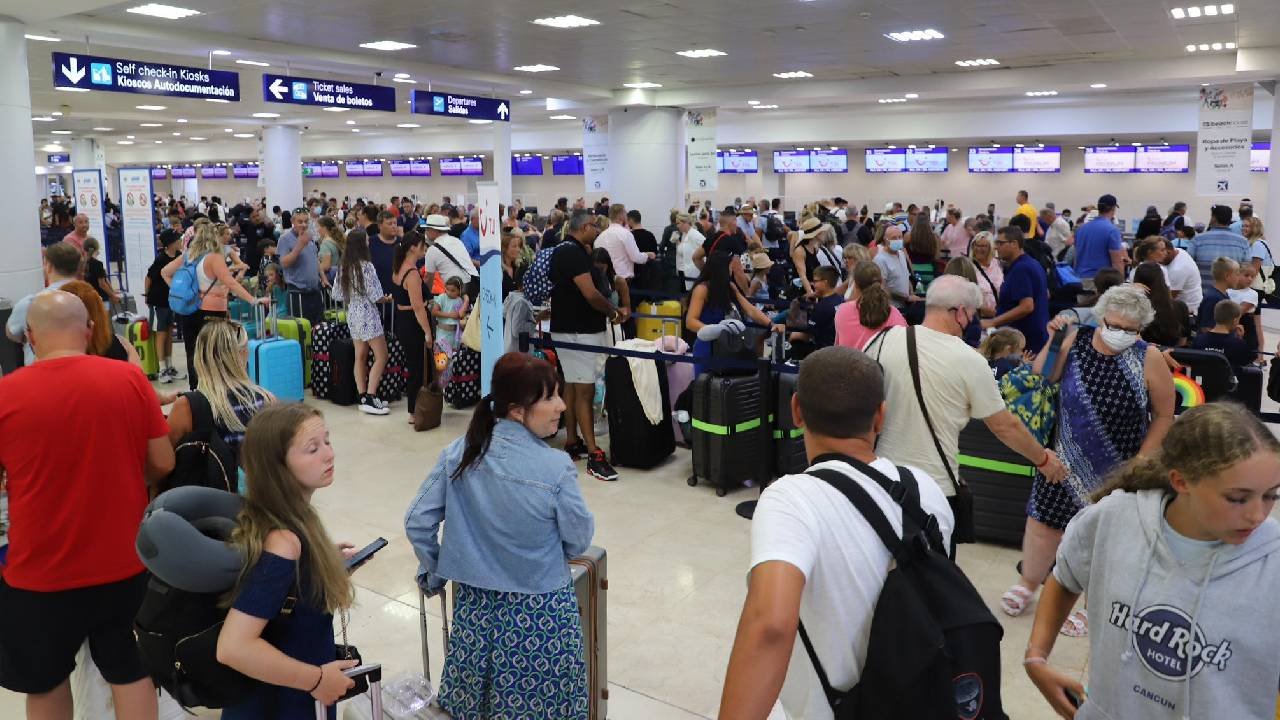
Quintana Roo, Mexico — The tourism activity of Quintana Roo registered a significant setback through October 2025, marked mainly by a decrease in air mobility, which directly impacted the arrival of visitors to the Mexican Caribbean.
According to the Statistical Summary of Tourism Activity from the Quintana Roo Secretariat of Tourism (Sedetur), the state lost 671,907 tourists compared to the same period in 2024, reflecting a slowdown environment in one of the key sectors of the state’s economy.
Lower Tourist Arrivals Despite Market Diversification
Between January and October 2025, the Mexican Caribbean received 16.48 million tourists, a figure that represented a drop of 3.9 percent compared to the 17.16 million registered in the same span the previous year.
Of the total visitors, 63.7 percent corresponded to international tourism, while 36.3 percent was domestic tourism, maintaining the high dependence on the foreign market, despite diversification efforts.
United States and Mexico, the Main Source Markets
The United States consolidated as the main source market, with 6.10 million tourists, equivalent to 37.2 percent of the total. It was followed by domestic tourism, with 6.05 million visitors, and Canada, with 1.60 million.
Other international markets had smaller shares: the United Kingdom represented 2.4 percent and Argentina 1.7 percent of the total tourists who arrived in Quintana Roo in the analyzed period.
Air Transport Decline, Key Factor in Tourism Contraction
The performance of air transport was one of the main factors that explained the decrease in tourism activity. During the first ten months of 2025, Quintana Roo’s airports mobilized 26.15 million passengers, which meant a reduction of 3.59 percent compared to the same period in 2024.
Cancun Registers Decline; Tulum Shows Growth
Cancun International Airport concentrated the highest volume, with 24.25 million passengers, although it reported a drop of 3.80 percent.
In contrast, Tulum International Airport showed a positive performance, registering a growth of 6.61 percent and mobilizing 1.02 million passengers, consolidating itself as the main point of air growth in the state, although still with a lower volume compared to Cancun.
Uneven Behavior by Passenger Nationality
In the analysis of international passengers, the U.S. market reported 4.72 million travelers, with a reduction of 5.1 percent.
Canada stood out with a growth of 6.6 percent, reaching 1.27 million passengers, while Argentina excelled with an increase of 20.9 percent, adding 221,008 travelers.
In the opposite direction, Colombia registered one of the most pronounced falls, with 140,511 passengers, which represented a decline of 29.9 percent.
Air Connectivity Maintained Despite General Downturn
During October 2025, Quintana Roo maintained air connectivity with 100 cities, of which 34 were located in the United States and 24 in Mexico.
Furthermore, the state preserved links with 13 countries in Latin America and 10 in Europe, which allowed it to sustain its international presence, despite the general decrease in passenger flow.
Cruise Tourism Grows and Mitigates Air Impact
In contrast to air transport, cruise tourism presented positive behavior. Between January and October 2025, 6.01 million visitors and crew members arrived, representing a growth of 4.2 percent compared to 2024.
Mahahual Stands Out for Its Dynamism
Cozumel received 3.76 million cruise passengers, with a marginal growth of 0.60 percent, while Mahahual stood out with 2.25 million visitors and an increase of 10.78 percent, consolidating itself as one of the ports with the greatest dynamism.
Hotel Occupancy Averages 70.2%
The average hotel occupancy in the Mexican Caribbean stood at 70.2% during the first ten months of 2025.
The zones with the highest occupancy levels were Costa Mujeres (77.9%), Cancun (72.1%), and Riviera Maya (70.1%). In contrast, Maya Kaan and Mahahual reported the lowest levels, with 37.2 and 46.7 percent, respectively.
Archaeological Zones and Maya Train Show Mixed Results
The state’s archaeological zones registered 1.41 million visitors, which meant a decrease of 1.5 percent compared to 2024. Nevertheless, the opening of Ichkabal in January 2025 notably boosted the sites in the south of the state.
Dzibanche-Kinichna stood out, with a growth of 408%, and Kohunlich, with 165.6%, while zones like El Rey and Tulum reported relevant declines.
Finally, the Maya Train in Quintana Roo transported 893,203 passengers between January and October 2025, with a majority participation of domestic travelers.
Discover more from Riviera Maya News & Events
Subscribe to get the latest posts sent to your email.