
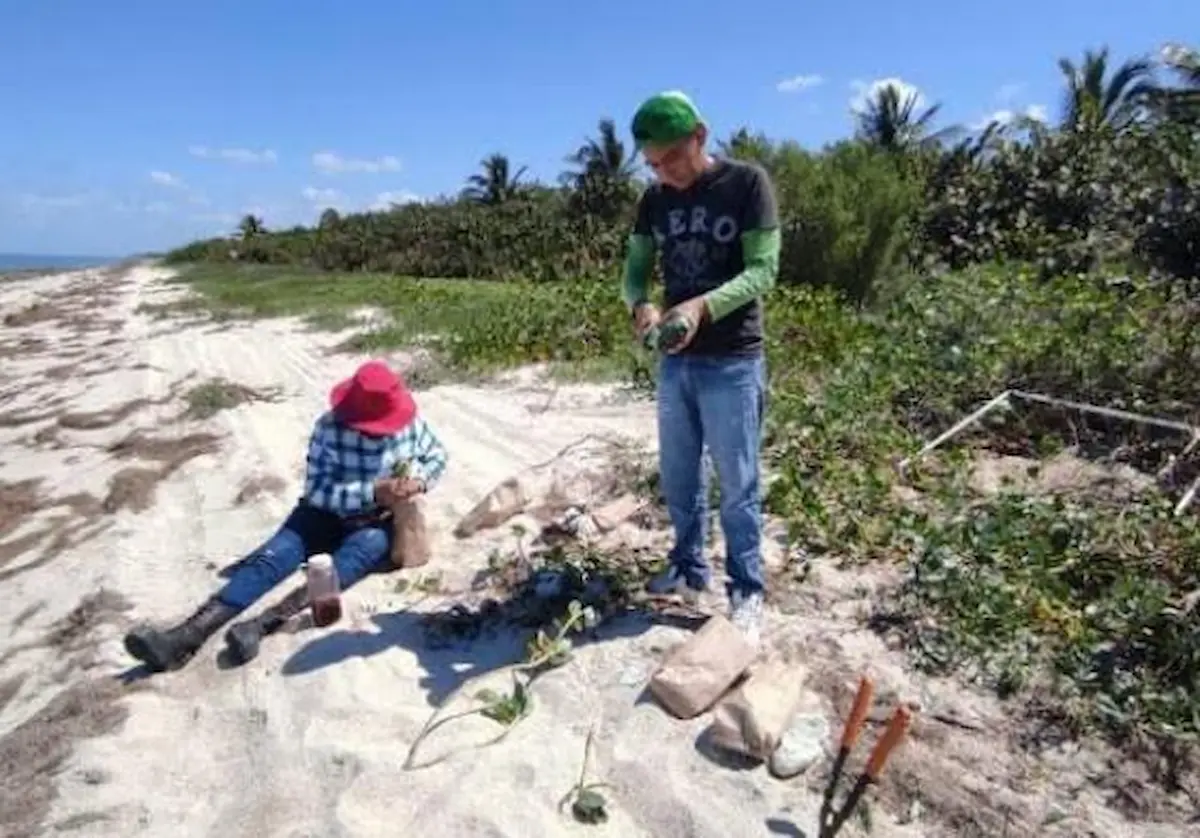
Cancún, Quintana Roo — Twenty-two hotels are now involved in dune restoration projects spanning more than 20 kilometers of coastline in the Mexican Caribbean, a sharp turn toward preservation and recovery work that has yet to be matched by an integrated strategy covering public beaches.
Vicente Ferreira, director general of the sustainability consultancy Sustentur, said that just two years ago only four or five hotels and resorts were paying attention to dune restoration, making the recent growth significant — though he stressed that much work remains.
The efforts along the coast are still largely isolated, carried out hotel by hotel, Ferreira said. He argued the reforestation work needs to evolve into a regional strategy for protecting and restoring the coasts of Quintana Roo, including public beaches.
According to Ferreira, the dune recovery underway now covers between 18 and 20 kilometers of coastline, while a preliminary estimate points to roughly 10 to 12 square kilometers of dunes restored.
Most of these projects are supported by GIZ, the German development cooperation agency, but organizers are looking to broaden their reach through financing schemes that would allow the work to extend beyond hotel properties.
“There are many other public beach areas where it is needed,” he said.
The aim is for restoration to move beyond isolated, hotel-by-hotel projects and toward a regional strategy for protecting and recovering the coasts of Quintana Roo.
Costs and Damaged Zones
Cost remains a challenge. Depending on the size of the property and the scope of the project, Ferreira estimated that a hotel can spend around 300,000 to 350,000 pesos a year on studies, plant purchases, materials and restoration work to launch such a program.
In Quintana Roo, dune deterioration is not uniform along the coast, he said. Some areas are worse off, particularly where tourist developments are older and were built closer to the shoreline, including parts of the Cancún Hotel Zone, Playa del Carmen and Playacar.
By contrast, destinations such as Costa Mujeres have fared better because many of their hotels kept the dunes as part of their development plans.
Ferreira said the goal for next year could be to raise the number of participating hotels from 22 to around 30, though he insisted the main objective is to create a public policy that drives a regional strategy.
The expert acknowledged that the dunes have been damaged not only by erosion from weather events. Sargassum seaweed is one of the toughest challenges, he said, and construction close to the coast has also removed dunes altogether.
More Environment
- Cancún Protesters Demand Answers on Fate of Big Cats Kept by ‘Pepe Tigre’
- Cancún Hotel Zone Projects Must Include Wastewater Pre-Treatment Plants
- Microplastics, Sunscreen Chemicals and Repellents Under Study in Quintana Roo Waters
- Cancún Launches Operation to Protect Blue Land Crabs During Migration to the Sea
- Quintana Roo to Present Mexican Caribbean Cenote Guide at DEMA Show 2026