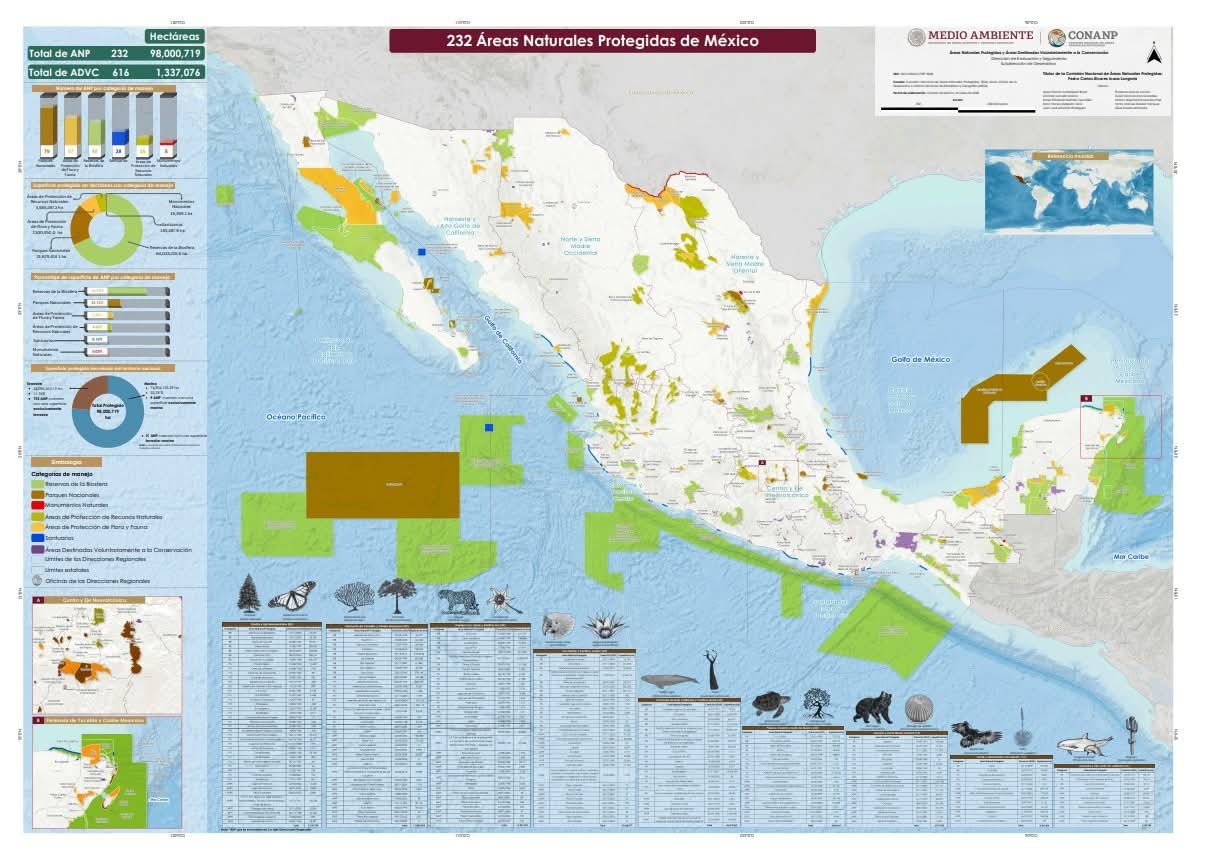
Yucatán Peninsula, Mexico — The Yucatán Peninsula and Mexican Caribbean have become the largest conservation complex in Mexico. In 2026, the regional subsystem of the National Commission of Natural Protected Areas (Conanp) reports 39 federal natural protected areas (ANP) covering 14,625,545.72 hectares and benefiting more than 21,000 inhabitants of Maya and fishing communities. These ANPs are distributed across Campeche, Quintana Roo, and Yucatán.
Additionally, the Government of Yucatán administers nine state natural protected areas covering 535,245.25 hectares equivalent to 14% of Yucatecan territory, of which three are coastal and six are continental. The state ANPs protect jungles, mangroves, and cenotes in reserves such as Dzilam, El Palmar, the Puuc Biocultural Reserve, and the Ring of Cenotes.
Regional Conservation Highlights
Among the region’s jewels are the Gulf of Mexico-South Reefs, a marine corridor of 4,109,731 hectares; the Sian Ka’an Biosphere Reserve (528,147.66 hectares), which safeguards jungles, mangroves, and wetlands; the Calakmul Biosphere Reserve (728,908.57 hectares), part of the Maya Forest and home to jaguars and howler monkeys; the Arrecife Alacranes National Park (333,768.51 hectares); and the Los Petenes Flora and Fauna Protection Area (282,857.62 hectares).
The Mexican Caribbean National Park, created in 2017, is the country’s largest marine area with 5,754,055 hectares, while Bajos del Norte, decreed in 2024, contributes 1,304,115 hectares of reefs and fishing zones. These areas and others like Ría Celestún, Ría Lagartos, and Cozumel Reefs protect hawksbill turtle nesting beaches, whale shark sanctuaries, and wetlands that feed flamingos, jabirus, and manatees.
Community Dependence and Challenges
Coastal communities depend on these ecosystems for their livelihoods. In Puerto Morelos, Quintana Roo, fishermen report that due to overexploitation, sea warming, pollution, and urbanization, their catches have fallen from more than 300 kilograms to less than 200.
Despite the peninsula concentrating some of the best-preserved mangroves and reefs, tourism expansion (Cancún, Riviera Maya), infrastructure projects like the Maya Train, and lack of drainage are affecting critical habitats.
Experts warn that ANPs have only temporarily halted urbanization and demand better management, adequate budgets, and participation of indigenous communities.
National Conservation Context
At the national level, Mexico reports 232 federal natural protected areas, of which 192 are terrestrial, 31 combine terrestrial and marine surface, and 9 are exclusively marine.
These ANPs total 98,000,719 hectares: 23,096,563 terrestrial hectares (11.76% of the country’s terrestrial surface) and 74,904,155 marine hectares (23.78% of jurisdictional waters).
Additionally, there are 617 Voluntarily Designated Conservation Areas (ADVC) certified, with 1,343,290.98 hectares under private and community protection.
Budget and Management Concerns
In November 2025, an analysis by the NOSSA coalition warned that each hectare of ANP would receive only 10.2 pesos in budget in 2025 and that Conanp would have 1,001 million pesos to manage 232 areas, representing the lowest budget in three presidential terms and an 81% drop in resources per hectare. From 2018 to 2024, more than 40 new ANPs were decreed, but many lack updated management programs and surveillance personnel.
Among the new areas declared in 2024 stand out the Nuevo Uxmal National Park (Yucatán and Campeche), the Bajos del Norte National Park in the Gulf of Mexico, the Puerto Morelos Mangrove Protection Area in Quintana Roo, and the Lago Tláhuac-Xico Park in Mexico City, in addition to sanctuaries like Playa Chenkan in Campeche.
These decrees allowed reaching 225 ANPs in January 2024 and expanded the protected surface from 93 million to 98 million hectares. However, the international 30×30 goal (protecting 30% of territory by 2030) remains distant; Mexico protects only 12.76% of its terrestrial surface and almost 24% of its waters.
Future Outlook
The Yucatán Peninsula is emerging as the heart of Mexican conservation, but its success will depend on strengthening surveillance, guaranteeing sufficient funding, involving Maya and fishing communities, and reconciling tourism development with protection of the Maya Forest and reefs.
For this, civil organizations and specialists demand that the federal government increase Conanp’s budget, update management programs, and meet the goal of conserving 30% of national territory before 2030.
Discover more from Riviera Maya News & Events
Subscribe to get the latest posts sent to your email.