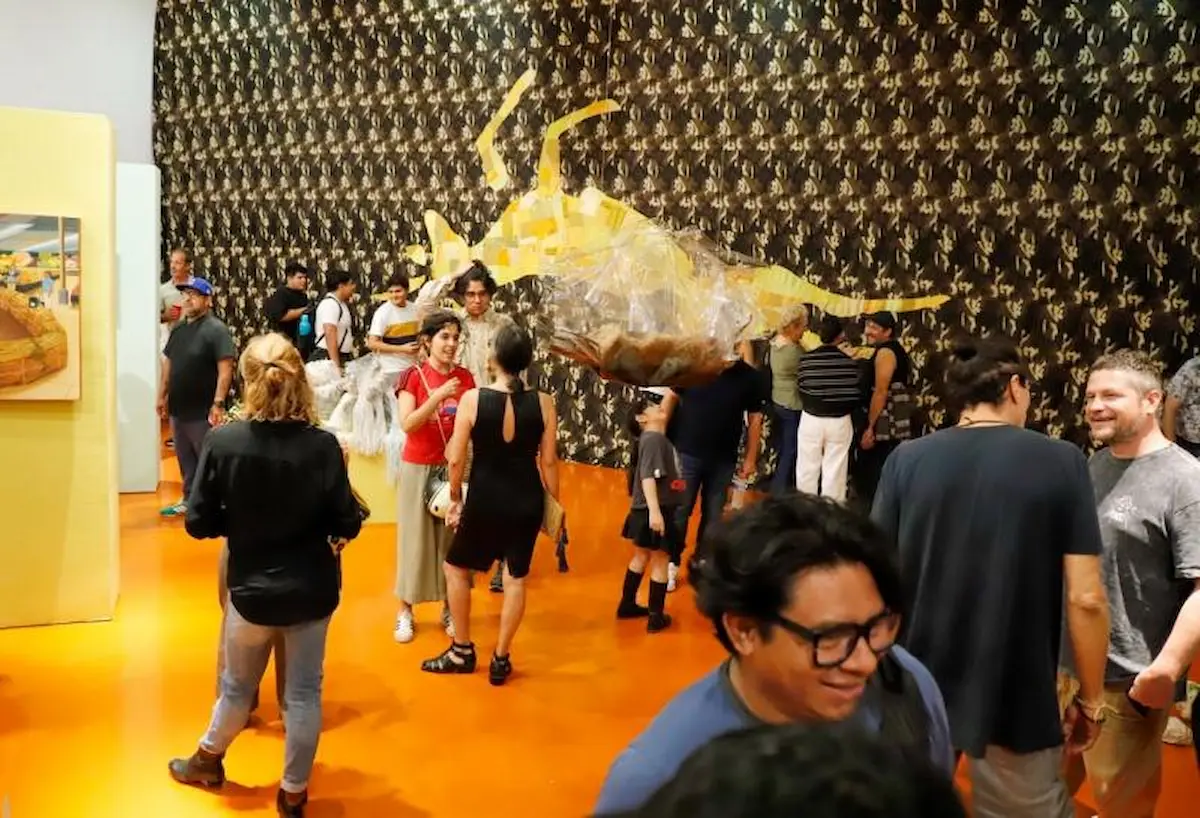
Merida, Yucatan — The Yucatan Ministry of Culture and the Arts (Sedeculta) opened the collective exhibition “Mirar otras voces” (Looking at Other Voices) and unveiled the mural “Azulmaya” by Mexican collective Tercerunquinto at the Gran Museo del Mundo Maya in Merida. The event drew a full house and also featured the film project “In Situ” and the performance piece “Vacío Void” by Lesdavag as part of the Noche de Artes Vivas program.
During the opening, Sedeculta head Patricia Martín Briceño said the upcoming opening of the Yucatan International Art Biennial on November 26 has sparked interest in contemporary art across Merida, with the Gran Museo joining in with its own programming that brings local and visiting audiences closer to artistic production from the peninsula.
“Mirar otras voces” is an independent initiative bringing together more than 30 artists of different generations who were born in the peninsula or have made it their home and creative base. Curated by Víctor Esquivel and Débora Carnevali, the exhibition explores the relationship between word and image through works linked to poetry, oral tradition, urban graphics and digital media.
The show is spread across indoor rooms and outdoor spaces at the museum, where a piece by Óscar M. García bridges to the exhibition “Neomaya: un arte para Yucatán. Cultura popular e identidad” in Temporary Room 1. His work “Intervención I” uses the stones and geometry of pyramids as a kind of time capsule in the jungle.
García draws on these architectural forms to turn attention to the present and the possibility that a society might repeat the processes that led others to collapse, continuing a line of research in which the Sinaloa-born artist works with landscape to address the traces violence and migration leave on a territory. As a precedent, in September he presented his solo show “Agreste” at the Centro Contemporáneo del Mayab, where he juxtaposed the landscapes of Sinaloa and Yucatan, while “Intervención I” returns to the peninsula through the memory held in its architecture.
“Azulmaya,” curated by Aldo Sánchez, brings the work of Tercerunquinto to the Gran Museo. The Mexican collective, made up of Gabriel Cázares and Rolando Flores, was formed in Monterrey and has devoted much of its work to the changes cities undergo and what their constructions reveal about those who inhabit them. Its trajectory includes the project “Graffiti,” presented at the Kunsthalle Basel in Switzerland, and the exhibition “Obra inconclusa” at the Museo Amparo in Puebla, which reviewed two decades of its production as part of research into the transformations of the urban environment.
To create “Azulmaya,” Cázares and Flores toured Merida and its surroundings in search of rubble that retained traces of blue paint, so that the color brings together fragments of walls from different buildings in the mural and links the history of Maya blue with the blues still found in the contemporary city.
The program also included “In Situ,” a project by Galia Eibenschutz, Iván Gabaldón, Daniel García and Roselys Oropeza, with original music by Natalia Pérez Turner, which grew out of a residency in an old industrial warehouse where body movement and camera work shaped a narrative without words.
As part of Noche de Artes Vivas, Lesdavag presented “Vacío Void,” a piece in which zapateado dancing on a steel chamber turns the body into a percussion instrument and explores, through movement and sound, the experience of violence.
“Mirar otras voces” will remain open to the public until February 2027, with free entry, at the Gran Museo del Mundo Maya in Merida. Those interested in the venue’s programming can check its schedule on Sedeculta’s social media.
More Culture
- Cozumel Art Exhibition ‘Desafiar al Polvo’ Showcases Local Craftsmanship
- Cozumel Museum Opens ‘Instantes Divinos,’ Michelle González Ávila’s Third Solo Show
- Cozumel Marks 177 Years Since Decree Recognizing It as a Town
- Maya Traditional Cooks Showcase Flavors and Knowledge at First Quintana Roo Gathering
- Maya Legacy Photo Exhibition Opens at Mureco in Quintana Roo