
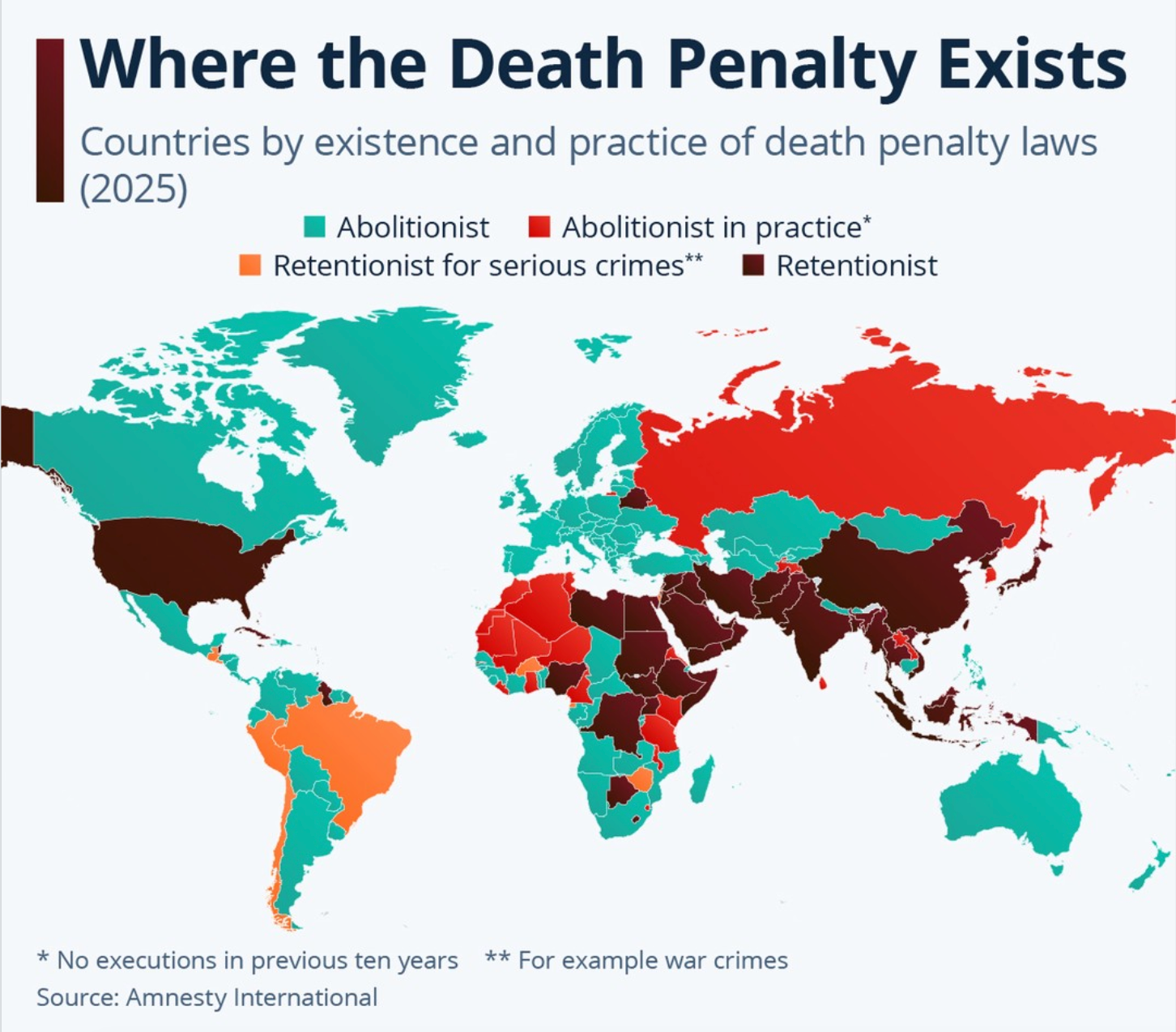
Mexico City — The death penalty is back at the center of the international debate, with two controversial cases in the United States — a military execution that officials want to broadcast live and a woman who survived a lethal injection — raising new questions about how capital punishment is applied and what it means for human rights.
The controversy coincides with the World Day Against the Death Penalty, observed every October 10 to push for the punishment’s definitive abolition. Most countries have already removed it from their laws or stopped carrying it out.
In Mexico, capital punishment has been barred by the Constitution for more than two decades, yet proposals to restore it resurface periodically, particularly as a response to crimes such as kidnapping, femicide and homicide.
What the day commemorates
The World Coalition Against the Death Penalty, an international alliance of civil associations, institutions, legal professionals and activists, launched the observance in 2003.
Its goals are to raise public awareness of the consequences of executions, denounce potential human rights violations and push for legal changes in countries that still allow capital punishment.
Abolitionist groups argue that the death penalty is irreversible, that it risks executing wrongly convicted people, and that inequalities influence who receives it. Even as abolition advances in various regions, thousands of people remain on death row and several governments continue to carry out executions.
A military execution in the United States
One of the most contentious cases this week involves Nidal Hasan, a former U.S. Army psychiatrist convicted of killing 13 people, 12 of them service members, in a November 2009 shooting at Fort Hood, Texas.
Hasan, 56, was sentenced to death in 2013. His execution by firing squad is scheduled for December 3, 2026.
U.S. Defense Secretary Pete Hegseth announced that the execution would be broadcast live so the public could watch, a decision that drew criticism from human rights organizations, religious representatives and lawmakers from both parties.
President Donald Trump, who authorized the execution, initially left the broadcast decision in suspense, while Vice President JD Vance voiced doubts about making it public.
If it goes ahead, it would be the first execution carried out by the U.S. armed forces since 1961 and the first military firing squad since World War II.
The United Nations warned that broadcasting an execution would amount to carrying it out publicly and would constitute cruel, inhuman or degrading treatment, contrary to international norms prohibiting torture.
Amnesty International also criticized the plan, saying that turning a state-ordered execution into a public spectacle compounds the cruelty of capital punishment.
Woman survives a lethal injection
Another case that has reignited the discussion involves Christa Pike, a 50-year-old woman convicted of murder in Tennessee, who survived an attempted execution by lethal injection on September 30.
Pike received two doses of pentobarbital, a drug used in executions, but the procedure failed to kill her.
After remaining hospitalized and unconscious for several days, she regained consciousness and began speaking. She later managed to walk around her room, though her lawyers say she is confused and suffers from memory and concentration problems.
Doctors have not yet determined whether she sustained permanent neurological damage.
Pike was convicted of killing a classmate in 1995. Since the failed execution, her defense has asked for her sentence to be commuted to life in prison.
The governor suspended executions in the state pending an independent investigation into what happened.
According to the Death Penalty Information Center (DPIC), the case is exceptional because Pike survived after receiving the drugs meant to kill her. In other failed attempts, procedures were halted because of problems administering the substances.
Where Mexico stands
Unlike the United States, Mexico expressly prohibits the death penalty in its Constitution, meaning no crime can legally be punished with an execution.
The ban became definitive through a constitutional reform published on December 9, 2005, during the administration of former President Vicente Fox.
The amendment of Articles 14 and 22 removed the provisions that still allowed capital punishment, particularly in the military sphere. Article 22 now states that “the death penalty, mutilation, infamy, branding, flogging, beating and torture of any kind are prohibited.”
Mexico’s last executions
Although the definitive constitutional ban came in 2005, Mexico had stopped carrying out the death penalty decades earlier.
The last civilian execution was recorded in 1957, while the last military execution took place on August 9, 1961, when soldier José Isaías Constante Laureano was shot by firing squad in Saltillo, Coahuila.
The punishment was phased out gradually. Through the 19th century and part of the 20th, various state laws allowed capital punishment, but states began removing it from their penal codes. Sonora was the last state to complete the process, in 1975.
Attempts to restore capital punishment
Despite the ban, the possibility of restoring the death penalty has returned to Mexico’s political debate, mainly after crimes that provoke public outrage.
The Green Party (PVEM) has been one of its main promoters, proposing the punishment for those responsible for serious crimes during several election campaigns.
In the 2009 and 2015 elections, the party pushed proposals to sentence kidnappers to death if they killed their victims.
The discussion gained strength again in 2018, when the PVEM revived a proposal to amend the Constitution and allow capital punishment for kidnapping, rape and intentional homicide.
In February 2020, Green Party lawmakers, backed by some Morena deputies, promoted an initiative to reform several constitutional articles and permit executions for femicides, child rapists and those responsible for intentional homicides. Supporters argued that existing prison sentences were not enough to deter those crimes.
None of the proposals succeeded in changing the constitutional ban.
Could Mexico reinstate the death penalty?
The main obstacle is not only the Constitution but also the country’s international commitments.
Mexico is party to the American Convention on Human Rights, whose Article 4 states that countries that have abolished the death penalty cannot reinstate it.
In 2007, Mexico also acceded to the Second Optional Protocol to the International Covenant on Civil and Political Rights, which is aimed at abolishing capital punishment.
Any attempt to restore it would therefore face major legal hurdles. Domestically, it would require a constitutional reform approved by a qualified majority in Congress and by most state legislatures — and even then, amending the Constitution would not automatically erase Mexico’s international obligations.
A debate that remains open
The October 10 observance takes place against two contrasting realities: while many countries have moved toward abolition, others retain capital punishment within their justice systems.
Recent events in the United States have once again put under scrutiny not only the existence of the punishment but also the methods used, the conditions under which executions are carried out and the limits set by human rights.
For the World Coalition Against the Death Penalty, the date is an opportunity to recall that, beyond the severity of a crime, justice must also weigh the risk of judicial errors, discrimination and the irreversible nature of an execution.
More Government
- Quintana Roo Lights Up Pink to Boost Breast Cancer Prevention
- Missing Quintana Roo Education Official Found Alive in Cancún
- Playa del Carmen Drafts Rules to Curb Urban Tree Loss
- Cancún Dump Truck Operators Protest Hotel Haven Riviera Over ‘Pirate’ Cargo Trucks
- Quintana Roo Environment Agency Accepts Federal Ruling in Alux 33 Case
