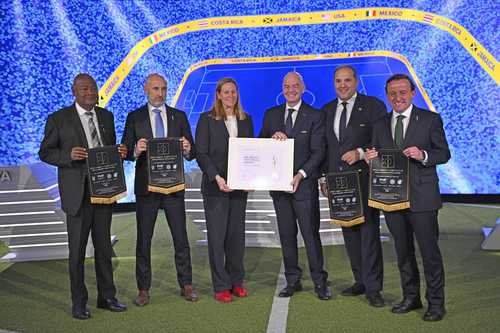
Zurich, Switzerland — FIFA officially named Mexico, the United States, Costa Rica and Jamaica as hosts of the 2031 Women’s World Cup during an extraordinary congress in Zurich, where member associations also confirmed that England, Northern Ireland, Scotland and Wales will stage the 2035 tournament. Both bids were approved without opposition.
“The girls deserve it. They grew up in an era when women’s soccer is fully accepted by the public. They no longer have to go knocking on doors, because they have everything,” Alicia “Pelé” Vargas, a star of the Mexican national team at the 1970 and 1971 World Cups, told La Jornada. Those tournaments were not sanctioned by FIFA but filled stadiums and opened a path that decades later allowed the women’s game to grow in Mexico.
The 2031 tournament — the first organized by four countries simultaneously and the most ambitious in the category to date, expanding from 32 to 48 teams and 104 matches — will coincide with the 40th anniversary of the first Women’s World Cup. The United States, a historic reference in the category with four titles, will host again, as it did in the memorable 1999 and 2003 editions.
“It will be the biggest women’s sporting event in history,” Cindy Parlow Cone, president of U.S. Soccer, told delegates. Mexican forward Charlyn Corral, a Ballon d’Or winner, and Mexican Football Federation (FMF) commissioner Mikel Arriola lent their voices and images to the project, which returns Mexico to the World Cup map, this time in its own right.
“The proposal contemplates that our country could host more than double the 13 matches it received for the 2026 World Cup,” the FMF said in a statement. Organizers estimate 4.5 million spectators across the tournament.
Fourth World Cup for Mexico
The designation marks Mexico’s fourth World Cup — after the men’s tournaments of 1970, 1986 and 2026 — but its first with FIFA’s official seal in the women’s game. The Concacaf bloc proposed 20 cities (14 in the United States, four in Mexico, plus San Jose and Kingston) that FIFA must reduce to a maximum of 16 stadiums. The venues proposed by the FMF are Mexico City (Banorte), Guadalajara (Akron), Monterrey (BBVA) — the three used at the recent men’s tournament — and Torreon (TSM Corona).
“Fifty years ago everything was in its infancy and deeply rooted in machismo. We were the ones who lit the fuse and didn’t care what anyone said,” added Pelé Vargas, a former striker and member of the International Football Hall of Fame in Pachuca. “A lot of progress has been made, although new generations have also had to endure low salaries, a lack of sponsorships and having nowhere to sleep after trying out for a team. What’s missing? Making up for lost time so the national team isn’t on edge for every qualifier. The United States is a powerhouse today, but there was a time when we ran them ragged; now we play them and lose by a rout.”
Both the host countries and FIFA President Gianni Infantino have promised an unprecedented commercial operation whose proceeds will be reinvested directly in professional soccer.
At the High Performance Center, where the women’s national team is continuing preparations for the Concacaf W Championship — which offers places at the 2027 Brazil World Cup and the 2028 Los Angeles Olympics — the announcement sparked a collective celebration.
“It’s the dream of an entire country, of many women who wanted to play soccer and couldn’t,” said Corral, named the year’s best forward by France Football magazine. “Mexico is soccer, it’s passion. The last World Cup was a success and that will happen again in 2031,” added Pachuca defender Kenti Robles.
United Kingdom for 2035
In the same session in Switzerland, FIFA’s congress approved the British bid for 2035. The project, led by England along with Scotland, Wales and Northern Ireland, proposes 19 venues headed by the iconic Wembley Stadium in London. With the designation, European soccer secures a golden decade as host, having also secured the men’s Euro 2028.
The tournament will arrive in islands devoted to their women’s team — the reigning back-to-back European champion and a strong candidate alongside Spain for Brazil 2027 — and will bring a World Cup back to English soil nearly seven decades after the historic men’s title of 1966.
“Together we will celebrate the power of women’s soccer, inspire the next generation and unite fans from every corner of the planet,” said Debbie Hewitt, president of the English Football Association.
Beyond the hosts, the extraordinary congress exposed internal tensions affecting the leadership of world soccer. Infantino repeated his message on the need to “close the gap” between the men’s and women’s games but declined to comment on the imminent March election, in which he will seek re-election against France’s Philippe Diallo and Japan’s Kozo Tashima.
“Our goal, of course, is to make women’s soccer truly global and build the future together with all member associations,” the Swiss-Italian official said in a message distributed by FIFA. “It is a moment of pride. This sport belongs to everyone, everywhere in the world, and we must create opportunities and drive development by building infrastructure. We also need resources to achieve it. Together we will achieve real impact.”
More Events
- Tizimín Unveils 2027 Feria de Reyes Lineup with Concerts and Vaquería
- Conalep Cancún 1 Marathon Marks 11 Years With Mobility Aid Giveaway
- Cancún’s Teatro de la Ciudad Brings Christmas Magic with Two Local Productions
- Cancún Diversifies Year-End Events to Boost High Season
- Grupo Lomas Wins Four Trophies at 2026 Travvy Awards