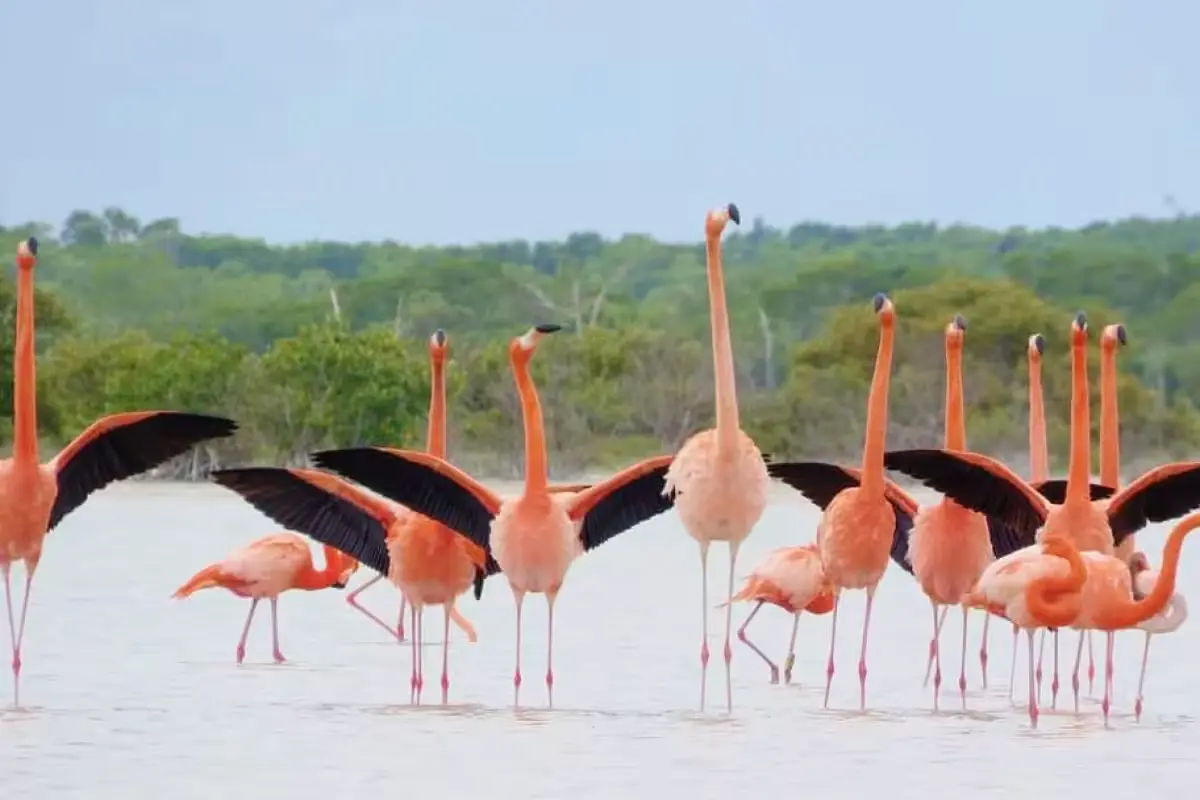
Ría Lagartos, Yucatan — The Ría Lagartos Biosphere Reserve has turned pink again with the massive arrival of Caribbean flamingos, a natural phenomenon not seen with such intensity in recent years.
Biologist Julián Rojas reported that previous seasons counted up to 77,000 specimens in the coastal reserves, and new flocks are now beginning to arrive, anticipating a significant nesting season for the region.
The area is vital for the reproduction of the Caribbean flamingo (Phoenicopterus ruber ruber), whose distribution in Mexico is restricted to the northern portion of the Yucatan Peninsula. The main nesting colonies are located in a strip east of the reserve, particularly in the El Cuyo basin.
Although there are significant populations in other Caribbean regions like Florida and the Bahamas, the species receives special protection in Mexican territory due to the ecological importance of its breeding sites.
The Ría Lagartos wetland hosts about 80 percent of the nesting pairs of this biogeographic population, making it the primary reproductive nucleus for the Caribbean pink flamingo.
Additionally, the ecosystem represents a unique example worldwide for its high biological productivity. Conditions ranging from marine salinity to hypersalinity, combined with the karst environment, create an ideal habitat for aquatic birds.
Within the reserve, researchers have identified 333 bird species: 177 resident, 142 migratory, and 14 with mixed behavior. The pink flamingo stands out as the emblem of the protected natural area, which received legal designation in 1979.
The specialist explained that each flamingo pair produces one chick per season. However, from hatching they face multiple risks: rising waters, predators including crocodiles, birds of prey, foxes, and raccoons, plus natural phenomena like cyclones.
There is currently no exact record of how many birds return to their sites of origin, since many juveniles take flight before being banded.
Since 1999, the National Commission of Natural Protected Areas (Conanp) has coordinated the Conservation Program for the American Flamingo or Caribbean Pink Flamingo, in collaboration with local communities, academia, the private sector, and civil organizations.
The effort is conducted jointly with the Yum Balam Flora and Fauna Protection Area, and the Ría Celestún and Los Petenes Biosphere Reserves. Between 1999 and 2024, officials documented the birth of 154,446 chicks, of which 7,142 were banded for monitoring.
Additionally, Conanp reported 14,757 nests in 2023 in the area known as La Angostura, within the Protected Natural Area.
In 2024, health studies were also conducted to rule out Influenza type A and Newcastle disease. The tests, performed by the General Directorate of Animal Health in high-security laboratories, came back negative, confirming the population remains healthy.
The arrival of the flocks strengthens the biodiversity of the eastern coast and sparks scientific interest to better understand their migratory routes and the factors determining their survival.
Discover more from Riviera Maya News & Events
Subscribe to get the latest posts sent to your email.